Addy Feuerstein, Merav Tzur, Ariel Kotzer (Arielko)"Once Upon a Time, or Never"The David Lopatie International Conference Center
In collaboration with generative AI programs, three contemporary Israeli artists embark on a thought experiment that seeks to create and invent a past that most likely never existed. Yet, had it taken place, it would be fascinating to examine how it might have shaped our present, the way we understand and accept historical truths, and perhaps even the as-yet hidden future, which largely stems from the unfamiliar past. Each artist turns toward a different temporal distance, suggesting distinctive operational latitudes for developments that might have unfolded from then until now.
The prompts fed by the artists into the AI systems are presented alongside the collaborative works, inviting exhibition visitors to trace the “course of thought and action” of the partners in creation.
70-90 Years Ago
Addy Feuerstein longs for an imagined past. In collaboration with the AI system Midjourney, he created a series of works he calls Artificial Nostalgia. It comprises images and videos that might be described as “retro-futuristic,” depicting scenes of people and machines attempting to coexist side by side (and at times within one another), in harmony that is at times maintained and at times ruptured.
Feuerstein is a designer and high-tech entrepreneur. His first start-up, AllofMe, focused on comparing personal and historical timelines, paving the way for an exploration of AI as a means of documenting the past. He asked the Midjourney engine to combine a futuristic gaze with objects and a design language from the mid-twentieth century.
3,500–10,000 Years Ago
Merav Tzur imagines — and creates, in collaboration with the AI engine Ideogram — an ancient civilization that existed from 8000 to 1000 BCE, in three periods: Antiquity-Gina, Mitzi-Gina, and Hadath-Gina. Tzur focuses on a tribe of women known as the Golden Sheaf, which sustained an enlightened and egalitarian society, alongside a flourishing of scientific inquiry and advanced technologies.
Unfortunately, all that remains today of this sophisticated and prosperous culture are several mural paintings depicting ritual practices alongside scientific research, as well as a number of striking sculptures of women. Despite their material and cultural achievements, the women of the Golden Sheaf, rather than continuing to inhabit a patriarchal and militant environment, opted to leave Earth. Harnessing the space travel technology they had developed, they set out into the expanses of the universe, in search of new home world.
The central question is, of course, where are they today? Would we ever be able to reconnect with them and learn from their accomplishments? This exhibition presents mural paintings by the Golden Sheaf women from their third and final era, Hadath-Gina.
Tzur holds a BFA from California College of the Arts and an MFA from UC Berkeley. Her works have been exhibited in museums and galleries in Israel and worldwide.
3.5–4.1 Billion Years Ago
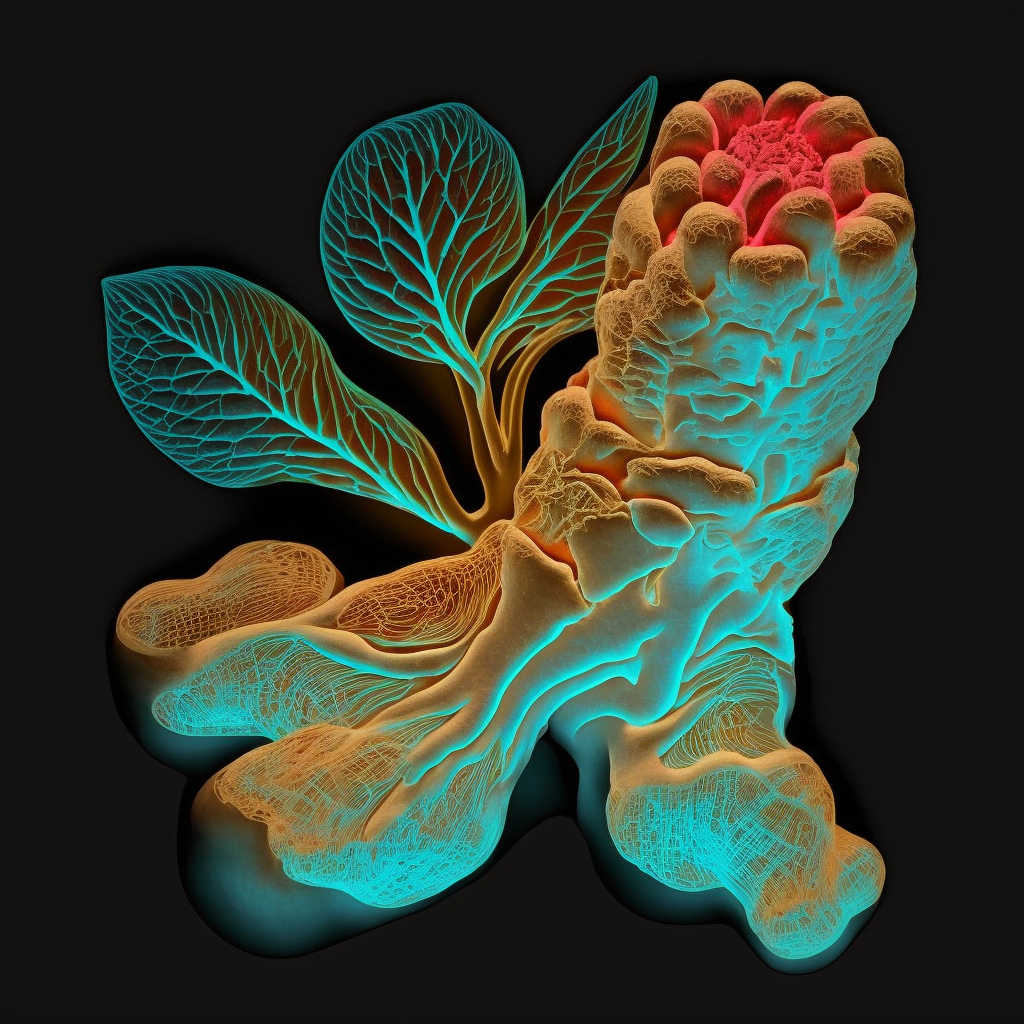
Earth formed some 4.5 billion years ago, and within one billion years, or perhaps even less, primitive life forms emerged on its surface. These were simple, single-celled organisms, likely inhabiting what Charles Darwin referred to as “warm little ponds.” Ariel Kotzer, artistically known as Arielko, stretches his imagination back to these distant times. In collaboration with the AI engine Midjourney, he has created images representing organic-mechanical microorganisms. What might evolution have looked like had it started with such semi-mechanical organisms?
Kotzer is a designer, creative director, and art director trained at the Pratt Institute in New York, and an architect educated at the Technion–Israel Institute of Technology. In his AI-based art practice, he provides the system with minimal prompts. His “Non-Prompting” method reflects a willingness to allow the AI to act independently and with a degree of randomness that, in his view, can foster a genuine partnership between human and machine.