|
|
Polarizability Anisotropy Based Heterodyne Detection (chemical heterodyning).
In Time
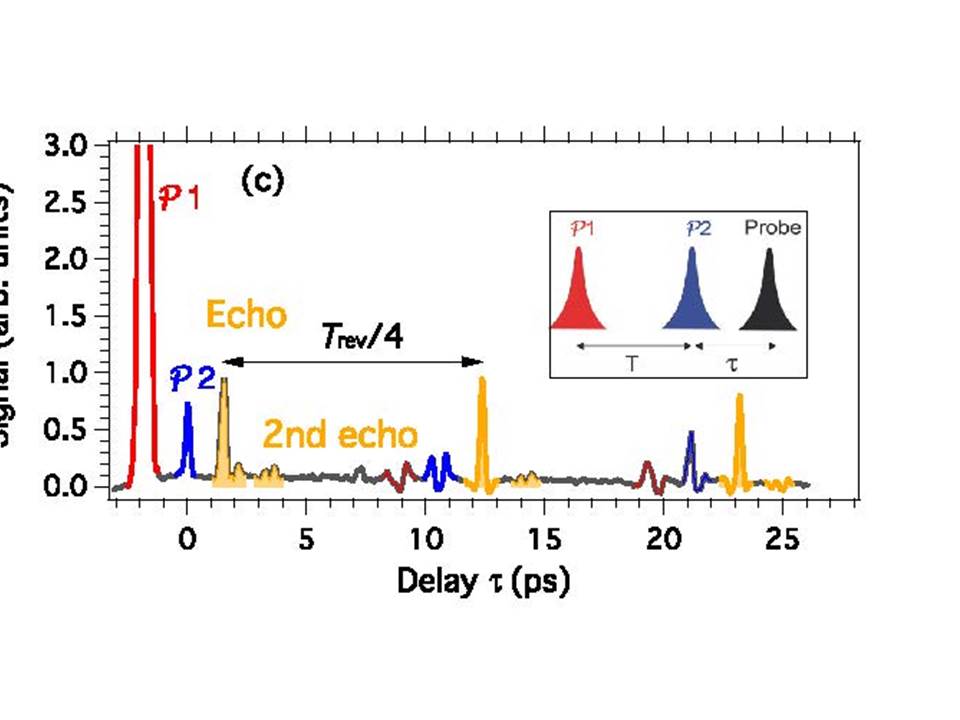
Resolved Coherent Anti-Stokes Raman Spectroscopy (TR-CARS) with
femtosecond pulses, due to the broad bandwidth of the pulses, many
levels are excited simultaneously, and their cumulative undispersed
signal is observed by a slow detector. The physical quantity measured is
the modulus square of the third order non-linear susceptibility (
Linearization of the signal and observation of the fundamental modes requires heterodyne measurements, namely mixing of the CARS signal field with an auxiliary local oscillator field. Heterodyne detection schemes are based on the addition of a Local Oscillator field independent of pump-probe time delay (τ) to the signal. Addition of such a “constant” (relative to τ) field, resulting in the linearization of the observed signal, and generally in much stronger signal that easier to observe, as it is the product of the generated optical field and an external source (local oscillator). Such a field can be provided directly to the detector in the form of an additional field or indirectly as an additional field generated in the sample. The new heterodyne technique uses the tendency of molecules with pronounced polarizability anisotropy to be aligned by strong, short electric field. Following their alignment, the molecules slowly return to the initial isotropic (unaligned) state, and this collective orientation relaxation occurs on time scales comparable to rotational frequencies, much slower then the vibrational motion of the modes observed in these experiments.
Thus this slow varying filed can play a role of the local oscillator Thus, the introduction of a non-oscillatory term ("DC" on the time scale of the vibrational measurement) sets up a heterodyne detection scheme with the corresponding desired linearization of the vibrational signal. The intensity of the desired DC component can be simply controlled by the changing amount of the anisotropic species in the sample. In that sense the presented technique can referred as chemical rather then optical heterodyning for no optical fields is mixed with a signal but real chemical species.
For further details pleas see our paper in Chemical Physics Letters 450 (2008) 408–416 |
|
|
|
||
|
|
|
|
|
![]() |