

Functional Pre-Clinical Models for Normal and Leukemic Human Stem Cells: Molecular and cellular communication between stem cells and the bone marrow microenvironment


Tsvee Lapidpot

Prof. Tsvee Lapidot
The Edith Arnoff Stein Professorial Chair in Stem Cell Research

Office: Wolfson Building, Room 301
Tel: +972-8-934-2481
Fax: +972-8-934-4141
E-mail: Tsvee.Lapidot@weizmann.ac.il


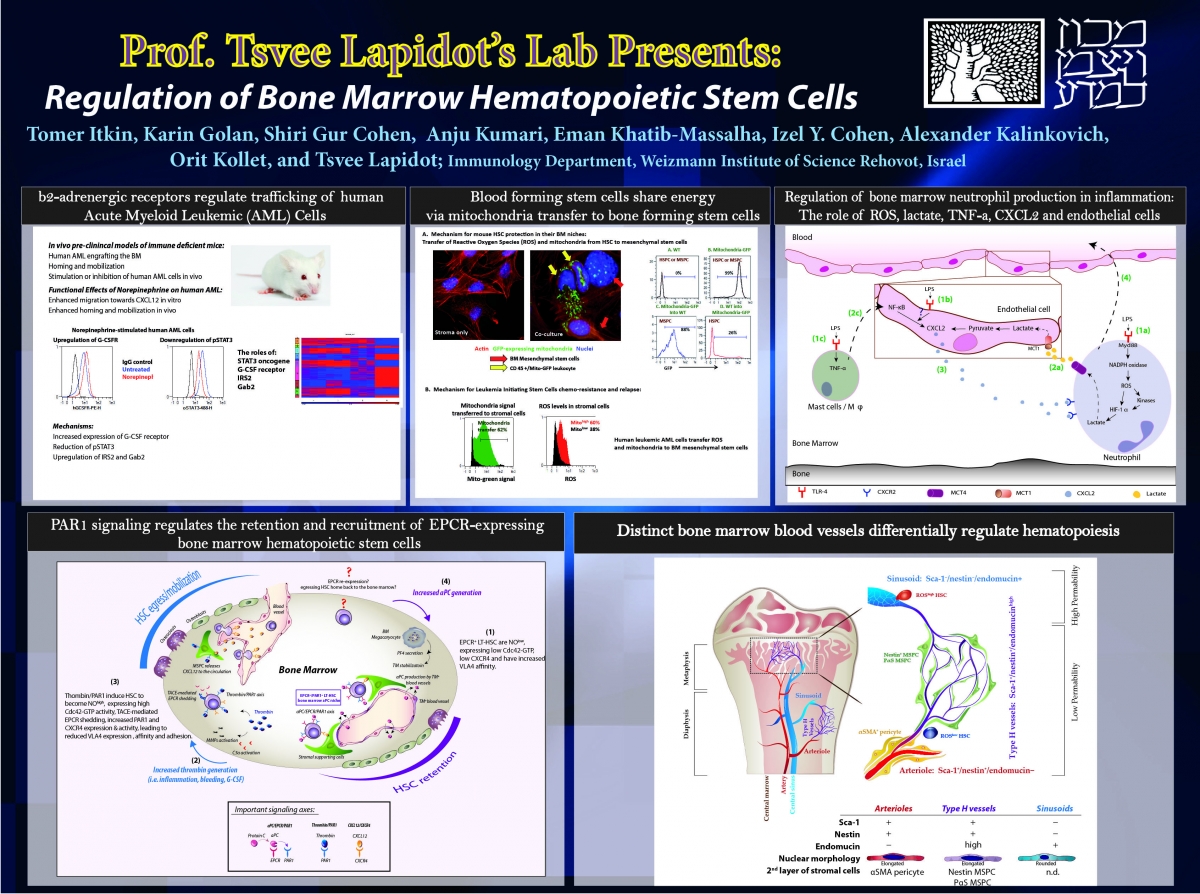
Our major goals are to investigate the regulation of normal and leukemic human blood forming (hematopoietic) stem cells by the brain-bone-blood triad in transplanted mice, including immune-deficient mice. This functional, preclinical model which we participated in its development, can predict clinical outcome and was used to identify and characterize, both normal (Lapidot et al, Science 1992) and leukemic (Lapidot et al, Nature 1994) human stem cells for the first time, as well as many other human cancer stem cells. We aim to decipher molecular mechanisms that govern stem cell development, proliferation, differentiation and migration in steady state homeostasis, stress induced recruitment and clinical mobilization for transplantation protocols. We seek to determine the mutual cross-talk between stem cells, and their dynamic bone microenvironment. Via adhesion interactions, stromal niche cells maintain stem cells in a quiescent non motile mode, while preserving their developmental potential. These dynamic interactions also include the nervous and immune systems and focus on bone remodeling and niche regulation of stem cell maintenance by myeloid monocytes/macrophages and osteoclasts. The unique roles of bone forming stromal stem cells, chemokines, cytokines, adhesion molecules, and proteolytic enzymes, which regulate both normal and leukemic human stem cell migration and development, are currently investigated. These include signaling events mediated by the chemokine SDF-1 (also termed CXCL12) and its major receptor CXCR4 which are essential for both stem cell quiescence as well as for stem cell migration.


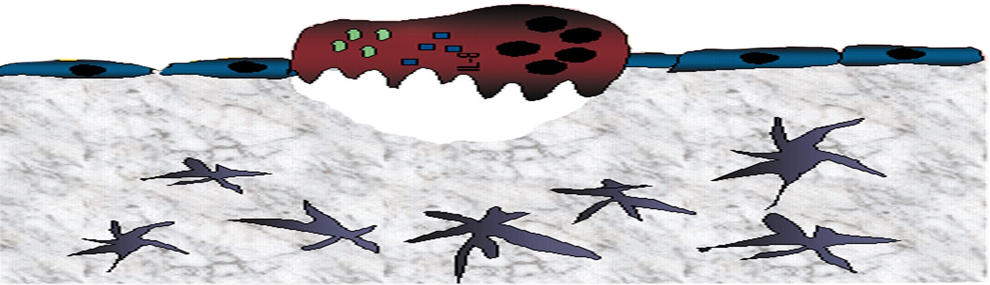
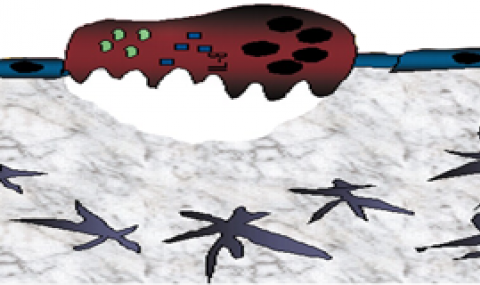
Figure (above): (A) Retention of CD34+ human stem and progenitor cells via SDF-1/CXCR4 interactions, adhesion CD44/HA interactions and inhibition of the proteolytic enzymes MT1-MMP and MMP2/9 by RECK, all leading to tissue-anchored, quiescent human stem cells. (B) G-CSF-induced mobilization of human stem and progenitor cells via activation of osteoclasts, suppression of bone-lining osteoblasts, proteloytic enzymes (including up-regulation of surface MT1-MMP), cleavage of CD44 and SDF-1 and CXCR4 up-regulation, leading to stem and progenitor cell proliferation, differentiation and increased recruitment to the circulation. Stimulation via the sympathetic nervous system (i.e. secretion of catecholamines) assists in the response to stress, driving stem cell mobilization. (C) Homing of human stem and progenitor cells in transplanted, immune-deficient NOD/SCID mice preconditioned with total body irradiation. Increased SDF-1 levels in the murine bone marrow endothelium and endosteum region attract human CXCR4+ human stem and progenitor cells, while CXCR4-/low human stem and progenitor cells are mostly trapped in the circulation.


Milestones:

1992:

Establishment of a functional pre-clinical model of immune-deficient mice for normal human stem cells (Science, together with Dr. John Dick, Toronto).

1994:

Identification of human cancer stem cells (Leukemia-initiating) using functional pre-clinical model of immune-deficient mice (Nature, together with Dr. John Dick, Toronto).

1999:

The SDF-1/CXCR4 axis is essential for normal human stem cell homing and engraftment (Science).

2002:

The SDF-1/CXCR4 axis is required for clinical human stem cell mobilization (Nature Immunology).

2005:

Regulation of SDF-1 levels by bone marrow stromal cells directing human stem cell trafficking (Nature Immunology).

2006:

Involvement of Osteoclasts in clinical stem cell mobilization (Nature Medicine).

2007:

Cathecolamines (neurotransmitters) regulate human stem cell migration and development (Nature Immunology).

2008:

McCulloch & Till Lecture and Award (International Society of Experimental Hematology).

2010:

The Ham-Wasserman Lecture Award (American Society of Hematology).

2011:

SDF-1 secretion by bone marrow stromal cells is mediated via cell contact mechanisms (Nature Immunology).

2012:

Indentification of a rare myeloid population in the bone marrow that preserves hematopoietic stem cells (Nature Immunology).


 Press Releases:

Bone Marrow Transplants may be Improved (1999)

To the Marrow (1999)

Unlocking Stem Cell Gates (2002)

Bone Marrow Transplants May be Improved Due to the Uncovering of a Key Mechanism Responsible for Stem Cell Mobilization (2002)

Stem Cells on a Call (2003)

How the Liver Cries for Help (2003)

Bones Hold the Key to Blood Renewal (2006)

Stem Cell Bodyguards (2012)