


Dr. Tali
Kimchi
Office:
Arison building, room #208
Tel: +972-8-934-6216
FAX: +972-8-934-6357
Email: tali.kimchi@weizmann.ac.il
Research
Subject:
Neuronal and molecular mechanisms of
sexually dimorphic social and reproductive responses in mammals.
Research
Background:
From invertebrates to humans, males and
females of a given species display identifiable differences in behaviors,
mostly but not exclusively pertaining to sexual and social behaviors, which is
crucial to the reproductive success of the animal and the survival of the
species. A long-standing and fundamental neurobiological question is ‘how are
sex-specific behaviors, such as courtship, mating, nursing, and aggression
encoded by neural circuits?’ These dimorphic behaviors include a robust set of
species-specific fixed action patterns that can be elicited in socially naïve
animals, suggesting that the underlying neuronal substrates necessary for their
execution are likely to be genetically determined and developmentally
programmed.
Surprisingly, with few exceptions, the
quest for traces of fundamental differences in male and female mammalian brain
structures and circuits that would parallel those of sexual behaviors and
peripheral organs has so far uncovered modest quantitative differences rather
than clear qualitative differences as expected.
How do sex differences in behavior
arise? What are the molecules and neural circuits govern sexually dimorphic
innate behaviors such as mating, aggression and care of young? How do sensory
and social stimuli modulate innate sexually dimorphic responses?
In most mammals, the vomeronasal organ
(VNO) is a primary chemosensory organ that detects pheromonal signals in the
environment. Pheromones, present in urine and different exocrine gland
secretions, provide information about an individual’s social and reproductive
status and can elicit innate immediate behavioral responses along with
long-lasting neuroendocrine responses.
Genetic ablation of the gene encoding
TRPC2, an ion channel essential for VNO signaling, has provided a robust
experimental system to directly investigate the repertoire of VNO-mediated
sensory responses and behaviors. It was shown that the TRPC2-/- male
mutants exhibit profound defects in male-male aggression and in their ability
to distinguish between males and females, and displayed mating behavior toward
males and females with equal frequency.
Recently we discovered that TRPC2-/-
females display a loss of sex discrimination and a reduction in
female-specific behaviors, which include maternal aggression and lactating
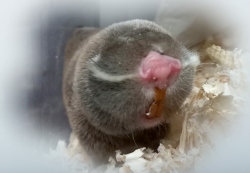
behavior. Remarkably, mutant females also adopting a male-typical pattern of
mating behaviors including mounting, pelvic thrust, anogenital olfactory
investigation, and emission of complex ultrasonic vocalizations (video).
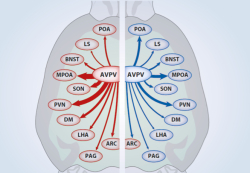
These findings suggest a new model in
which male and female mating circuits exist in both sexes, but sex-specific
chemosensory circuitry directs pheromonal cues to brain circuitry that
activates same sex circuitry and represses opposite sex behavior circuitry thus
allowing for the initiation of the appropriate male or female behavior
Research
Interests:
•
Sexually
dimorphic pheromone signals – perception, processing and biology function.
•
Characterizing
novel pheromone-mediated behavioral and neuroendocrine responses in wild-caught
mouse colonies.
•
Identifying
the genetic basis of sex-typical social and reproductive behaviors.
•
Mapping
and manipulating brain circuits controlling reproductive behaviors in males and
females.
Research
Methodologies:
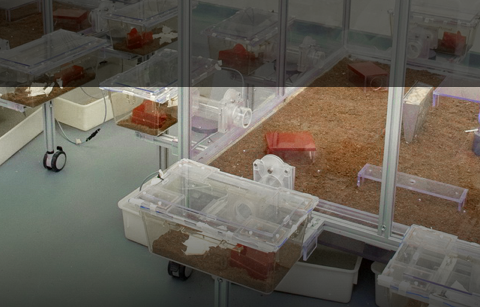
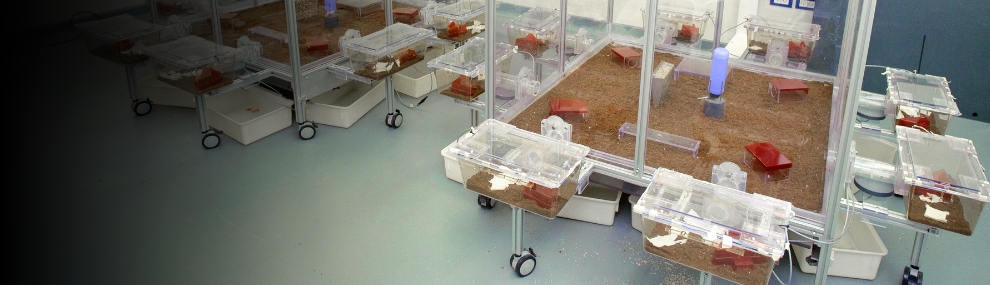
Behaviors: We are using innovative costume-designed experimental
set-ups including, large semi-natural enclosures that are equipped with array
of cameras, microphones and telemetry-based systems, to remotely record large
battery of social interactions and physiology data, in naturally behaving mouse
colonies.
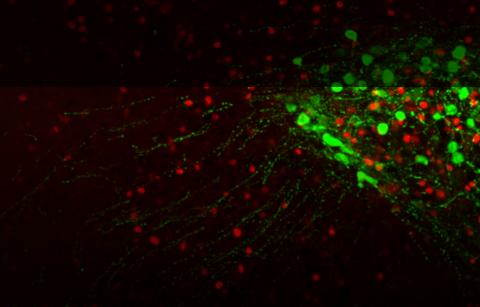
Molecular and cellular: Genetic modified mouse lines and conditional viruses
are used to manipulate gene expression, neuronal activities, and to trace
neuronal circuits.
Large scale genetic profiling: Microarray and high-throughput sequencing Solexa (Illumina)
platforms are used for large scale gene expression profiling in animals with
normal and deviate sex-typical behavioral repertoires.
Selected
Publications:
·
Kimchi,
T. and Terkel, J. (2001).
Spatial learning and memory in the blind mole rat (Spalax ehrenbergi) in
comparison with the laboratory rat and
·
Kimchi,
T. and Terkel, J. (2001).
Magnetic compass orientation in the blind mole rat, Spalax ehrenbergi. Journal
of Experimental Biology, 204, 751-758. [PDF]
·
Kimchi,
T. and Terkel, J. (2002).
Seeing and not seeing. Current Opinion in Neurobiology, 12, 728-734. [PDF]
·
Kimchi,
T. and Terkel, J. (2003). Mole
rats (Spalax ehrenbergi) select bypass burrowing strategies in
accordance with obstacle size.
Naturwissenschaften, 90, 36-39. [PDF]
· Kimchi, T. and Terkel, J. (2003). Detours by the blind mole-rat
follow assessment of location and physical properties of underground obstacles.
Animal Behaviour, 66, 885-891. [PDF]
·
Kimchi,
T. Etienne, A. and Terkel, J.
(2004). A subterranean mammal uses the magnetic orientation for path
integration. Proc Natl Acad Sci
·
Kimchi,
T. and Terkel, J. (2004).
Comparison of the role of somatosensory stimuli in maze learning in a blind
subterranean rodent and a sighted surface-dwelling rodent. Behavioural Brain
Research, 153, 389-395. [PDF]
·
Kimchi,
T., M. Resehf and Terkel, J.
(2005). Evidence for the use of reflected self-generated seismic waves for
spatial orientation in a blind subterranean mammal. Journal of Experimental
Biology, 208, 647-659. [PDF] [JEB inside]
·
Dulac,
C & Kimchi, T. (2007). Neural mechanisms underlying sex-specific
behaviors in vertebrates. Current Opinion in Neurobiology, 17, 675-683 [PDF]
·
Kimchi,
T.,
Nature, 448, 1009-1013. [PDF] [News and Views] [Neuron Report] [Harvard Magazine Report] [Nature Review Neuroscience Report] [video1] [video2]