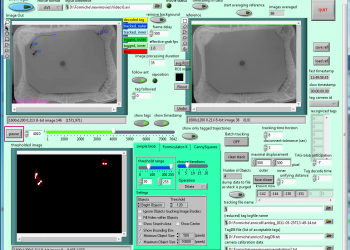
Automation software: Data acquisition, Instrument integration, Image and Data Analysis, Database Design, and Instrument Buying Consultancy

We are excited and privileged to push forward cutting-edge science by providing outstanding engineering services for all Weizmann Institute scientists
Automation software: Data acquisition, Instrument integration, Image and Data Analysis, Database Design, and Instrument Buying Consultancy

Design mechanical prototypes of versatile laboratory instruments and provide solutions to technical problems.

Produce custom-made instruments, assemblies and machines with conventional machining and 3D printers.

Produce complex parts following a coded programmed instruction using first-class CNC machines.

Repair and maintain laboratory equipment.

Provide high precision welding and soldering solutions for complex parts in vacuum systems.

Design and build custom electronics and software for data acquisition and experiment control systems.

Numerical simulation, advanced physical modelling; algorithm design; data analysis; digital image processing; Computerized instrument control and design of user interfaces; laboratory automation in small and large scale.

Operation & maintenance AMS accelerator, assembly and maintenance of ion-sources, design, assembly and maintenance of experimental facilities and of high & ultrahigh vacuum systems.

Part-time consultation on the design of experimental systems, including production of 3-D drawings, determination and requisition of required materials and components.

3D printing is an additive technology used to manufacture parts.

Supply of liquid Helium and liquid N2

Produce detectors for the ATLAS projects.

Provide assistance in all astronomical aspects.

Lasers repair, laser alignment, optical cleaning, and preventative maintenance.