![]() |
|
![]() |
| Home | Overview | Group | Recent Studies | Selected Publications | Biomineralization |
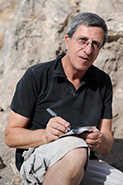
Professor Weiner conducts his own research in the field of archaeology (described below).
He is also the director of the Kimmel Center for Archaeological Science.
Recent studies:
1. Diagenesis in Prehistoric Caves: the Use of Minerals that Form In Situ to Assess the Completeness of the Archaeological Record.Panagiotis Karkanas, Ofer Bar-Yosef, Paul Goldberg and Steve Weiner
An interpretation of the archaeological record, in particular that of a prehistoric cave site, is complicated by the diversity of depositional and post-depositional processes that affect the material deposited. Here we propose to use the authigenic minerals that form in situ within the cave sediments to reconstruct the ancient chemical environments in the sediments. This can be done by experimentally determining the conditions under which each of the authigenic minerals are stable. Although this information is not available, to date, for minerals formed in a prehistoric cave, we present calculated stability field data for the relevant minerals. The results clearly demonstrate the feasibility of this approach. This information, particularly if based on measurements of real authigenic cave minerals, will facilitate an assessment of the completeness of the cave archaeological record. This is particularly important for determining whether or not the distributions of archaeologically important materials, such as bones, teeth, plant phytoliths, charcoal and ash, reflect their original burial distributions or were altered as a result of secondary diagenetic processes.Reference: Journal of Archaeological Science, 27, 915-929, 2000.
2. Solubilities of bone mineral in archaeological contexts.Francesco Berna, Alan Matthews and Steve Weiner
The mineral in modern bone is carbonated hydroxyapatite. It is present in the form of very small and thin plate-shaped crystals, that have large surface areas as compared to their bulk volumes. They are thus relatively soluble and hence less stable than their inorganic counterparts. Surprisingly little is known about their solubilities, which is the key parameter in understanding stability. We therefore measured the mineral phase from a series of sub-recent and fossil bones, and found that more or less between pH and 8, the mineral phase of modern bone is unstable and undergoes recrystallization. This process can be monitored conveniently by changes in the infrared spectrum of the mineral phase (the splitting factor). The results of this study provide a more in depth understanding of the stability of bone carbonated hydroxyapatite as well as carbonated hydroxyapatite that forms authigenically in the sediments. It has implications for using bone mineral for dating and other studies such as paleodiet reconstructions.Reference: Berna, F., Matthews, A. and Weiner, S. 2003.
Solubilities of Bone Mineral from Archaeological Sites: the Recrystallization Window.
Journal Archaeological Science 31, 867-882.3. Reconstructing spatial use at the site of Tel Dor, Israel from analyses of the sediment components.Ruti Shahack-Gross, Francesco Berna, Adi Bahar, Ayellet Gilboa, Ilan Sharon and Steve Weiner
Tel Dor site
Section from the Iron Age in D2 showing a series of floors, phytoliths layers and burned sediments.. Tel Dor is a Late Bronze to Roman period site located on the Mediterranean coast of Israel. It was an important port for a long period of time. We are studying the sediments in several locations within the site using on-site Fourier transform infrared spectrometry and X-ray fluorescence. We also take samples for micromorphological analysis, EDS analysis and for the study of phytoliths. The results to date show that a major portion of the sediments have been subjected to heating in one form or another. We are studying this phenomenon both in the laboratory ansd on-site. We have also identified many layers that are very rich in phytoliths, opening up the opportunity to reconstruct more fully the use of plant materials directly by the human ccupants or via the domestic animals that they maintained. Detailed studies of two sections reveal a richness of information not suspected by only visual inspection. This is an ongoing project that will be one of the major focuses of our research.Reference:Shahack-Gross, R., Albert, R.M., Gilboa, A., Nagar-Hilman, O, Sharon, I and Weiner, S. (2005).
Geoarchaeology in an urban context: the uses of space in a Phoenician Monumental building at Tel Dor (Israel).
J. Archaeological Science 32, 1417-1431.4. Flint mining in prehistory: a new method using in situ cosmogenic isotopes.Francesco Berna, Alan Matthews, Elisabetta Boaretto, Giovanni Verri, Michael Paul, Ran Barkai, Avi Gopher, Abraham Ronen and Steve Weiner
The use of stone tools represents a breakthrough in human technological and intellectual development. The first archaeological evidence of the use of tools dates to about 2.5 million years ago. One of the most widely used raw materials was flint, a microcrystalline form of quartz. As flint quality varies, the choice of raw materials for producing tools is important; the flaking properties of flint are known to modern flint knappers to be superior for mined flint as compared to surface exposed material. There are only a few reports of flint mining from the early Paleolithic, namely the Acheulian complex at Isampur (India) (ca. 1.0 My), the Lower- Middle Paleolithic in Mount Pua (Israel) (ca. 200,000 y) and the Middle Paleolithic in Qena (Egypt) (ca. 50,000 y). A flint exposed on the surface is bombarded by cosmic rays and accumulates in situ produced 10Be atoms, while a flint buried a meter or more is shielded. We use 10Be measurements to investigate the development of flint mining and show that flint artefacts approximately 300,000 years old from Qesem Cave (Israel) were surface collected and/or obtained from shallow quarries, whereas the artefacts from the late Acheulian in Tabun Cave (Israel) were initially collected on the surface or shallow mined, and in the Acheulo-Yabrudian were most likely obtained from mines more than a meter deep.
Reference: Verri, G., Barkai, R., Bordeanu, C., Gopher, A., Hass, M., Montanari, P., Paul, M., Ronen, A., Weiner,S. and Boaretto, E. 2003
Mining in prehistory recorded by in situ p roduced cosmogenic 10 Be in flint.
Proc. Natl. Acad. Sci. U.S.A. 101, 7880-7884.
5. Structure and Diagenesis of Wood CharcoalIlit Cohen-Ofri, Lev Weiner, Ronit Popovitz-Biro, Neomi Rebollo, Elisabetta Boaretto and Steve Weiner.
Charcoal is a common material in most archaeological sites. It was generally assumed to be relatively stable, although some studies clearly showed that charcoal does indeed undergo some diagenetic changes with time. We have studied both modern and fossil charcoal. TEM studies show that modern charcoals all contain a so-called non-organized phase and in some cases also graphite-like crystallites. A small amounted of rounded onion-like structures are also present. No oxygen was detected in modern charcoals using electron energy loss spectroscopy (EELS). Fossil charcoals from archaeological sites generally contain less of the crystalline graphite-like phase as compared to modern charcoals, and the non-organized phase contains oxygen. Infrared spectra show that this oxygen is mainly in the form of carboxylate groups. Thus charcoal diagenesis involves oxidation and converts the original constituents into a form that resembles humic substances.Reference:Cohen-Ofri, I., Weiner, L., Boaretto, E., Mintz, G. and Weiner, S. (2006). Modern and fossil charcoal: aspects of structure and diagenesis. &J. Archaeological Science 33, 428-439.
Reference:Cohen-Ofri, I., Popovitz-Biro, R. and Weiner, S. 2007. Structural characterization of modern and fossil natural charcoal using high resolution TEM and Electron Energy Loss Spectroscopy (EELS). Chem. Eur. J.13, 2306-2310.
6. Plaster and Ash: Calcite Formed at High TemperaturesLior Regev, Elisabetta Boaretto and Steve Weiner
When calcite is exposed to high temperatures in an open fire or a kiln, the mineral decomposes into calcium oxide. Upon cooling, the calcium oxide takes up carbon dioxide from the atmosphere and reforms into calcite. This pyrogenic calcite is present in large quantities in many archaeological sites in the form of ash; plaster and mortar. We recently discovered that pyrogenic calcite is more disordered than calcite formed slowly from solution, and thus still bears a signature of the fact that it was formed at high temperatures. This signature can be used to identify plaster and mortar or ash in sites and distinguish it from geogenic calcite. Furthermore, because the carbon is now derived from the atmosphere, it can in principle be used for radiocarbon dating – a subject under active investigation in our laboratory.Reference:Gueta, R., Natan, A., Addadi, L., Weiner, S., Refson, K. and Kronik, L. 2007. Local atomic order and infrared spectra of biogenic calcite.Angew. Chem. Int. Ed. 46, 291-294.
Reference:Chu, V., Regev, L., Weiner, S. and Boaretto, E. 2007.
Differentiating between calcite produced at high temperatures in plaster, mortar and ash and natural calcite using infrared spectroscopy: implications in archaeology.Journal of Archaeological Science (in press)
| Home | Overview | Group | Recent Studies | Selected Publications | Biomineralization |