
Biohazard detection

Project title: Blending silk and Gallium Nitride electronics for detection technology (G-6194)
Project Co-Directors:
Prof. Leonid Chernyak, University of Central Florida, Orlando, FL, USA (NPD)
Prof. Ulyana Shimanovich, Weizmann Institute of Science, Rehovot, Israel (PPD)
Kickoff Date: March 11, 2024
Duration: 42 month
NATO Budget: 350,000 EUR
Abstract: This US-Israel SPS three-year project aims at combining smart silk substrate technology with solid-state electronics Gallium Nitride technology for various biohazard detections, thus responding to 1-d-i NATO Key Priority. A detecting instrument consisting of smart-silk biosensor (290-400 nm sensing range), AlGaN-based laser diode (290-300 nm) and GaN-based p-i-n photodetector, having a maximum responsivity at ~ 360-365 nm, is proposed. The advantages of the proposed instrument for biohazard detection are in its small size, compatible with portable equipment, low cost, ability of pathogen detection at room temperature and finally in superior sensitivity due to enhanced GaN photodetector quantum efficiency.
The main tasks of this NATO collaborative project are as follows:
Task 1: Fabrication of silk substrates with variable morphologies and composition
Task 2: Silk functionalization with plasmonic gold nanoparticles
Task 3: Attachment of the tag molecule for biohazard detection
Task 4: Optical and environmental characterization of silk substrates
Task 5: Processing of UV photodetectors for the project
Task 6: Dark property and noise characterization
Task 7: Correlation of charge injection regimes and photodetector performance
Task 8: Prototyping
Task 9: Research-oriented training
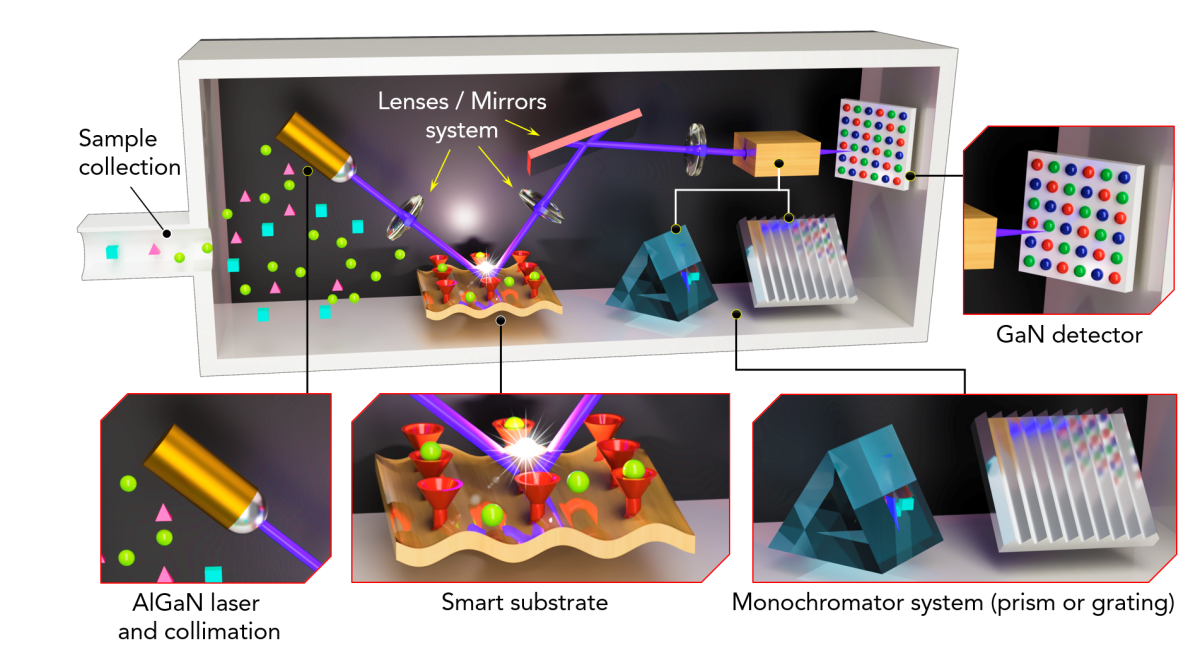 Figure 1. Prototype schematics. Air collection will be carried out by a commercial cyclone and the smart substrate excitation will be performed using a commercially available laser. Lasers and UV prisms or gratings are available for purchase at www.thorlabs.com.
This project will integrate in a mobile, sensitive, and cost-effective instrument (under $1K): 1. 300 nm ultraviolet AlGaN-based laser for optical excitation; 2. Smart silk substrate for pathogens absorption and light emission under laser excitation (photoluminescence); 3. AlGaN photovoltaic detector for room temperature sensing of pathogen optical signature.
The novelty and, therefore, the impact of the proposed project is threefold: 1. Use of gold nanoparticles, incorporated into silk substrate, for plasmonic light amplification. 2. Use of tag molecules within the smart silk substrate for selective biohazard detection in the wavelength range of AlGaN photodetector sensitivity. 3. Use of periodic pulses of solid-state charge injection to enhance (x10) the quantum efficiency of AlGaN photovoltaic detector.
Summary of Accomplishments
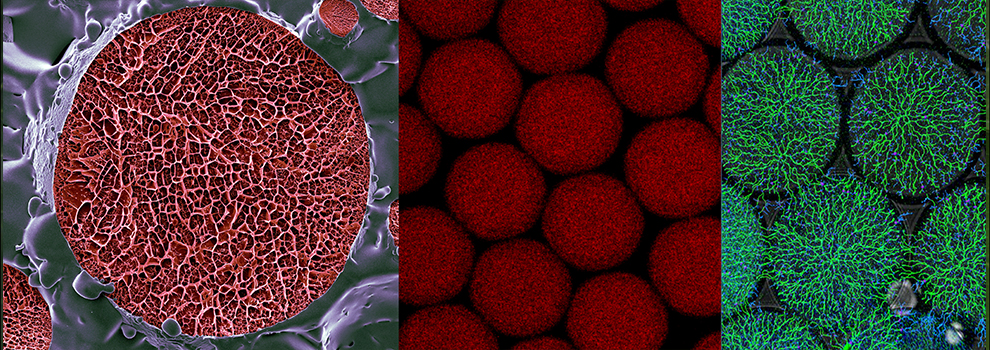
Shimanovich lab has developed technology enabling to both modulate the processing parameters, and, at the same time, resolve how they modify the structure of silk protein as well as the structural, assembling characteristics of silk materials [P-616657-IL and P-605999-IL, PCT/IL2022/050967] and final properties of the material. The capability to control the performance of silk-based materials enables its potential use in pathogen detection technology. One of the approaches in silk-based pathogen detection involves the integration of silk fibroin with biological recognition elements, such as antibodies or aptamers, to create biosensors. These biosensors can detect specific pathogens by capturing and interacting with their corresponding target molecules.
The US team discovered that electron injection into p-type GaN leads to considerable changes in the material's electronic properties, in particular longer diffusion length, which translates into up to one order of magnitude enhancement of a photovoltaic detector responsivity, thus indicating a possibility of device performance control (Chernyak et al., US patents ## 6,674,064; 11,054,312 B2).
Publications
1. Leonid Chernyak, Alfons Schulte, Jian-Sian Li, Chao-Ching Chiang, Fan Ren, Stephen J. Pearton, Corinne Sartel, Vincent Sallet, Zeyu Chi, Yves Dumont, Ekaterine Chikoidze, and Arie Ruzin, “Cathodoluminescence studies of electron injection effects in p-type gallium oxide”, AIP Advances, 14, 085103 (2024). https://doi.org/10.1063/5.0220201
2. Leonid Chernyak, Seth Lovo, Jian-Sian Li, Chao-Ching Chiang, Fan Ren, Stephen J. Pearton, Corinne Sartel, Vincent Sallet, Zeyu Chi, Yves Dumont, Ekaterine Chikoidze, Alfons Schulte, Arie Ruzin, Ulyana Shimanovich, “EBIC studies of minority electron diffusion length in undoped p-type gallium oxide”, AIP Advances, 14, 115301 (2024). https://doi.org/10.1063/5.0238027
3. Hsiao-Hsuan Wan, Jian-Sian Li, Chao-Ching Chiang, Labed Madani, Ho Jung Jeon, You Seung Rim, Gabriel Marciaga, Seth Lovo, Leonid Chernyak, Alfons Schulte, Jihyun Kim, Nahid Sultan Al-Mamun, Aman Haque, Fan Ren, S.J. Pearton, “10 MeV Proton and Neutron Damage in Lateral AlN Rectifiers”, ECS JOURNAL OF SOLID STATE SCIENCE AND TECHNOLOGY, 14 (4), 045005 (2025). https://doi.org/10.1149/2162-8777/adc59d
4. Mariia Rodionova, Aleksei Solomonov, Anna Kozell, Leonid Chernyak, and Ulyana Shimanovich, “Recent advances in the development and use of silk-based biomaterials”, Annual Review of Materials Research, vol. 55, (2025). https://doi.org/10.1146/annurev-matsci-080423-114451
5. S. J. Pearton, Fan Ren, Alexander Y. Polyakov, Eugene B. Yakimov, Leonid Chernyak, Aman Haque, “Perspective on comparative radiation hardness of Ga2O3 polymorphs”, J. Vac. Sci. Technol., A 43, 038501 (2025). https://doi.org/10.1116/6.0004444
6. Gabriel Marciaga, Jian-Sian Li, Chao-Ching Chiang, Fan Ren, Stephen J. Pearton, Corinne Sartel, Zeyu Chi, Yves Dumont, Ekaterine Chikoidze, Alfons Schulte, Arie Ruzin, Leonid Chernyak, “Electron beam irradiation-induced transport and recombination in p-type gallium oxide grown on (001) β-Ga2O3 substrate”, J. Appl. Phys., 138 (7) (2025). https://doi.org/10.1063/5.0288118
7. Zeyu Chi, Corinne Sartel, Vincent Sallet, Bruno Berini, Yves Dumont, Yunlin Zheng, Leonid Chernyak, Amador Pérez-Tomás, Ekaterine Chikoidze, “p-type β-Ga2O3 homoepitaxial films with superior electrical transport properties”, Advanced Electronic Materials, in press (2025).