


Publications
2021
-
(2021) Communications Chemistry. 4, 1, 62. Abstract
The process of amyloid nanofibril formation has broad implications including the generation of the strongest natural materials, namely silk fibers, and their major contribution to the progression of many degenerative diseases. The key question that remains unanswered is whether the amyloidogenic nature, which includes the characteristic H-bonded β-sheet structure and physical characteristics of protein assemblies, can be modified via controlled intervention of the molecular interactions. Here we show that tailored changes in molecular interactions, specifically in the H-bonded network, do not affect the nature of amyloidogenic fibrillation, and even have minimal effect on the initial nucleation events of self-assembly. However, they do trigger changes in networks at a higher hierarchical level, namely enhanced 2D packaging which is rationalized by the 3D hierarchy of β-sheet assembly, leading to variations in fibril morphology, structural composition and, remarkably, nanomechanical properties. These results pave the way to a better understanding of the role of molecular interactions in sculpting the structural and physical properties of protein supramolecular constructs.
(2021) Molecules. 26, 22, 6925. AbstractCyclic 6-membered aromatic compounds such as benzene and azabenzenes (pyridine, pyridazine, and pyrazine) are known to be light-sensitive, affording, in particular, the Dewar benzene type of intermediates. Pyridine is known to provide the only Dewar pyridine intermediate that undergoes reversible ring-opening. We found that irradiation of photosensitive gels prepared from poly(4-vinyl pyridine) and pyridine at 254 or 312 nm leads to pyridine ring-opening and subsequent formation of 5-amino-2,4-pentadienals. We show that this light-induced process is only partially reversible, and that the photogenerated aminoaldehyde and aminoaldehyde-pending groups undergo self-condensation to produce cross-linked, conjugated oligomers that absorb light in the visible spectrum up to the near-infrared range. Such a sequence of chemical reactions results in the formation of gel with two distinct morphologies: spheres and fiber-like matrices. To gain deeper insight into this process, we prepared poly(4-vinyl pyridine) with low molecular weight (about 2000 g/mol) and monitored the respective changes in absorption, fluorescence,1H-NMR spectra, and electrical conductivity. The conductivity of the polymer gel upon irradiation changes from ionic to electronic, indicative of a conjugated molecular wire behavior. Quantum mechanical calculations confirmed the feasibility of the proposed polycondensation process. This new polyacetylene analog has potential in thermal energy-harvesting and sensor applications.
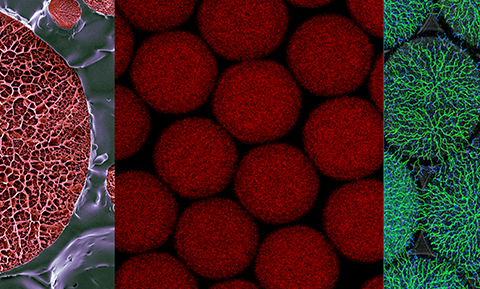
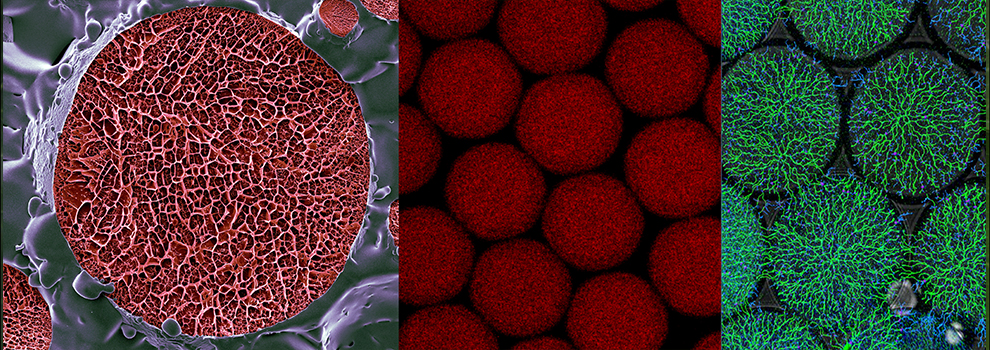
(2021) Small. 17, 26, 2007188. Abstract[All authors]Peptides and proteins have evolved to self-assemble into supramolecular entities through a set of non-covalent interactions. Such structures and materials provide the functional basis of life. Crucially, biomolecular assembly processes can be highly sensitive to and modulated by environmental conditions, including temperature, light, ionic strength and pH, providing the inspiration for the development of new classes of responsive functional materials based on peptide building blocks. Here, it is shown that the stimuli-responsive assembly of amyloidogenic peptide can be used as the basis of environmentally responsive microcapsules which exhibit release characteristics triggered by a change in pH. The microcapsules are biocompatible and biodegradable and may act as vehicles for controlled release of a wide range of biomolecules. Cryo-SEM images reveal the formation of a fibrillar network of the capsule interior with discrete compartments in which cargo molecules can be stored. In addition, the reversible formation of these microcapsules by modulating the solution pH is investigated and their potential application for the controlled release of encapsulated cargo molecules, including antibodies, is shown. These results suggest that the approach described here represents a promising venue for generating pH-responsive functional peptide-based materials for a wide range of potential applications for molecular encapsulation, storage, and release.