The healing power of pain
Dr. Tamar Ben-Shaanan studies the surprising role of pain-generating nerves in healing skin and aiding tissue regeneration
New scientists
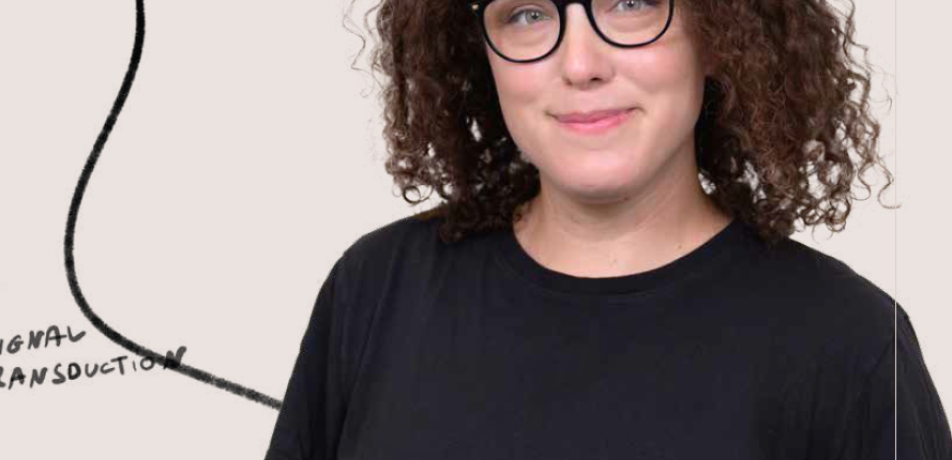
No organism navigates life unscathed―tissue damage is inevitable as we age, particularly damage to the skin, the body’s largest sensory organ. Our skin contains specialized sensory neurons known as nociceptors that detect harm and signal pain, an unpleasant yet life‑preserving sensation. But pain is more than a symptom: as innovative research by Dr. Tamar Ben‑Shaanan reveals, it can also be the body’s first step on the path to recovery.
According to Dr. Ben-Shaanan, who joined the Department of Molecular Neuroscience in July 2025, nociceptors are the body’s hidden architects of repair. When injury strikes, they help coordinate how skin repairs itself, communicate with nearby immune cells, and even summon help from the brain and hormonal system to patch us up. Dr. Ben‑Shaanan aims to understand how nociceptors communicate with skin cells—on a molecular level—with the hope of using that knowledge to help people recover faster, more fully, and with fewer scars.
Serendipity steps in
Dr. Ben-Shaanan took a brief hiatus from academia after earning her BSc in psychobiology from the Hebrew University of Jerusalem, feeling frustrated by the chasm between the work she could do studying proteins in individual neurons, and the broader mystery of conscious behavior.
“Being able to explain behavior, emotions, decision‑making—we neuroscientists all strive to ask these noble questions,” she says, “but it’s hard to get answers with that same level of sophistication as with single cells.” Then, as she puts it, “serendipity” stepped in. One of Dr. Ben‑Shaanan’s friends, a lab manager at the Technion-Israel Institute of Technology, called her to say, “There’s a new principal investigator here, Dr. Asya Rolls, and she’s doing exactly the type of science you enjoy!” One conversation later, and Dr. Ben-Shaanan,
who had been exploring biotech, was drawn back into academia, pursuing a PhD in medical sciences from the Technion.
The Rolls lab studies the placebo effect—in which a patient, convinced he has received an active treatment, responds positively, even though no active treatment has been given. This phenomenon has a known impact on the brain: People experiencing the placebo effect
exhibit activity in a region of the brain, known as the VTA, that is associated with positive reinforcement (and its evil twin, addiction).
Dr. Ben-Shaanan was tasked with understanding how VTA activity affects the immune system, as it must be doing something if the patient is getting better!
Now this was a question she could sink her teeth into. She used a chemogenetic approach known as Designer Receptors Exclusively Activated by Designer Drugs (DREADDs) that, as the name implies, involves engineering component proteins in neuron receptors so
that they are activated by certain synthetic drugs—but not by the body’s natural molecules. This technology allows researchers to turn specific cell populations on or off to study their function in the brain.
In this case, Dr. Ben-Shaanan and her colleagues used DREADDs to show that increased VTA activity triggered increased activity of antibacterial and anti-cancer immune cells. It was striking proof of the mind-body connection—and the power of positive thinking.
Separating pain from injury
For her postdoctoral work at the University of California, San Francisco, Dr. Ben-Shaanan focused on the immune system’s ability to aid recovery, particularly in cases of skin damage. Working with legendary immunologist Prof. Jason Cyster, she found that nociceptors in the skin affected cellular activity, ultimately promoting hair regrowth in both healthy and wounded skin.
Through her innovative work, she developed a model that separates pain from injury and was able to trigger nociceptors to send “ouch!” messages to the brain without causing actual harm to the skin. Furthermore, triggering nociceptors awakened a cellular pathway
involving skin cells that prompted hair growth and regeneration post-injury.
At the Weizmann Institute, Dr. Ben-Shaanan uses single-cell RNA sequencing, proteomics, and DREADDs to determine how neurons, skin cells, and immune factors interact to either signal or dampen inflammation and regeneration in painful scenarios, and how painful
perceptions can herald the onset of recovery.
These findings could lead to new therapeutic approaches for promoting wound healing, minimizing scarring, and alleviating chronic pain syndromes.
Returning home
Multiple factors brought the Netanya-native back to Israel, particularly her eldest daughter’s enlistment into the Israel Defense Forces and desire that Israel, not the United States, be her home. Dr. Ben‑Shaanan also felt a longing to return home.
Although she had enjoyed a wonderful experience in California, she reflects that, unlike in the US, where there is pressure to be highly publication-focused and results‑oriented, “In Israel, you can be more of a dreamer.” Especially at the Weizmann Institute, she adds, where curiosity is celebrated.
Dr. Ben-Shaanan is married and has two children and a Labradoodle.
EDUCATION AND SELECT AWARDS
• BSc, Hebrew University of Jerusalem (2005)
• MSc, Hebrew University-Hadassah Medical School
(2007)
• PhD, Technion-Israel Institute of Technology (2018)
• Postdoctoral Fellow, University of California, San Francisco (2018-2025)
• Fulbright Postdoctoral Fellowship (2018)
• Zuckerman Faculty Scholar (2025-2026)
• Co-inventor of two patented methods related to neural inhibition and modulation