Bridging mathematical worlds
Prof. Ehud Hrushovski uses logical frameworks to unlock mathematical mysteries
New scientists
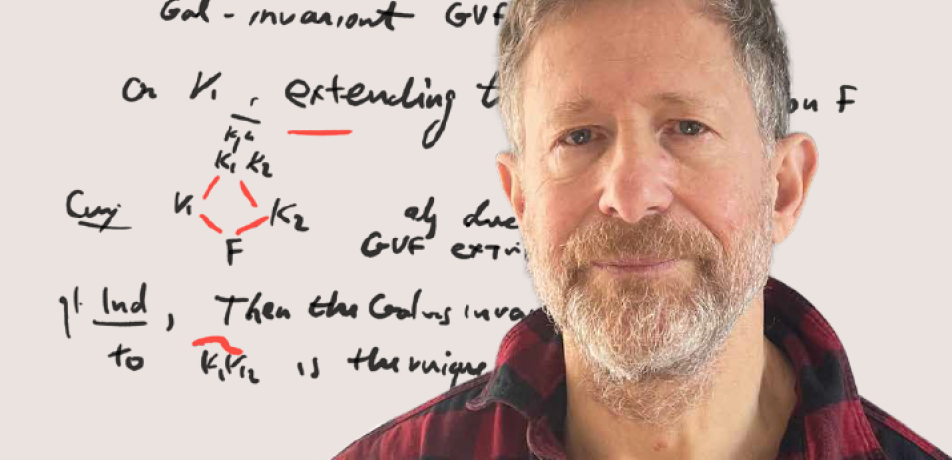
When Prof. Ehud (Udi) Hrushovski was in grade school in Jerusalem, his teacher used a grid of squares and vertices to show that 5 x 4 equals 4 x 5, also known as the property of commutativity. Most students likely nodded and moved on. But young Udi was captivated— and suspicious.
“I was amazed,” he recalls. “I wondered if they were cheating me by counting vertices instead of squares. It was a striking thing.” That childhood moment of wonder became the defining characteristic of Prof. Hrushovski’s career, over the course of which he has built a reputation for seeing what others miss—hidden structures and unexpected connections that transform entire fields of mathematics.
Finding symmetry in unexpected places
Prof. Hrushovski is a world expert in model theory, a branch of logic that studies the relationship between mathematical languages and the structures they describe to solve mathematical problems. His inspiration comes from the ability to solve a problem or answer a question.
“It’s like when you see an autostereogram [a picture with a hidden 3D image] and at first glance there is nothing, but you have a feeling there is something there, and then suddenly it appears,” he explains. “I love being able to see what is there.”
Though he initially thought he would study philosophy, a gap year at Oxford University opened his eyes to the beauty of mathematics. A friend told him about Prof. Saharon Shelah—one of the greatest mathematicians of the century—and his groundbreaking work in Jerusalem. Intrigued, Prof. Hrushovski chose to attend University of California, Berkeley, where he completed both his undergraduate studies and PhD under Prof. Leo Harrington, diving deep into Prof. Shelah’s theories.
Prof. Shelah created a way to organize all possible mathematical models into distinct classes—from “well-behaved/stable” to “chaotic/unstable”. As Prof. Hrushovski studied this theory, he noticed more familiar structures and patterns, or symmetries, that weren’t apparent before and could be used to explain puzzling behaviors within the model.
This breakthrough, the subject of his PhD thesis, transformed Prof. Shelah’s stability theory into a more powerful tool for geometric insights.
Prof. Hrushovski has since gone on to use logic tools to solve other longstanding problems in the fields of geometry and number theory—disciplines that often seem worlds apart. His methods, including the influential Hrushovski constructions, are used by mathematicians worldwide.
Math and poetry
Prof. Hrushovski’s intellectual curiosity was nurtured from an early age. His father, Prof. Benjamin Harshav, was a renowned literary theorist and poet who fled Vilnius as a child during World War II, fought in Israel’s War of Independence, and created the comparative literature department at Tel Aviv University, later moving to Yale University. Though Prof. Harshav initially studied math and physics, he eventually chose literature because, Prof. Hrushovski recalls, he felt that, at the time, “poetry is more important to the nation.”
“He had an enormous influence on me,” Prof. Hrushovski reflects, “in terms of his approach to language and learning, and how to view science.” He still remembers how his father taught him to sum geometric series in grade school, and how he approached literature with a mathematical sensibility. “His point of view on literature was abstract, and he loved analyzing the music of poetry, which is quite mathematical in itself.”
Uncovering what’s hidden
At the Weizmann Institute, Prof. Hrushovski will continue to use language and proof systems to expand the reach of model theory, focusing on how new mathematical areas fit within logical frameworks. Working to enlarge the domain that math models can cover, his research builds frameworks that can become powerful analytical tools. Throughout it all, his goal remains constant: to uncover what’s hidden and show that the right logical tools can illuminate truths that were there all along.
EDUCATION AND SELECT AWARDS
• BA (1982), PhD (1986), University of California, Berkeley
• Karp Prize from the Association for Symbolic Logic (1993, 1998), Erdős Prize from the Israel Mathematical Union (1994), Rothschild Prize (1998), Heinz Hopf Prize from ETH Zurich (2019), Shaw Prize in Mathematical Sciences (2022).
• Fellow, American Academy of Arts and Sciences (2007), Fellow, Israel Academy of Sciences and Humanities (2008), Fellow of the Royal Society of London (2020)
APPOINTMENTS
• Visiting Assistant Professor, Princeton University (1987-1989)
• Assistant Professor, Massachusetts Institute of Technology (1990-1994)
• Professor, Hebrew University of Jerusalem (1994‑2016), Albert Einstein Chair (2000-2016)
• Merton Professor of Mathematical Logic, University of Oxford (2016-present)