Atoms beware: it's a trap
Dr. Tom Manovitz uses precision laser systems to trap and manipulate atoms, shedding new light on quantum phenomena
New scientists
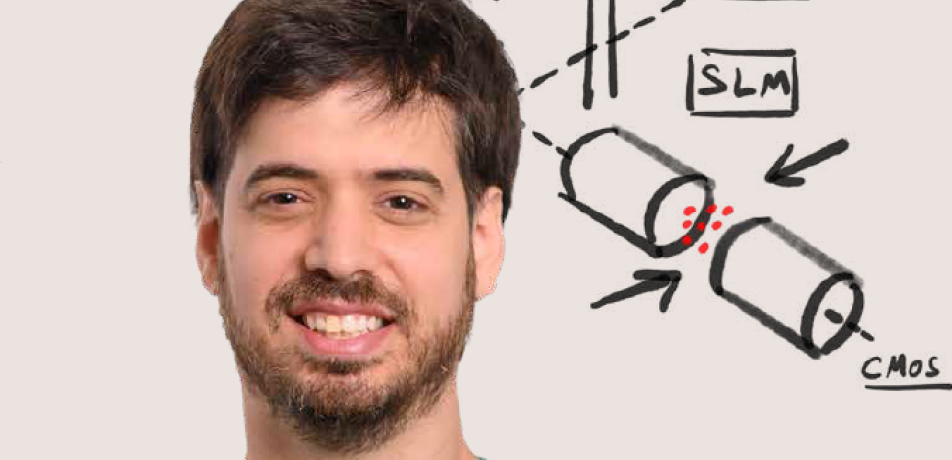
It takes extraordinary focus to hold a single atom in place and then use it to ask some of the biggest questions in physics. That same focus has shaped Dr. Tom Manovitz’s path as an experimental physicist at the forefront of quantum science. Now, in a full‑circle moment, he is returning to the Weizmann Institute—his alma mater—after four years in Prof. Mikhail Lukin’s group at the renowned Max Planck‑Harvard Research Center for Quantum Optics.
In October of 2025, Dr. Manovitz joined the Department of Physics of Complex Systems at Weizmann, where he previously earned both his graduate and doctoral degrees under the supervision of Prof. Roee Ozeri. His research harnesses finely tuned lasers to isolate individual atoms in a vacuum, organize them in precise arrays, and study their dynamics under the strange and powerful laws of quantum physics.
“We’re working at a level where intuition often fails,” he says. “But with the right tools and enough precision, you can begin to see these phenomena clearly and even start to control them—at least to an extent where new behavior may emerge.”
For Dr. Manovitz, this control is not an end in itself; rather, it is a gateway to exploring complex many‑body systems and advancing novel approaches to quantum computing.
The science-humanities duality
Drawn from a young age to numbers and patterns, Dr. Manovitz found that physics didn’t just offer answers—it raised profound questions about how the world works. “I’ve always been drawn to the parts of science that touch on philosophy,” he says.
That curiosity led him to the Amirim Honors Program in the Humanities at the Hebrew University of Jerusalem, where he studied physics alongside literature, history, and philosophy. “Amirim encouraged a kind of intellectual freedom. It taught me to think of science as part of a much larger conversation.”
During his graduate studies at Weizmann, he continued to explore both the technical and the reflective sides of science. Alongside his intensive lab work, he organized a lecture series on the history and philosophy of science and volunteered for a longstanding independent organization that brings Weizmann students and faculty into high school classrooms in Lod to teach math and physics.
Exploring the great unknown
At Harvard, Dr. Manovitz joined one of the world’s most competitive experimental quantum groups, developing atomic systems designed to investigatev quantum behavior and support the development of next-generation quantum computing technologies. He contributed to several major projects, resulting in back‑to‑back publications in Nature.
“I’ve had an incredible opportunity to work alongside brilliant experimental and theoretical physicists, pushing the boundaries of our field together,” he shares.
His newly launched lab at Weizmann will leverage high‑resolution laser arrays to trap and manipulate neutral atoms at the quantum level. The platform allows for exceptional control over atomic interactions and will serve as a testbed for exploring questions in quantum information and the collective behavior of complex quantum systems.
“There’s a deep connection between the experimental craft and the theoretical questions we want to explore,” he says. “I hope to create a space where both are valued equally.”
He also sees his role as extending beyond the research itself. “My goal is to build a lab culture that is collaborative, curious, and thoughtful. I want people to feel they can take intellectual risks and go beyond what is known or accepted.”
EDUCATION AND SELECT AWARDS:
• BSc, Hebrew University of Jerusalem (2013)
• MSc (2016) and PhD (2021), Weizmann Institute of Science
• Postdoctoral Fellow (2021-2025), Harvard University
• Amirim Interdisciplinary Honors Program (2010‑2013), Israel Council for Higher Education Fellowship in Quantum Science and Technology (2021-2023), Weizmann Physics Faculty Prize for Outstanding Experimental Research (2021), Harvard Quantum Initiative: Prize Postdoctoral Fellowship (2021‑2025), Sir Charles Clore Prize for Outstanding Appointment as Senior Scientist in the Experimental Sciences (2025)