Riding the brain wave
The ultra-fast MRI of Prof. Noam Shemesh
New scientists
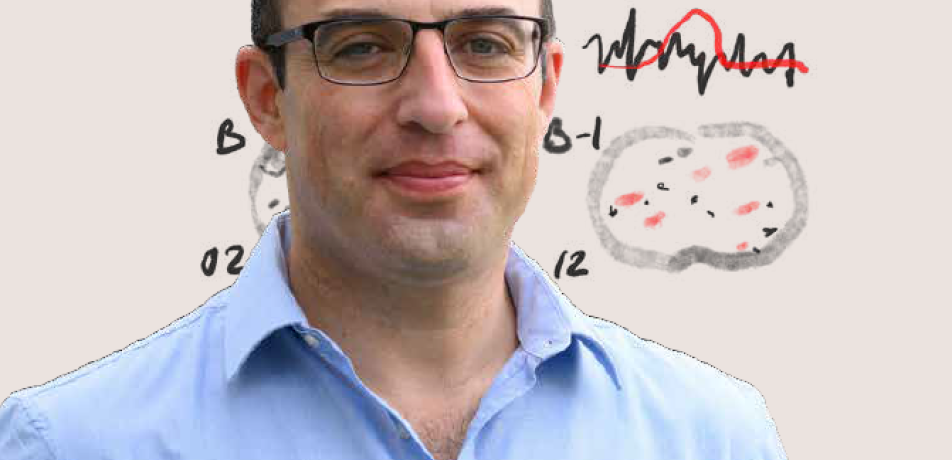
If you’ve ever had a medical MRI scan, you were inside a very strong magnet. But in the world of basic science, ultra-high field magnets―anywhere from two to seven times stronger than the magnets used to examine human patients―are unveiling previously invisible structures and dynamics that can be used to identify early signs of disease before symptoms appear. Ultra‑high field MRI is at the heart of the work of Prof. Noam Shemesh, who is joining the Department of Chemical and Biological Physics.
Prof. Shemesh grew up in the rhythm of academic life. His earliest memories were formed on the campus of the Hebrew University of Jerusalem, where his father was completing his doctorate. He recalls being cared for by a series of overqualified babysitters, including future winners of the Israel Prize.
“I was always a curious kid,” he says. “No one forced me to choose any particular path, but by the age of five or six I knew I wanted to be a scientist.”
After completing his military service and a subsequent trip abroad, he enrolled at Tel Aviv University, where he earned a BSc in chemistry and went on to complete his PhD in micro-architectural MRI, an imaging approach that makes it possible to visualize structures in the brain far smaller than what standard MRI can resolve. He was then accepted as a postdoctoral fellow in the Weizmann lab of Prof. Lucio Frydman, one of the world’s leading experts in using ultra-high field MR spectroscopy in animal models of disease.
“It was an amazing two-and-a-half years,” he says, adding that work in the Frydman lab helped prepare him for an unexpected twist in his career path. “After giving a presentation at the Champalimaud Centre for the Unknown in Lisbon, I got an offer to establish my own lab there. Portugal was off the beaten track, but it was a great opportunity; mine was the first-ever ultra-high field MRI lab in the country, and during my time there, we were able to develop research methods that led to some amazing findings.”
Optical approaches
Prof. Shemesh’s investigative strategy combines functional MRI (fMRI), which tracks changes in blood volume and oxygenation to reveal neural activity in the working brain, and microstructural MRI, which models water diffusion in tissue. At Weizmann, he plans to expand this toolkit by incorporating optical approaches that can record signals directly from neural tissue within the MRI scanner.
The multi-modal methodology developed by Prof. Shemesh enables the measurement of neural activity at an unprecedented speed, allowing for the detection of phenomena in animal models of disease
that had never been observed before.
“In my lab in Portugal, we developed new approaches for imaging tissues and dynamics associated with stroke, Parkinson’s disease, and Alzheimer’s, and have even shown that we can differentiate between tumors that, using typical MRI methods, would look exactly alike,”
Prof. Shemesh explains, adding that this ultra-fast image acquisition also helped his team identify how different areas of the brain communicate with each other.
“When neurons fire, it could be a local phenomenon, or it might result from oscillating waves of cross‑brain activity. Our fast measurements allow us to directly catch that oscillating wave and its spatial patterns for the first time.”
Seeing is believing
Prof. Shemesh is looking forward to returning to Weizmann thanks to its “unparalleled excellence and critical mass of outstanding researchers.” He plans to collaborate with basic science investigators who, like him, are fascinated by the biophysics of the brain, and are doing research that could produce real‑world impact.
“Work in my new lab at the Institute may lead to brain imaging methods that improve disease diagnosis and clarify how tiny changes in brain structure impact behavior,” he says. “With MRI, seeing is believing, and I believe that, in my lab, we’ll be seeing lots of things that will lead to very interesting discoveries.”
On a personal level, Prof. Shemesh is pleased to return to Israel with his family, especially in these complex times.
“Just a few days after the war erupted on October 7, 2023, I was shocked to hear many colleagues and friends make very strong anti-Israel statements. I submitted my application to Weizmann on October 12,” he recalls. “Once we’re settled into our new home on campus, my wife and I will have the privilege of raising our two children in a peaceful academic atmosphere, like what I experienced as a child. I am sure that joining the Weizmann community will inspire them as they grow up and eventually choose their own paths forward.”
EDUCATION AND SELECT AWARDS
• BSc (2006), PhD (2011), Tel Aviv University
• Postdoctoral Fellow, Weizmann Institute of Science (2011-2013)
• Young Investigator Award from the International Society for Magnetic Resonance in Medicine (2011), European Research Council Starting Grant (2015), Marie Sklodowska Curie Individual Fellowship from the European Commission (2015), Portuguese Foundation for Science and Technology grant (2016), Mantero Belard Award from the Santa Casa da Misericórdia de Lisboa (2021), Israel Science Foundation’s Or Fellowship for senior tenured scientists returning to Israel (2025)
APPOINTMENTS
• Principal Investigator (2014-2019), Associate Professor and Director of the Preclinical MRI Center (2019-2025), Champalimaud Centre for the Unknown in Lisbon, Portugal