| Class I, monomeric ArgRS, same-subunit binding |
Class II, heterodimeric PheRS, cross-subunit binding |

|
 |
|
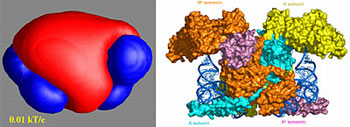
Figure 1. 3D-isopotential surface representation of aaRSs and overall views of their complexes with cognate tRNA: class I monomeric ArgRS (a, b); class II heterotetrameric PheRS (c, d). Pairs of figures 1a and 1b, etc., are displayed in different scale and have equivalent orientation. Structural domains of ArgRS and subunits of PheRS are marked with different colors. The tRNA is shown as blue ribbons. All isopotential surfaces are calculated and built at �0.01 kT/e with GRASP. Patches of positive (+) and negative (-) potentials are shown in blue and red respectively.
|
 |
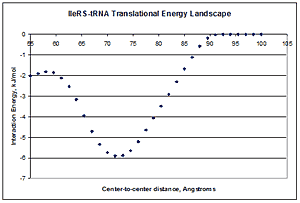 |
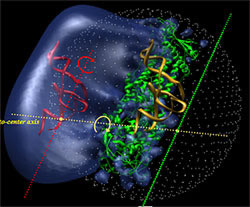
| Figure 2. The tRNAIle pathway toward the bound state in IleRS-tRNAIle complex. (a) The energetically most favorable position of tRNAIle (red) on the Reactive sphere (RES). The tRNAIle (red) immersed into the reactive patch, determined as the area of positive potential (blue) on RES. The IleRS and tRNAIle in binary complex are colored by green and gold. (b) The binding energy (?Eint) dependence of the center-to-center distance between IleRS and tRNAIle. The ?Eint shows its minimum when the center-to-center distance approaches the RES radius. |
)
)