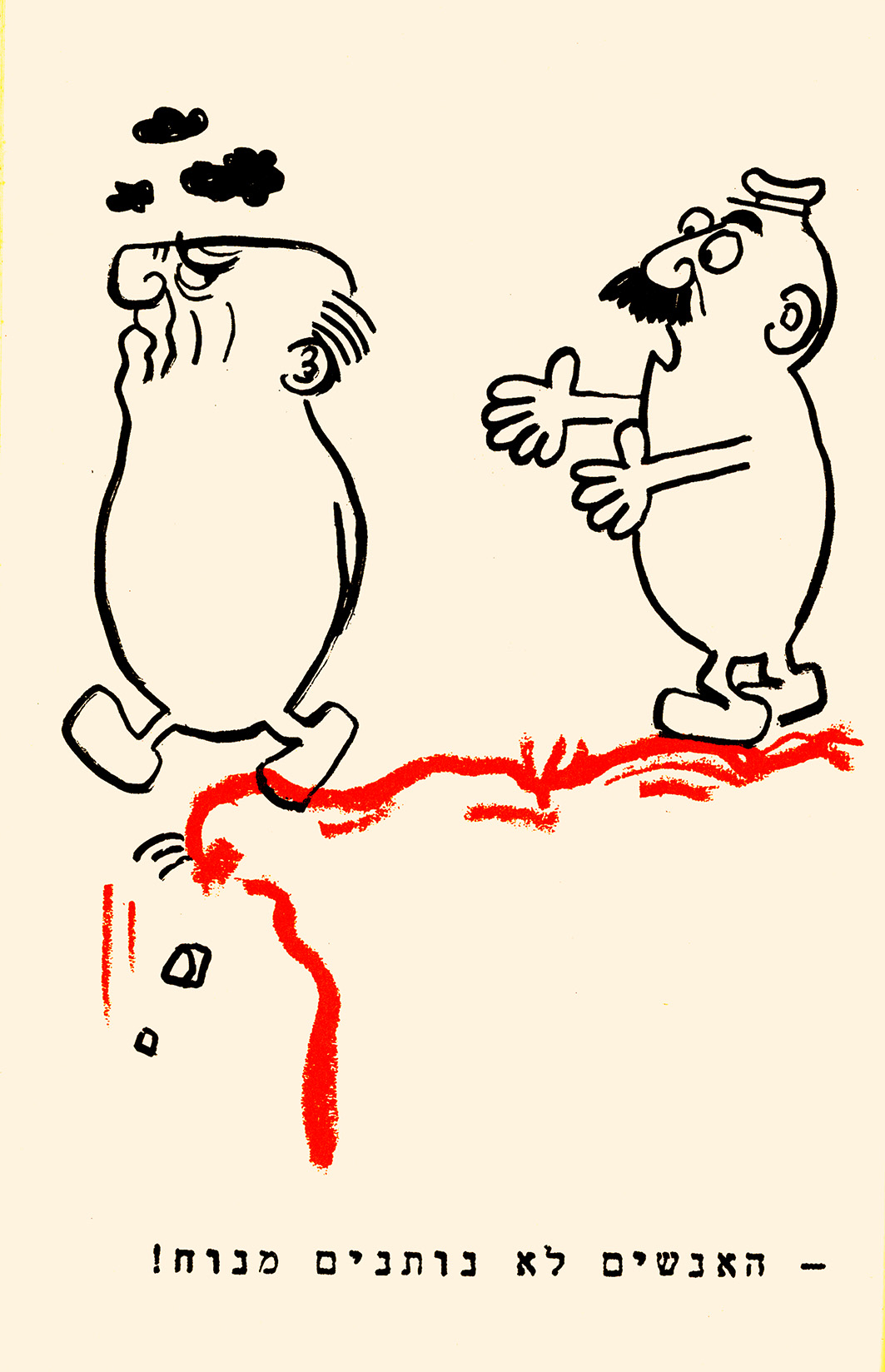
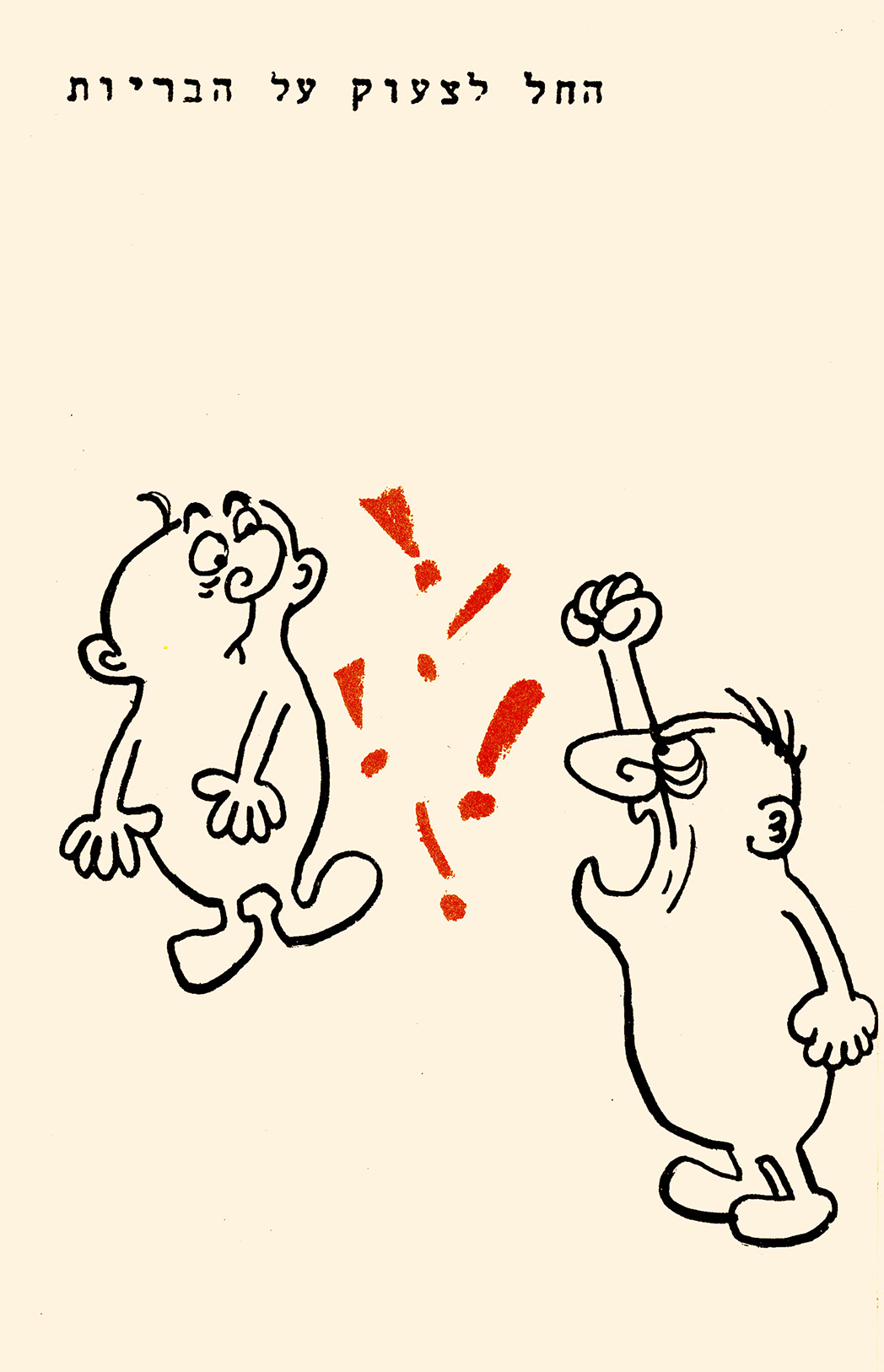
Kariel Gardosh (Dosh)"False Tales – The Contrast Formula"Artist wall in Michael Sela Auditorium1
Kariel Gardosh, known by his artistic moniker Dosh (1921–2000), was a publicist and visual storyteller who uniquely bridged word and image. Through his writings and drawings, he illuminated the human condition in its broadest sense, while also capturing the nuances of Israeli life and character.
His keen, perceptive gaze reached deep into the recesses of the human spirit and returned with amusing observations that invariably prompted reflection, learning, and at times, a shift in perspective.
The “contrast formula” he developed and applied throughout much of his work was based on the tension between what is seen and what is read or heard. In this sense, in the oeuvre of Dosh — and contrary to Marshall McLuhan’s famous dictum — the medium is not the message.
This exhibition presents six short illustrated stories, originally published in his book False Tales (Amikam Publishing, 1967), each revealing a profound, fundamentally human truth. The “contrast formula” announces itself almost immediately in these stories, often from the very first page.
A notable example is “The Not-So-Happy Dog,” which opens with the sentence “Once upon a time there was a little dog,” with an illustration of a crow-like bird above it. From there, the plot proceeds along a path that leads to inevitable disaster. Those who wish to derive from this that a bird should not attempt to think and behave like a dog (and those who choose to extend this lesson into the human sphere) are free to do so.
Dosh was born as Kariel Gardoshin Budapest in 1921. His mother died during childbirth, and he was raised in an extended household with his father, aunt, and her partner. In high school, he distinguished himself in both writing and drawing.
During World War II, he was sent by the Nazis to forced labor in copper mines and later taken on a death march from which he escaped to join the partisans. After the war, he studied at a French-language university in Hungary, published short stories, and worked as a journalist. Moving to Paris, he studied literature and philosophy at the Sorbonne and engaged with circles surrounding Sartre and Camus.
During this period, he joined the Lehi paramilitary underground organization and began contributing cartoons under the pseudonym “Shir” to Lehi’s publication HaMa’as. In 1948, he immigrated with his wife Shoshana to Israel, shortly before the state’s Declaration of Independence.
After two years of working for several newspapers, he joined the weekly magazine HaOlam HaZeh as graphic editor under editor Uri Avnery. Influenced by Avnery, he changed his first name from Karol to the Hebrew-sounding Kariel, and adopted the signature Dosh.
Following an injury caused by a bomb planted in the editorial offices by the magazine’s opponents, he left HaOlam HaZeh and accepted an offer from Dr. Ezriel Carlebach, founder and first editor of the widely circulated newspaper Maariv. There, alongside fellow Hungarian immigrants such as Ephraim Kishon and Joseph (Tommy) Lapid, he emerged as Israel’s foremost and most celebrated cartoonist. During this period, he created “Srulik,” the iconic figure embodying Israel and the Israeli spirit. In addition to cartoons, he published personal columns and essays, and continued writing for the theater.
Dosh also dedicated time to supporting IDF soldiers, and in the 1970s served for two years as head of public relations for the Civil Guard, holding the rank of Superintendent. In the 1980s, he was appointed Cultural Attaché at the Israeli Embassy in the United Kingdom, and later served on the Executive Board and Plenary of the Israel Broadcasting Authority.
With thanks to Nirit Gurevich and Daniella Gardosh.