T.Arumugam
T.Ben Moshe
G.Cantarella
Y.Goltsev
T.Goncharov
G.Koluman
A.Kovalenko
R.Krishnan
S.Leu
A.Rajput
P.Ramakrishnan
M.Schuchmann
T.Shmushkovich
E.Varfolomeev
N.Yogev
S.Q.Zhang
T.Shmushkovich
E.Varfolomeev
 
Regulation of cell-death and immune defense by receptors of the TNF/NGF family

David Wallach

Tel. +972 8 934 3941 Fax +972 8 934 3165

Email:d.wallach@weizmann.ac.il


Receptors of the TNF/NGF family control all aspects of immune defense and play important roles in the regulation of developmental processes. The knowledge existent today of their action mainly concerns common features of their signaling mechanisms and falls short of providing information of the basis for specificity in their action. Our studies aim at elucidating the mechanisms regulating the induction of two of the most unique activities of these receptors: programmed cell death, an effect that occurs in a protein-synthesis independent manner, and activation of transcription factors such as NF-kappa B that participate in the induction of immune defense mechanisms. These two activities are in part exclusive as certain NF-kappa B-induced genes have the ability to block the apoptotic effect of some of the receptors. We are applying genetic screens and proteomic approaches to identify the signaling proteins participating in the induction of cell death and immune defense, and complement these in vitro studies by transgenic approaches for elucidating the in vivo role of these proteins.

Signaling for cell death

Exploring the sequence of protein-protein interaction events initiated by the death receptor Fas (CD95), we have discovered an adapter protein, FADD/Mort1, that associates with death receptors and recruits caspase-8, a member of the caspase cystein protease family that plays a crucial role in all apoptotic processes. It also recruits cFLIP/CASH, a caspase-8 homologue that serves as a biological inhibitor of death induction and initiator of non-apoptotic effects of the receptors. Our analysis of the in vivo role of caspase-8 by targeted disruption of its gene in mouse confirmed that the enzyme plays a pivotal role in death induction, but also revealed that this enzyme has some non-apoptotic functions that we now further explore. Both genetic screens and protein-purification approaches are applied to isolate regulatory proteins that associate with caspase-8 and cFLIP/CASH Fig. 1.

Signaling for activation of the transcription factor NF-kappa B

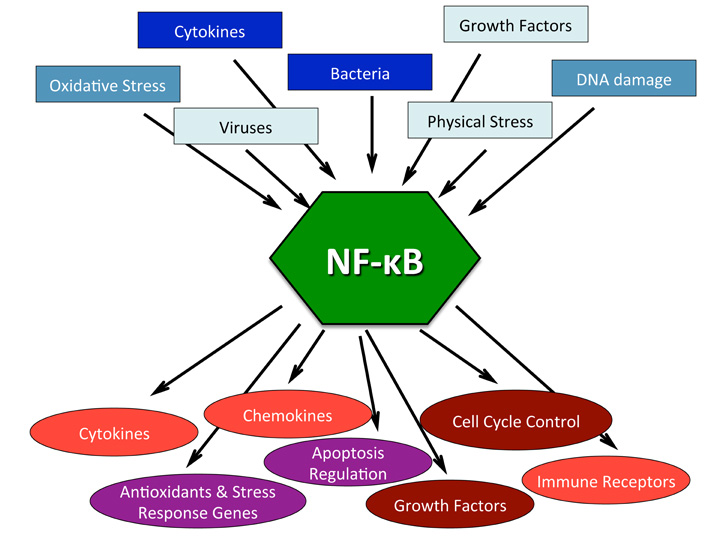
NF-kappa B is a highly pleiotropic group of transcriptional factors that regulate a wide range of genes, mainly participating in immune defense and development. All members of the TNF/NGF receptor family activate these transcriptional factors, Fig. 2

yet with different functional consequences. Some promote adaptive, and others, innate immunity; some control embryonic development through NF-kappa B activation, and some employ this transcriptional factor to restrict their own cytotoxic activity. Receptor-associated adapter proteins of the TRAF family serve to initiate this activation, and a kinase complex composed of two protein kinases, IKK1 and IKK2, as well as a non-enzymatic component, NEMO (IKK-gamma), act as the effector element in it. Attempting to elucidate the molecular interactions that impose specificity of action on this common set of signaling molecules, we have discovered two novel interactions of the receptor-associated adapter protein TRAF2: binding to a novel protein kinase, NIK, that through phosphorylation of the IKK complex enhances expression of NF-kappa B target genes specifically involved in adaptive immunity, and binding to a novel protein that transmits signaling to NF-kappa B activation through small G proteins. We have also discovered novel interactions of NEMO that impose specificity on the action of the IKK complex. Functions of receptors of the TNF/NGF family are central to the pathology of various diseases. Our discovery, 12 years ago, of the soluble forms of the TNF receptors formed the basis for the current wide application of these soluble receptors for effective treatment of Rheumatoid Arthritis and Crohn's disease. Elucidation of the intricacies of the signaling mechanisms activated by the TNF/NGF family will form the basis for future development of drugs for other diseases to which this receptor family contributes.
Selected Publications

Malinin, N. L., Boldin, M. P., Kovalenko, A. V. and Wal l ach, D. (1997) MAP3K-related kinase involved in NF-kappa B induction by TNF, CD95 and IL-1. Nature, 385, 540-544.

Goltsev, Y. V., Kovalenko, A. V., Arnold, E., Varfolomeev, E. E., Brodianskii, V. M. and Wallach D.(1997). CASH, a novel caspase homologue with death effector domains. J. Biol. Chem. 272, 19641-19644.

Wallach, D. (1997) Cell death induction by TNF: a matter of self control. Trends Biochem. Sci., 22, 107-109.

Varfolomeev, E. E., Schuchmann, M., Luria, V., Chiannilkulchai, N., Beckmann, J. S., Mett I. L., Rebrikov, D., Brodianski, V. M., Kemper, O. C., Kollet, O., Lapidot, T. s., Soffer, D., Sobe T., Avraham, K. B., Goncharov, T., Holtmann, H., Lonai, P. and Wallach, D. (1998). Targeted disruption of the mouse caspase-8 gene ablates cell-death induction by the TNF receptors, Fas/Apo1, and DR3 and is lethal prenatally. Immunity, 9, 267-276.

Wallach, D. , Kovalenko, A. V., Varfolomeev, E. E. and Boldin, M. P. (1998) Death-inducing functions of ligands of the TNF family: a Sanhedrin verdict. Current Opin. Immunol, 10, 279-288.

Watts AD, Hunt NH, Wanigasekara Y, Bloomfield G, Wallach D, Roufogalis BD and Chaudhri G (1999) A casein kinase I motif present in the cytoplasmic domain of members of the tumour necrosis factor ligand family is implicated in Ôreverse signallingÕ. EMBO J. 118, 2119-2126.

Wallach, D., Varfolomeev, E. E., Malinin, N. L., Goltsev, Y. V., Kovalenko A. V. and Boldin, M. P (1999) TNF receptor and Fas signaling mechanisms. Ann. Rev. Immunol, 17, 331-367. (1307)

Zhang S. Q, Kovalenko A., Cantarella G. and Wallach, D. (2000) Recruitment of the I-kappa-B-kinase (IKK) signalosome to the p55 TNF receptor: RIP and A20 bind to NEMO (IKK gamma) upon receptor stimulation. Immunity. 12, 301-313.