Research Projects
Receptors of the TNF/NGF family control all aspects of immune defense and play important roles in the regulation of developmental processes. Today, the existing body of knowledge of their activity mainly concerns common features of their signaling mechanisms, and falls short of providing information about the basis for specificity in their actions. Our studies are aimed toward elucidating the mechanisms regulating the induction of two cardinal activities of these receptors:programmed cell death, an effect that occurs in a protein-synthesis independent manner activation of transcription factors such as NF-kappa B that participate in the induction of immune defense mechanisms.
These two activities are in part mutually exclusive, as certain NF-kappa B-induced genes have the ability to block the apoptotic effect of some of the receptors. In our lab, we are applying genetic screens and proteomic approaches to identify the signaling proteins which participate in the induction of cell death and immune defense, and complement these in vitro studies by transgenic approaches for elucidating the in vivo role of these proteins.
Signaling for cell deaths
Studies in vitro
While exploring the sequence of protein-protein interaction events initiated by the death receptor Fas (CD95), we have discovered an adapter protein, FADD/Mort1. This protein associates with death receptors and recruits caspase-8, a member of the caspase cystein protease family that plays a crucial role in all apoptotic processes. It also recruits cFLIP/CASH, a caspase-8 homologue that serves as a biological inhibitor of death induction and initiator of non-apoptotic effects of the receptors. Both genetic screens and protein-purification approaches are applied to isolate regulatory proteins that associate with caspase-8 and cFLIP/CASH.
Studies in vivo
Our analysis of the in vivo role of caspase-8 by targeted disruption of its gene in mice, and by its conditional knockout using the Cre/loxP recombination system, has confirmed that the enzyme plays a pivotal role in death induction. Deletion of caspase-8 in hepatocytes, for example, protected them from Fas-induced hepatocyte death and from fatal liver damage similar to that which occurs in acute hepatitis. In addition, this analysis revealed that caspase-8 also serves cellular functions that are non-apoptotic. Caspase-8 deletion in endothelial cells resulted in degeneration of the yolk sac vasculature and embryonic death due to circulatory failure. Its deletion in bone-marrow cells resulted in arrest of hematopoietic progenitor functioning, and in cells of the myelomonocytic lineage - in arrest of differentiation into macrophages and to death. We are currently exploring the mechanisms that determine whether caspase-8 activation in a cell will lead to its death, or, alternatively, to non-apoptotic changes.
Signaling for activation of the transcription factor NF-kappaB
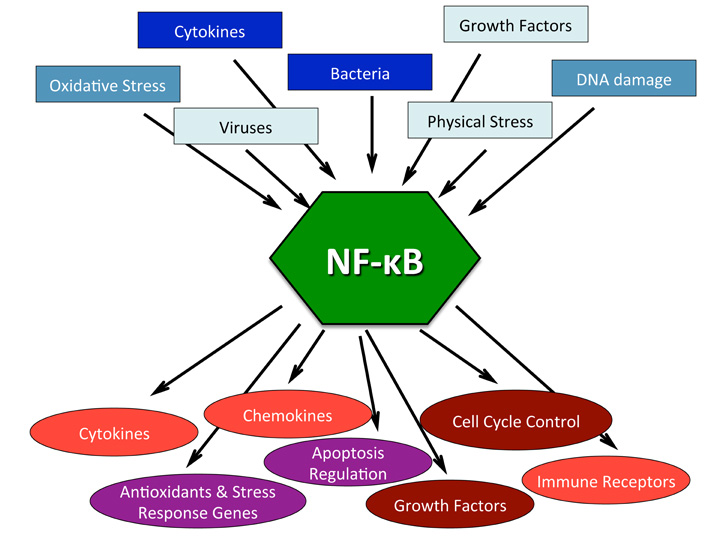
NF-kappa B is a highly pleiotropic group of transcriptional factors that regulate a wide range of genes, mainly participating in immune defense and development. All members of the TNF/NGF receptor family activate these transcriptional factors, but each with different functional consequences. Some promote adaptive immunity, and others, innate immunity; some control embryonic development through NF-kappa B activation, and some employ this transcriptional factor to restrict their own cytotoxic activity. Receptor-associated adapter proteins of the TRAF family serve to initiate this activation, and a kinase complex composed of two protein kinases, IKK1 and IKK2, as well as a non-enzymatic component, NEMO (IKK-gamma), acts as the effector element in it. Attempting to elucidate the molecular interactions that impose specificity of action on this common set of signaling molecules, we have discovered a novel interaction of the receptor-associated adapter protein TRAF2 with a novel protein kinase, NIK, that through phosphorylation of the IKK complex enhances expression of NF-kappa B target genes specifically involved in adaptive immunity. Our findings indicate that NIK participates in a unique set of proximal signaling events, initiated by specific members of the TNF/NGF family that regulate adaptive immune responses. Its activation by these specific receptors leads to activation of several different NF-kappa B proteins. We have also discovered a novel interaction of NEMO with CYLD, a protein that possesses de-ubiquitinating activity that is directed towards K63-linked poly-ubiquitin chains. It negatively modulates NF kappa B activation on the part of members of the TNF/NGF family by arresting signaling events that depend on K63-linked poly-ubiquitination of NEMO and of members of the TRAF adapter protein family. CYLD dysfunction leads to excessive activation of NF-kappa B and can trigger cell transformation, apparently through increased resistance to apoptosis or perturbation of the cell cycle. We are currently exploring the involvement of other NF-kappa B and cell death regulating proteins in human cancer. Functions of receptors of the TNF/NGF family are central to the pathology of various diseases. Our discovery, 14 years ago, of the soluble forms of the TNF receptors formed the basis for the current wide application of these soluble receptors for effective treatment of Rheumatoid Arthritis and Crohn's disease. Elucidation of the intricacies of the signaling mechanisms activated by the TNF/NGF family will form the basis for future development of drugs for other diseases to which this receptor family contributes.
OPEN POSITIONS
I. Description: Molecular mechanisms defining the specificity of cytokine-induced transcriptional responses.
More Information: The project will aim at purification and characterization of novel chromatin-associated protein complexes responsible for distinct ligand-specific profiles of gene induction in response to cytokines of the TNF superfamily.
The position is available for a highly motivated PhD with extensive experience in molecular and mammalian cell biology techniques. Working knowledge of methodologies of affinity purification of endogenous signaling complexes and their analysis by mass-spectrometry is prerequisiste. Also required is a thorough understanding of the molecular mechanisms of gene expression regulation and genome organization.