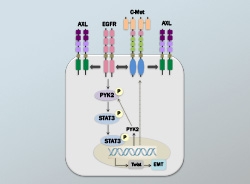

Normal cell growth and motility are controlled by complex signaling pathways that respond to diverse environmental cues including nutrients, growth factors, hormones and components of the extracellular matrix (ECM). Understanding how intracellular signaling networks function in normal cells, and how they are altered in cancer cells, is a major challenge of cancer biology research.
We study breast cancer, the most prevalent cancer among women, and one of the leading causes of cancer-related death worldwide. In particular, we focus on a highly aggressive subclass of breast cancer known as triple negative breast cancer (TNBC). Our long-term goals are to gain better understanding of how this disease develops, progresses and spreads and to identify target therapies and potent combination therapies for different TNBC subtypes.