Phenomenology of High Energy Physics

Research Activities

We are theoretical physicists, working on phenomenology of high energy physics. High energy physics, also known as particle physics, investigates the elementary particles in nature and the interactions among them. It asks the most basic questions in physics, and seeks for the laws of nature from which all phenomena can, in principle, be understood. The word “phenomenology” refers, in this context, to theoretical work that is undertaken in close relation to laboratory experiments. Phenomenologists either interpret new experimental results, or build models of particle physics that can be tested in present or near future experiments. Below is a description of some of the specific topics on which we have worked.

CP Violation

Are the laws of nature the same for matter and antimatter? Physicists use the term CP (Charge Parity) to talk about matter-antimatter symmetry. If nature treated matter and antimatter alike, then, in physics-speak, nature would be CP-symmetric. If not, CP is violated.

Experiments have shown that nature’s weak force – which is responsible for the decay of particles – does in fact violate CP. Yet CP violation poses a mystery.

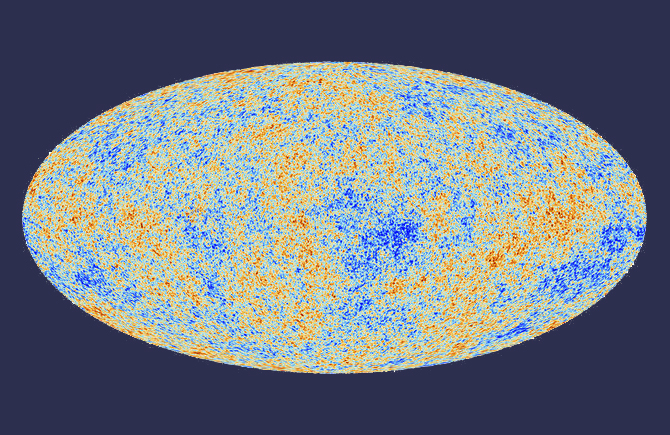
The big bang should have created equal amounts of matter and antimatter, with subsequent annihilation leaving neither behind. And yet, the observable universe has about ten billion galaxies that consist entirely of matter (protons, neutrons, and electrons) with no antimatter (antiprotons, antineutrons, and positrons). Very soon after the big bang, some forces must have caused the CP violation that skewed the equality in the number of matter and antimatter particles and left behind excess matter. The weak force by itself can only explain a small amount of CP violation, not enough to leave matter for even a single galaxy. Some other hidden force – not accounted for in our Standard Model of particles and forces – must have been responsible for the extra CP violation that led to the universe we observe. Current and future particle accelerator experiments are designed to search for sources of CP violation large enough to account for the all-matter universe around us.

We have been involved in various aspects of research in this field, from relating various theories that go beyond the Standard Model, through measurements carried out in current experiments, to investigating alternative scenarios that might explain how the large asymmetry between matter and antimatter has been generated during the history of the universe.

Neutrinos

The most elusive of all elementary particles are the neutrinos. They are subject to the effects of neither the strong force nor the electromagnetic one. Thus, it is only the weak force to which they are sensitive.

The weak interaction of neutrinos makes them unique messengers. Consider, for example, the Sun. Much of what we know about the Sun comes from observing photons (that is, the light coming from the Sun). Photons do, however, interact electromagnetically. Thus, a photon produced near the center of the Sun makes its way to the surface of the Sun in about a hundred thousand years, changing directions and energies, and losing much information about the processes in the core of the Sun that have produced it. In contrast, neutrinos that are produced near the core of the Sun, make their way out at a speed close to the speed of light, with rarely any interruption. Some eight minutes after they have been produced, they arrive at Earth, with direction and energy unchanged. There is so much more that we could learn about our Sun if we could observe these neutrinos!

The great elusiveness of neutrinos, which makes them such excellent messengers, is also a source of great experimental difficulty in observing them. If the whole Sun is transparent to neutrinos, how can we hope to stop them and measure their properties in our detectors? Indeed, detecting neutrinos has been one of the most challenging tasks for particle physicists. In recent years, however, there has been huge progress in this endeavor, with ever more sophisticated and imaginative detectors to do the job. And, together with the experimental success came a big reward: The features of the neutrinos as extracted from measuring, for example, the flux of solar neutrinos, did not fit the expectations based on our Standard Model. In particular, while this model predicts that neutrinos have no mass, it turned out that neutrino masses, though tiny (about 10,000,000,000 times lighter than the proton), are definitely not zero. Thus a window to new physics, beyond the Standard Model, was opened.

We have studied many different aspects of neutrino physics, from the constraints implied by the fact that their masses cannot make a large part of the energy density of the universe, to interpreting the details of their measured masses in the context of models of new physics. More recently, we investigated the possibility that neutrino telescopes –detectors that aim to observe very energetic neutrinos coming from remote astrophysical sources – will measure some new fundamental properties of the neutrinos.

One of the more exciting directions of research is a very intriguing possible connection between neutrino physics, CP violation, and the puzzle of the matter-antimatter imbalance in the universe. It turns out that the observed features of neutrinos are very suggestive of a stage in the history of the universe where forces that distinguish between neutrinos and antineutrinos have generated the imbalance that later led to the disappearance of all antimatter. This scenario, known as "leptogenesis", is now considered the most attractive solution of this puzzle in cosmology.

LHC physics

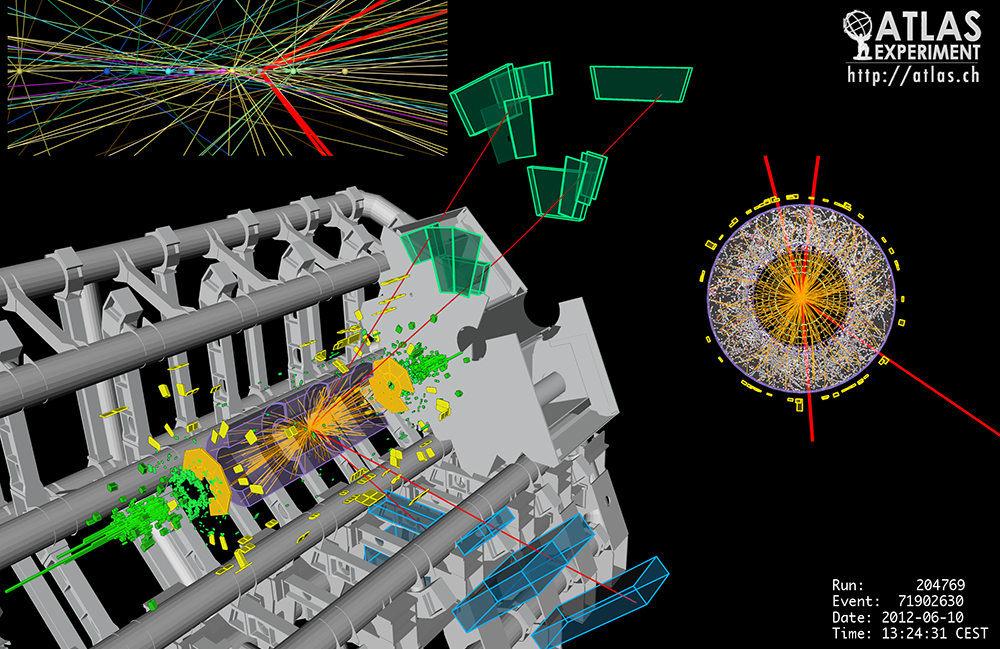
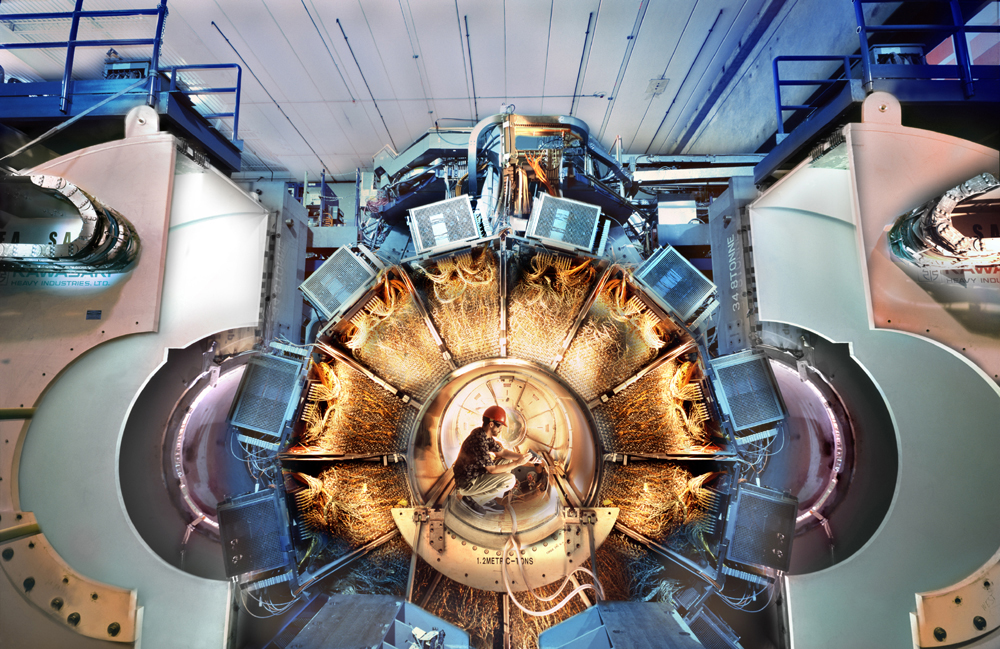
High energy physics is about to enter a new era, when the Large Hadron Collider, the most powerful proton accelerator ever built, will start operating at CERN (European Organization for Nuclear Research) near Geneva, allowing physicists to directly probe processes at energies higher than ever. The community of high energy physicists, we included, is thus turning its attention to the possible outcomes of this experiment.

Indeed, we have two promising clues that surprises are awaiting to be discovered within the new range of high energies that will be explored by the LHC. The first clue is related to the only missing piece of the Standard Model, the Higgs particle. This is an as-yet hypothetical particle, whose existence is predicted within the Standard Model. It provides us with an explanation of why the weak force, unlike all other forces, is very short-ranged. At the same time, it poses a puzzle: It requires – within the Standard Model – quite a conspiracy between seemingly unrelated forces to balance each other to an amazing accuracy so as to keep the Higgs as light as needed. This is called “the fine-tuning problem.” Such a miracle can be avoided, however, if new particles and interactions exist beyond the Higgs particle. Both the Higgs particle itself and the additional new particles are predicted to have masses light enough that they can be produced and observed in the LHC.

Another clue comes from cosmology. Some twenty percent of the energy of the universe comes from matter that does not shine (that is, electromagnetically neutral) but is much more massive than neutrinos. This type of matter, for which there are no candidates among the Standard Model list of elementary particles, has been named "Dark Matter." The cosmological and astrophysical observations are very suggestive that the mass of the dark matter particles should also be light enough that they can be produced and observed at the LHC. Thus, it is quite possible that the dark matter particles will be produced and identified in the LHC, and their properties measured in a way that will lead to complete understanding of this current puzzle in particle physics.

Our group is now in the process of learning and starting research on the physics of the LHC and of the dark matter. We have started a comprehensive investigation of what ATLAS and CMS, two of the LHC detectors can teach us about flavor physics, that is the interactions that distinguish between the different quarks.