Anti-Alzheimer¹s Drug Mechanism
Revealed With X-Rays
Using x-rays produced by the National Synchrotron Light Source at
Brookhaven National Laboratory, a team of scientists has gained new
insight into the effects of a newly approved drug, called
rivastigmine, in the treatment of Alzheimer¹s disease a
debilitating brain causing memory loss and other cognitive deficits
in about 10 percent of the elderly. The new results, which may
provide important information for generating improved drugs for this
as-yet incurable neurodegenerative disease, were published in the
March 19, 2002, issue of the American Chemical Society journal
Biochemistry.
³We were very
surprised by our results,² says Joel Sussman, a structural biologist
at the Weizmann Institute of Science in Rehovot, Israel, and the
lead author of the study. ³They show that we can safely treat
Alzheimer¹s disease with much lower quantities of rivastigmine, thus
minimizing unwanted adverse effects.²
Though the drug is currently available under the trade name
Exelon, its mechanism of action at the atomic level had not been
studied until now. So, the team of scientists, composed of Sussman¹s
team and scientists from Novartis, a pharmaceutical company based in
Basel, Switzerland, decided to take a close look at how the drug
helps to slow the memory loss of Alzheimer¹s patients.
One of the main pathological phenomena in Alzheimer¹s disease is
the deterioration of nerve cells releasing acetylcholine, a chemical
that helps to carry messages among brain cells. The inadequate
supply of acetylcholine in Alzheimer¹s patients is compounded by the
action of an enzyme called acetylcholinesterase (AChE), which breaks
down acetylcholine in the body at the rapid rate of 20,000 molecules
per second.
The desired effect of potential Alzheimer¹s treatments, such as
rivastigmine, is to inhibit AChE long enough to offset the absence
of acetylcholine. But rivastigmine and other anti-Alzheimer¹s drugs
have side effects and may merely slow deterioration rather than halt
it.
To look at the action of the drug over time, Israel Silman, a
neurochemist at the Weizmann Institute of Science and a
co-investigator on the study, together with Pazit Bar-On, a joint
graduate student with Sussman and Silman, tested the drug on various
types of AChE, extracted from an electric ray, the fruit fly, and
human beings. ³We wanted to see how long it takes AChEs to go back
to normal, or become Œreactivated,¹ after being inhibited by the
drug,² Silman says.
The scientists were very surprised to notice an ³extremely low
reactivation² of the AChEs from all three organisms. ³Inhibition of
AChE by rivastigmine appears to be almost irreversible, with little
reactivation over a period of days,² Silman says.
To explain what happens at the molecular level, the scientists
took ³snapshots² of rivastigmine while it was binding to AChE, using
a method called x-ray crystallography. They projected x-rays
produced by Brookhaven National Laboratory¹s National Synchrotron
Light Source (NSLS) on crystals of rivastigmine combined with AChE.
They then determined the structure of the complex rivastigmine-AChE
by looking at how the x-rays scattered off the crystal. By
reconstructing the positions of these scattered x-rays, the
scientists established a molecular map that revealed the locations
of all the atoms of AChE and rivastigmine in three dimensions.
³When we looked at this map, things became clearer,² Sussman
says. ³We had suspected that rivastigmine was binding very tightly
to AChE, preventing surrounding fluid mainly water from breaking
this bond quickly, as it usually does.²

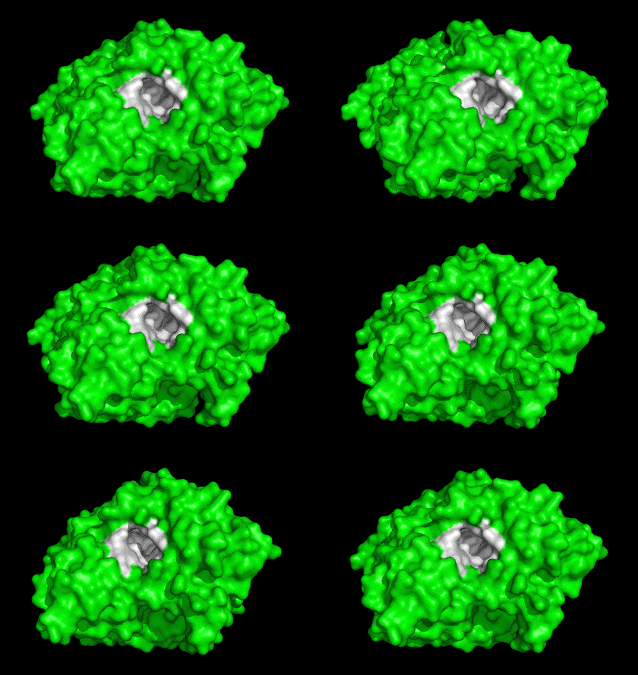
By looking closely at the AChE ³active site² the part to which
rivastigmine binds to AChE Sussman and his colleagues noticed that
rivastigmine was broken in two, each part being ensconced
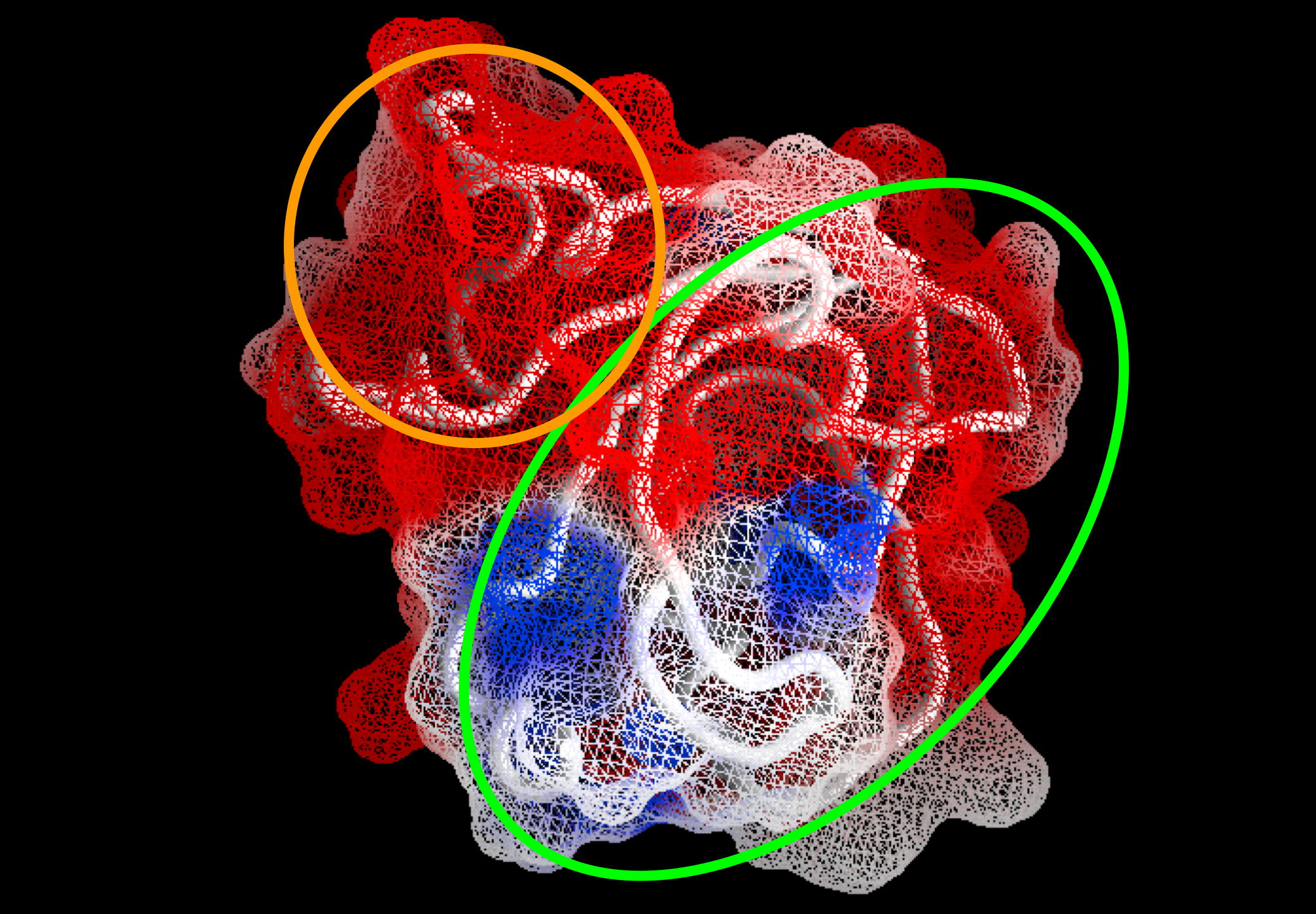
comfortably in the active site (Figure 1). The scientists also
precisely determined how each part was bound to the surrounding AChE
atoms and moved other AChE atoms, which slowed down reactivation of
AChE (Figure 2).

³The x-ray molecular maps allow us to see how every atom of
rivastigmine interacts with the atoms of AChE¹s active site,² Silman
says. ³This information will be important in designing new chemicals
that will target specific atomic sites in AChE, possibly leading to
better drugs that last longer and have less undesirable effects on
Alzheimer¹s patients.²
³I am very excited by the perspectives offered by these results,²
Sussman says. ³By fine-tuning the properties of anti-Alzheimer¹s
drugs or their targets at the molecular level, we can truly hope to
find a cure for Alzheimer¹s disease in the future.²
- BEAMLINE
- X12C
-
- PUBLICATION
- P. Bar-On, et al., "Kinetic
and Structural Studies on the Interaction of Cholinesterases with
the Anti-Alzheimer Drug Rivastigmine," Biochemistry,
41, 3555-3564 (2002).
SCIENCE WRITER: Patrice
Pages FOR MORE INFORMATION,
CONTACT: Joel Sussman or
visit http://www.weizmann.ac.il/~joel/
|