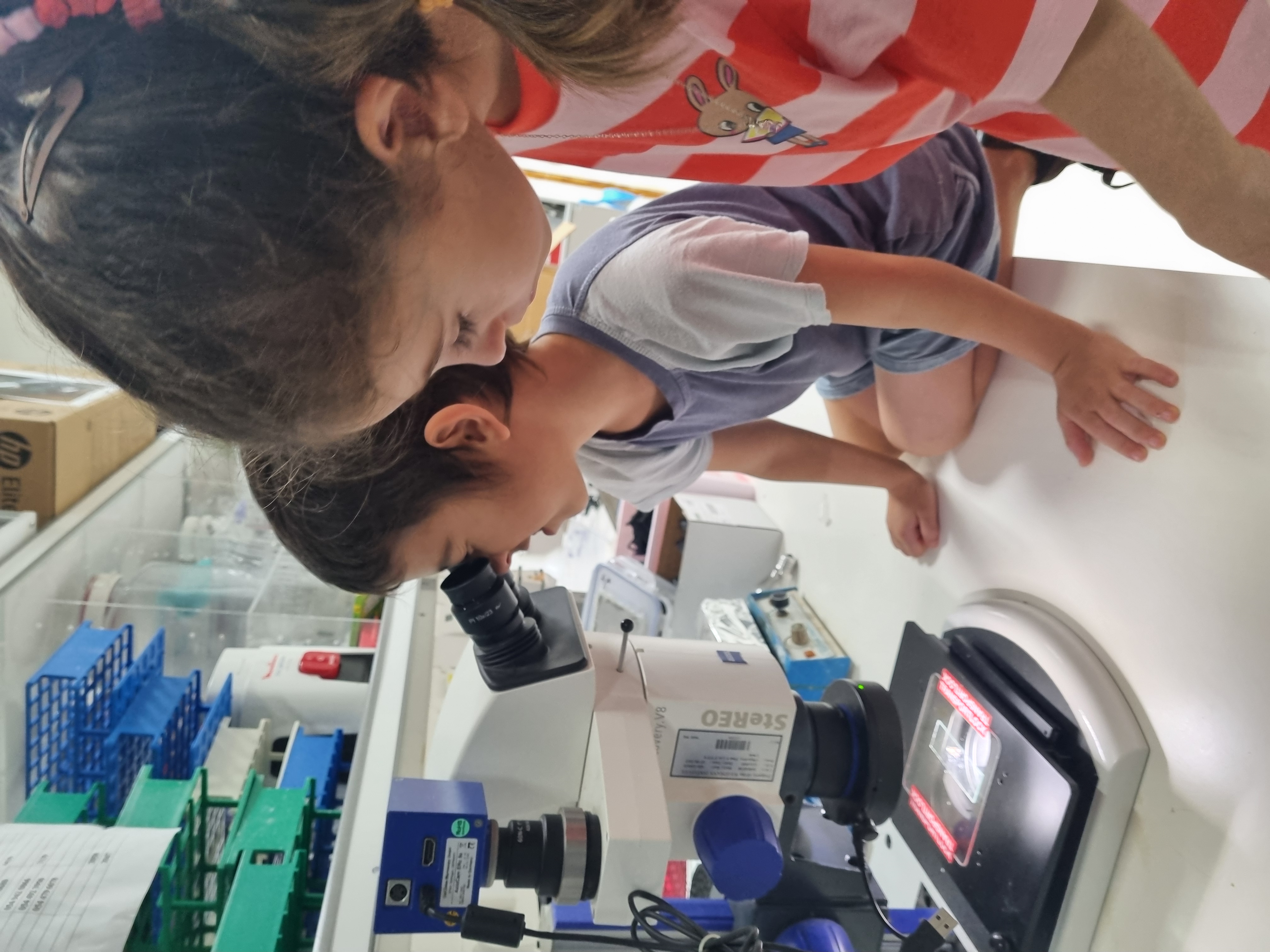



My group's major objective is to develop means of bridging the dynamics of biological discoveries and high-school biology education. The leading theme in my academic activities is to adapt practices employed by scientists to the practices by which students and teachers construct their knowledge within the discipline of biology. My hypothesis is that with proper adaptation, the rational reasoning and logic of research processes practiced within the academic scientific community can be embedded in the biology study programs in high school. My ongoing working approach to adapt practices employed by scientists for the teaching and learning of biology is in line with current calls to embody scientific practices into science teaching and learning.

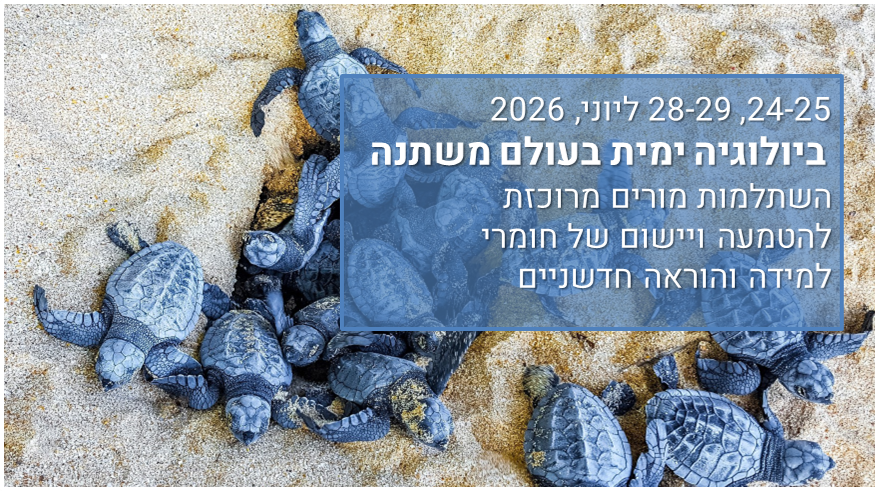
מורות ומורים לביולוגיה? הצטרפו אלינו להשתלמות מרתקת בת 4 ימים בנושא ביולוגיה ימית, עם הרצאות, סדנאות וסיורים מרתקים. ההשתלמות תתקיים בתאריכים 24-25.6, 28-29.6. שימרו ביומנים! פרטים יפורסמו בקרוב באתר ההשתלמות.
Shemi A., Vardi A. & Yarden A.
(2026)
Npj Climate Action.
5,
2.
Recognizing the ecological roles of microorganisms as drivers of marine biogeochemical cycles and how they are influenced by seawater pollution, warming, and acidification is essential to understanding climate change mechanisms and their global impacts. We call for updating current science teaching standards by linking microscale processes and macroscale dynamics in the context of marine ecosystems to promote ocean and climate literacy among the next generation.
Siani M. & Yarden A.
(2025)
Evolution: Education and Outreach.
18,
1,
1.
The teaching of evolution stands as a cornerstone in the realm of biological sciences, yet how best to frame and teach the complex web of concepts that are a part of evolutionary theory is still under debate. To address this issue, we propose two sequences for teaching the evolution ideas and concepts that are included in the Israeli curriculum for upper secondary school, starting from either the foundational principles of molecular genetics or the intricate dynamics of ecology or integrating both. This approach involves considering the strengths of both molecular genetics and ecology as frameworks for understanding evolution, recognizing that each perspective offers valuable insights that can enrich students' understanding of the topic. Molecular genetics is the area of evolutionary theory that relies on terms such as genes, alleles, and mutations. Ecology offers a broader, more holistic view of evolution and includes the dynamic interplay between organisms and their environment. The molecular genetics sequence focuses on the mechanism of evolution and the ecology sequence focuses on the external factors that affect the mechanism. This dual approach creates options for teachers; they can take into consideration each paths advantages and use the characteristics of their classes to choose one of the suggested perspectives or integrate both perspectives to teach evolution.
Ariely M., Salman A., Yarden A. & Alexandron G.
(2025)
International Journal of Science Education.
The educational landscape is rapidly evolving, driven by Generative Artificial Intelligence (GenAI) advancements. As GenAI transforms educational practices, a key area of impact is developing automatic scoring systems to efficiently and accurately assess students' problem-solving and explanation skills. This study introduces a novel prompt engineering strategy, Reflective Prompt Engineering (RPE), which applies iterative human-AI collaboration through discussion and reflection with a powerful LLM to enhance scoring performance. In RPE, human experts guide the AI by integrating its inferred criteria and language into subsequent prompts, enabling reflective alignment and improvement. We applied RPE to score open-ended biology items using analytic grading rubrics, evaluating its performance against two benchmarks: a BERT-based scoring model and multiple examples prompts with no discussion. Performance (accuracy and Cohen's Kappa) was assessed in two scenarios: within-item and cross-items. RPE achieved excellent agreement with human experts (Cohen's Kappa > 0.8) using only 40-60 examples and consistently outperformed the multiple examples strategy, achieving significantly higher Kappa values. Our findings highlight the potential of RPE to optimise AI alignment with human-designed tasks and open pathways for broader applications across diverse domains, advancing automated evaluation practices with enhanced precision and adaptability.