

Open-source language models
Dr. Leshem Choshen is working on collaborative development of large language models
New scientists
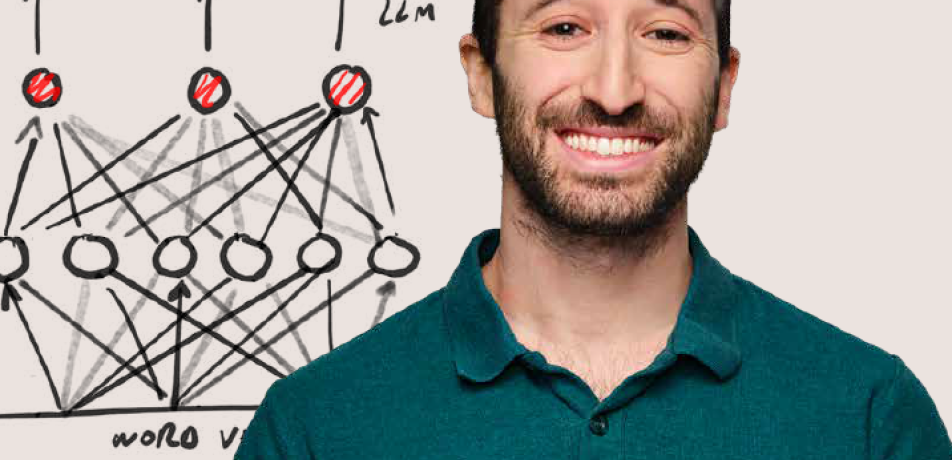
Will computers one day “think,” react, and interact with humans using language? Dr. Leshem Choshen, a new principal investigator who will join the Department of Computer Science and Applied Mathematics in September 2026, is helping make that happen.
Born and raised in Jerusalem, Dr. Choshen attended the Hebrew University Secondary School and later earned his BSc in computer science from the Hebrew University of Jerusalem. Both his MSc and PhD degrees, also completed at Hebrew University, focused on natural language processing (NLP)—a pillar of artificial intelligence research in which computers are taught to interpret, manipulate, and comprehend human language. While still a student, he worked on NLP research at IBM Israel.
Now a postdoctoral research fellow at the Computer Science and Artificial Intelligence Laboratory (CSAIL) at the Massachusetts Institute of Technology, he is working on a key aspect of NLP—large language models, which take a prompt and use probability to predict the most likely next word, and then the next, until they generate a response. Large language models (LLMs) are trained on vast amounts of existing written material—“10,000 human lives’ worth of text,” as Dr. Choshen puts it.
While he hopes that his artificial intelligence research will “make a lot of things easier and more efficient,” he is not without concerns. “If you have one technology that does everything, the person who controls the technology has immense power… They’ll use the technology for their own interests,” he muses.
Decentralizing power
This awareness is part of what drives Dr. Choshen’s deep commitment to collaborative models and development. He compares his work on collaborative LLMs to open‑source computer code, which is constantly evolving thanks to input from researchers, developers, and users.
“We used to find information using Google, but Google didn’t control the information itself. Now you have one source of information—a single answer to your question. By slightly skewing the answer, you can influence people’s opinions. That’s a lot of what is leading me to look at shared ownership, shared creation. These decentralize the creators’ power,” he explains.
Dr. Choshen is married to Michal, a lawyer. Once they return to Israel, they will likely begin the next chapter of their life in Weizmann campus housing, although whether they stay in Rehovot will depend partly on where she finds work.
With several job options open to him in Israel, Dr. Choshen ultimately opted for Weizmann. In his discussions before taking the position, he was impressed by the Weizmann Institute’s willingness to allocate resources to pure scientific research. He also appreciates the flexibility he will enjoy, in terms of what and when to teach to students, the freedom to reach out to industry, and the collegiality on campus—“there is a sense that people like each other,” he says.
Social science
Dr. Choshen is an active and enthusiastic social media user. Originally, he began posting simply because he noticed that there was very little science content in Hebrew. Then he realized that social media was fundamentally changing how knowledge was being disseminated, and he began posting items about his own work and that of colleagues.
He also has an experimental cooking channel on Instagram, combining food preparation with scientific explanations.
Social media is a “very strong tool in a world that is flooded with information. It’s a way to influence [people],” he says.
“I aspire to create links between people.”
EDUCATION AND SELECT AWARDS
• BSc (2016), MSc (2017), PhD (2022),
Hebrew University of Jerusalem
• Postdoctoral Fellow, MIT Computer Science and
Artificial Intelligence Laboratory-CSAIL (2023-2026)
• Pat Goldberg Memorial Best Paper Award from IBM (2018), Clore Scholars Programme (2019), Blavatnik Award for Most Promising PhD (2023), Fulbright Postdoctoral Fellowship (2023), Rothschild Postdoctoral Fellowship (2023), Best Dissertation Award from the Israeli Association for Artificial Intelligence (2023)