

Stopping cancer’s spread
How ‘niche’ research by Prof. Neta Erez may save lives
New scientists
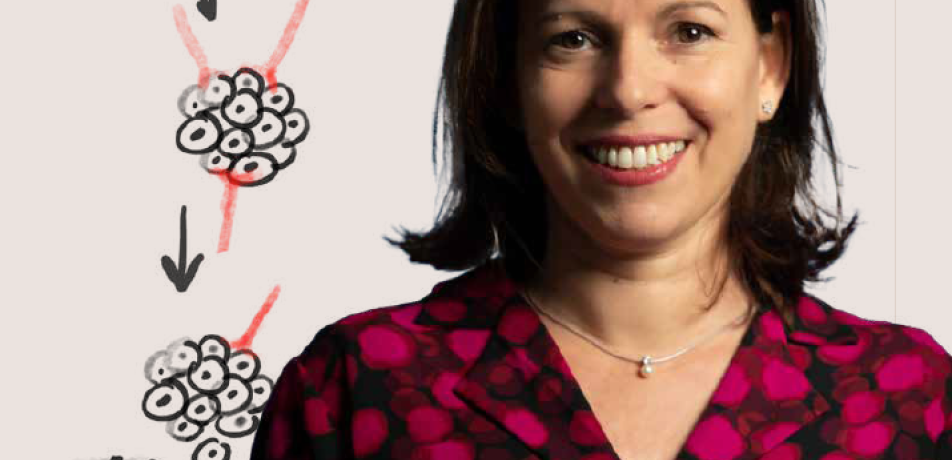
Can science transform cancer into a chronic, manageable disease? According to Prof. Neta Erez, the newest member of the Department of Systems Immunology, the answer to this question depends largely on how well we can learn to fight metastasis―the spread of cancer cells from the primary tumor to distant “niches” in other parts of the body. Metastatic relapse after initially successful treatment is heartbreaking and is the most common cause of cancer-related death.
“For most tumor types, once cancer has metastasized, there is no effective medical treatment,” says Prof. Erez, whose work has led to discoveries related to metastasis as it occurs in breast cancer and melanoma, among other tumor types. “In my lab, we examine the very beginning of this process, in hopes of finding a way to prevent metastases from taking root.”
Early beginnings
Prof. Erez grew up in Ness Ziona, not far from the Weizmann campus. The daughter of a biology teacher, she remembers examining onion layers and plant leaves through a simple microscope her mother brought home from school. She began her studies at the Hebrew University of Jerusalem’s Faculty of Agriculture in Rehovot, where she planned to study animals. Then, a summer job in the lab of physician-scientist Prof. Irun Cohen at the Weizmann Institute sparked her fascination with immunology. Embarking on a master’s degree at Weizmann, her first rotation was in the lab of Prof. Adi Kimchi, who “blew her mind” by introducing her to the molecular biology of cancer.
“From that moment on, I knew I wanted to be a research scientist,” Prof. Erez recalls, adding that having two female advisors―Prof. Kimchi during her graduate studies and Prof. Varda Rotter, who, together with Prof. Cohen, supervised her PhD―had a significant impact on her.
“I was lucky to have role models of women who successfully combined family life with outstanding research,” Prof. Erez says.
“This served me well as I left for San Francisco to pursue a postdoctoral fellowship, which can be a kind of glass ceiling for women in science. Navigating the challenges of combining science and motherhood, I returned to Israel at the end of my postdoc with my two small children. Becoming a successful scientist sometimes requires all the stars to align.”
Continuing collaborations
In 2010, Prof. Erez was hired as an Assistant Professor at Tel Aviv University’s Faculty of Medicine, rising through the ranks to become a Full Professor in 2021. While there, she developed unique murine models that enable the characterization of organ-specific dynamics contributing to metastasis progression and affecting response to anti-cancer therapies. Currently serving as the President of the Israeli Society for Cancer Research, Prof. Erez was recently named the President of the US-based Metastasis Research Society, a position she will hold from 2026 to 2028. She is also the co-author of three patents related to innovative immunotherapy compounds and treatment methods.
As she joins the Weizmann Institute faculty, Prof. Erez looks forward to continuing longstanding collaborations. In the wake of the ballistic missile strike on the Weizmann campus in June of 2025, the Institute is renting temporary lab space for Prof. Erez in the nearby Science Park until her permanent building on campus is fully repaired and operational.
“I’ve done joint research with a number of Weizmann scientists and am very excited to join them in Rehovot,” she says. “Not only will this give me access to the Institute’s terrific infrastructure, but it will also open up new opportunities as I become part of this great cancer research community once again.”
EDUCATION AND SELECT AWARDS
• BSc, magna cum laude, Hebrew University of Jerusalem, Faculty of Agriculture (1992)
• MSc, magna cum laude (1997) and PhD (2004), Weizmann Institute of Science
• Postdoctoral Fellow, Weizmann Institute (2004‑2005) and University of California, San Francisco (2005-2010)
• European Research Council Starting Grant (2015), Tel Aviv University Dean’s and Rector’s Awards for Excellence in Teaching (2016, 2019, and 2023), Nature Research Award for Mentoring in Science (2020), Melanoma Research Alliance Established Investigator Award (2021), Kadar Award for Outstanding Research from Tel Aviv University (2024)
APPOINTMENTS
• Assistant Professor (2010-2018), Associate Professor (2018-2021), Full Professor (2021‑2026), Tel Aviv University
• Vice Dean for Excellence in Preclinical Teaching & Mentoring, Tel Aviv University (2022-2026)