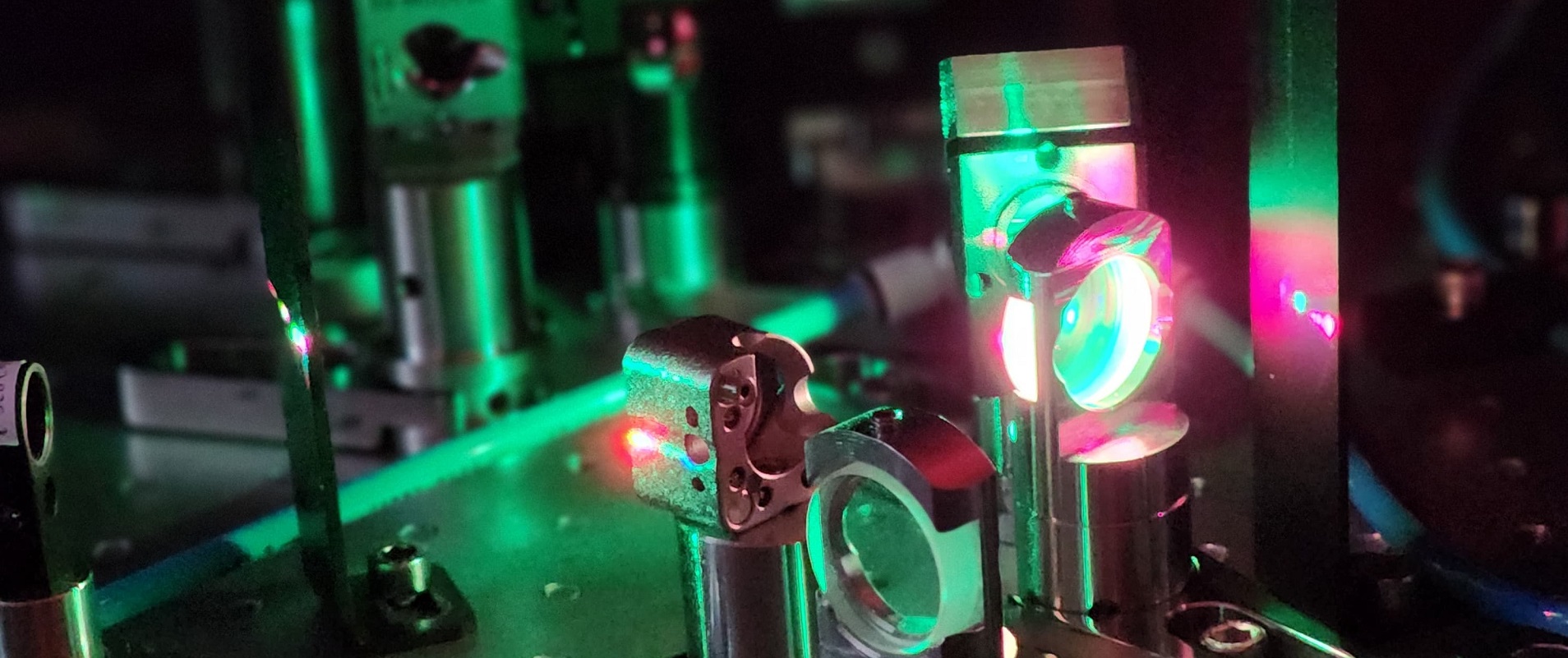
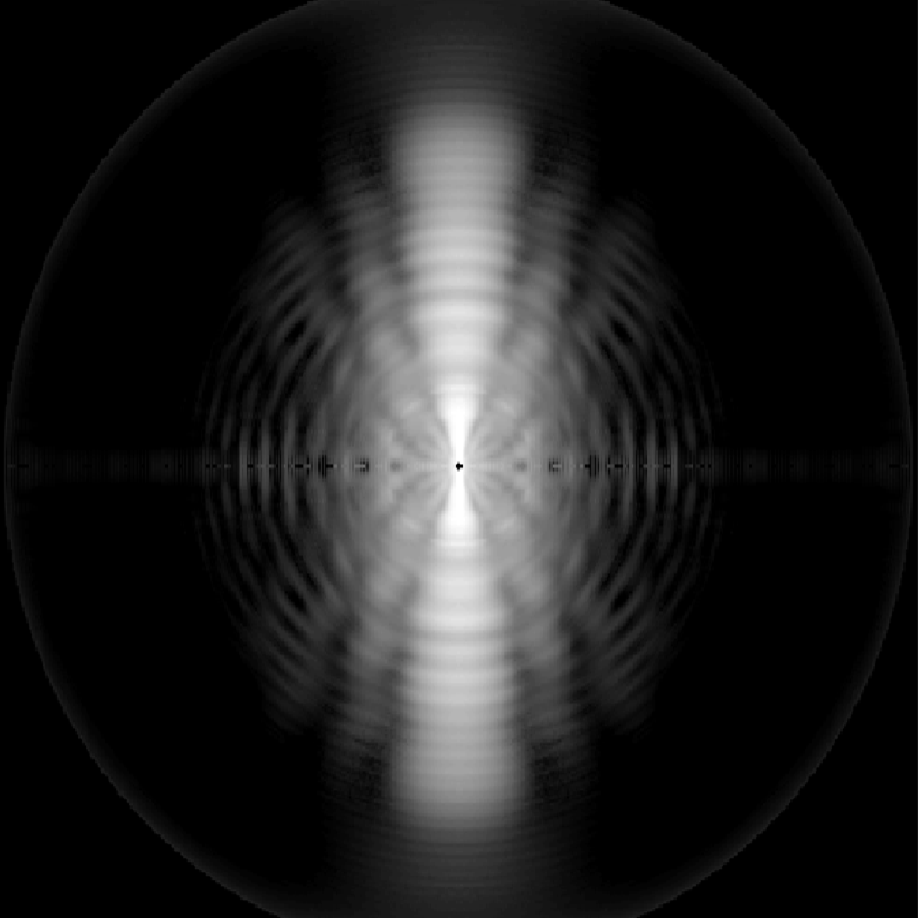
Our group studies basic phenomena in strong field light-matter interactions, focusing on the generation and measurement of attosecond processes. We develop new approaches to observe these phenomena and manipulate their evolution in time and space.
Bruner B. D., Maksimenka R., Thiré N., Faeyrman L., Weiss R., Avni N., Arusi-Parpar T., Pertot Y. & Dudovich N.
(2025)
Scientific Reports.
15,
1,
34438.
High-harmonic generation (HHG) spectroscopy enables the observation of fundamental ultrafast phenomena in nature. Recent advances in laser technology have led to the development of wavelength tunable ultrashort light sources, allowing the study of a wide variety of systems-from complex molecules to condensed matter. However, achieving broad control in key laser parameters-such as wavelength, pulse duration, and peak intensity-remains a significant challenge. We present an advanced, optical parametric chirped pulse amplifier (OPCPA) source, pumped by a single Yb:YAG laser at 50 kHz, which generates simultaneous and fully independent outputs in both the short-wave infrared (SWIR) and mid-infrared (MIR). In the SWIR, the output is optimized for two distinct wavelengths, producing pulses with a peak power of up to 17 GW centred at 2.1 µm (350 µJ, 21 fs) or 10 GW centred at 1.75 µm (420 µJ, 40 fs). In the MIR, the OPCPA delivers up to 57 µJ, with pulse durations as short as 48 fs and tunability from 2.5 to 7.6 µm. We demonstrate the systems versatility by tailoring the laser parameters to optimize high-harmonic generation across a broad range of band gap energies in solid-state materials. In the SWIR, XUV measurements are performed at high repetition rates, overcoming the typical challenges of operating in high-vacuum environments under such conditions. In the MIR, we demonstrate that temporal pulse shaping can optimize harmonic emission while simultaneously suppressing deleterious nonlinear effects induced by the strong driving field. With its unique combination of wavelength tunability and peak power at high repetition rates, this OPCPA opens up exciting possibilities for expanding the boundaries of strong-field physics and attosecond science.
Kneller O., Mor C., Klimkin N. D., Yaffe N., Krüger M., Azoury D., Uzan-Narovlansky A. J., Federman Y., Rajak D., Bruner B. D., Smirnova O., Patchkovskii S., Mairesse Y., Ivanov M. & Dudovich N.
(2025)
Nature Photonics.
19,
2,
p. 134-141
15734.
Attosecond transient absorption resolves the instantaneous response of a quantum system as it interacts with a laser field, by mapping its sub-cycle dynamics onto the absorption spectrum of attosecond pulses. However, the quantum dynamics are imprinted in the amplitude, phase and polarization state of the attosecond pulses. Here we introduce attosecond transient interferometry and measure the transient phase, as we follow its evolution within the optical cycle. We demonstrate how such phase information enables us to decouple the multiple quantum paths induced in a light-driven system, isolating their coherent contribution and retrieving their temporal evolution. Applying attosecond transient interferometry reveals the Stark shift dynamics in helium and retrieves long-term electronic coherences in neon. Finally, we present a vectorial generalization of our scheme, theoretically demonstrating the ability to isolate the underlying anomalous current in light-driven topological materials. Our scheme provides a direct insight into the interplay of light-induced dynamics and topology. Attosecond transient interferometry holds the potential to considerably extend the scope of attosecond metrology, revealing the underlying coherences in light-driven complex systems.
Krüger M. & Dudovich N.
(2024)
Ultrafast Electronic and Structural Dynamics
.
Ueda K.(eds.).
p. 45-71
In this chapter, we introduce all-optical attosecond interferometry using high-harmonic generation (HHG). Interferometry provides an access to phase information, enabling the reconstruction of ultrafast electron dynamics with attosecond precision. We discuss two main pathwaysinternal and external attosecond interferometry. In internal interferometry, the manipulation of quantum paths within the HHG mechanism enables phase-resolved studies of strong-field processes, such as field-induced tunneling. In external interferometry, the phase of the light emitted during the HHG process can be determined using optical interference in the extreme-ultraviolet regime. Both pathways have significantly progressed the state of the art of ultrafast spectroscopy, as evidenced by numerous examples described in this chapter. All-optical attosecond interferometry is applicable to a wide range of systems, such as atomic and molecular gases and condensed-matter systems. Combining the two pathways has the potential to access to hitherto elusive ultrafast multi-electron and chiral phenomena.