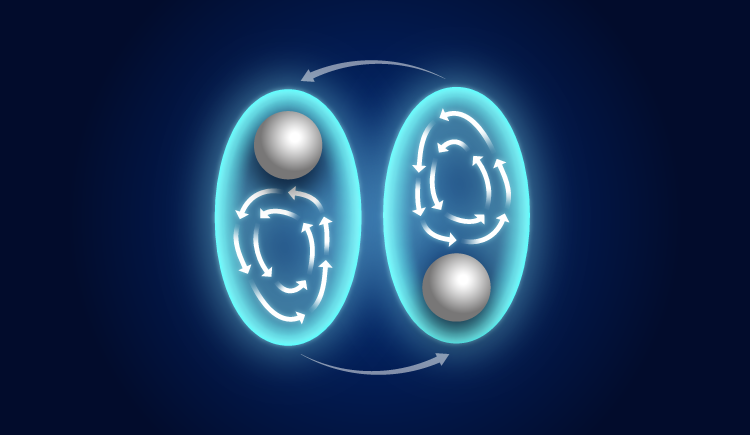
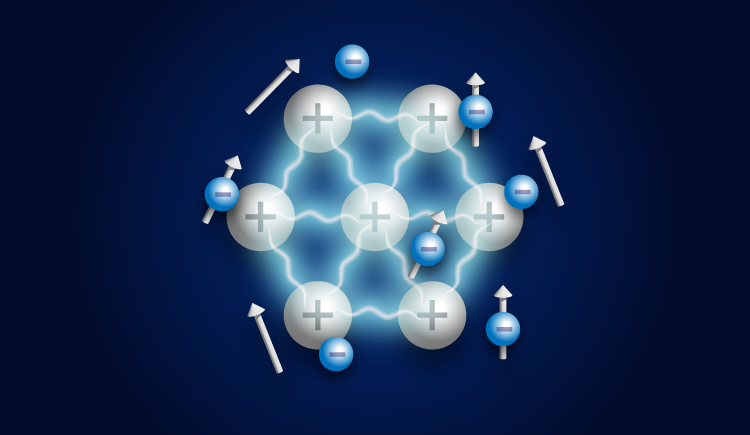
Our group's research focuses on exotic phases of quantum condensed matter. Microscopically, they are comprised of electrons but exhibit properties that belie these humble ingredients. Their excitations may carry fractional quantum numbers or obey exchange statistics that are neither bosonic nor fermionic. An essential question is how to 'get fractions by combining integers' and what conditions may prompt a microscopic system to do so. We address this challenge by deriving and applying duality relations. The best-known experimental system exhibiting such phenomena is the fractional quantum Hall effect, which is a central part of our work. Additionally, we use insights and techniques developed there to predict new phases of matter in other topological systems and quantum magnets.
Kim J., Shaer A., Kumar R., Ilin A., Watanabe K., Taniguchi T., Stern A., Mross D. F. & Ronen Y.
(2026)
arXiv.org.
Even-denominator quantum Hall states can host several types of anyons with distinct exchange statistics. Depending on the anyon type, exchanging two quasiparticles can impart a phase to the manybody wave function or even transform it into a different state. Here, we realize a gate-tunable FabryPérot interferometer with an embedded antidot that provides local control over the number of anyons within the interference loop. By independently tuning the magnetic field, carrier densities acrossthe device, and the antidot potential, we access regimes in which localized anyons form reproducibly and measure the associated statistical phases eiθbraid . We resolve braiding phases of θbraid = π and θbraid =π2, which we attribute to e/2 quasiparticles encircling either e/2 or e/4 quasiparticles, respectively. We further observe switching between different anyon occupancies of the antidot over time, directly resolving individual anyon tunnelling events into the interference loop. Similar behavior occurs at filling factor one third. Our work addresses one of the two key challenges in observingnon-Abelian braiding, which requires control of both localized and interfering anyon types.
Haug A., Kumar R., Firon T., Yutushui M., Watanabe K., Taniguchi T., Mross D. F. & Ronen Y.
(2026)
Physical Review X.
16,
011039.
Topological and crystalline orders of electrons both benefit from enhanced Coulomb interactions in
partially filled Landau levels. In bilayer graphene (BLG), the competition between fractional quantum
Hall liquids and electronic crystals can be tuned electrostatically. Applying a displacement field leads to
Landau-level crossings, where the interaction potential is strongly modified due to changes in the orbital
wave functions. Here, we leverage this control to investigate phase transitions between topological and
crystalline orders at constant filling factors in the lowest Landau level of BLG. Using transport
measurements in high-quality hBN-encapsulated devices, we study transitions as a function of
displacement field near crossings of N = 0 and N = 1 orbitals. The enhanced Landau-level mixing near
the crossing stabilizes electronic crystals at all fractional fillings, including a resistive state at ν = 1/3 and a
reentrant integer quantum Hall state at ν = 7/3. On the N = 0 side, the activation energies of the crystal and
fractional quantum Hall liquid vanish smoothly and symmetrically at the transition, while the N = 1
transitions out of the crystal appear discontinuous. Additionally, we observe quantized plateaus forming
near the crystal transition at half filling of the N = 0 levels, suggesting a paired composite fermion state
stabilized by Landau level mixing
Kim J., Dev H., Shaer A., Kumar R., Ilin A., Haug A., Iskoz S., Watanabe K., Taniguchi T., Mross D. F., Stern A. & Ronen Y.
(2026)
Nature.
649,
8096,
p. 323-329
Position exchange of non-Abelian anyons affects the quantum state of their system in a topologically protected way1. Their expected manifestations in even-denominator fractional quantum Hall (FQH) systems offer the opportunity to directly study their unique statistical properties in interference experiments2. Here we present the observation of coherent AharonovBohm interference at two even-denominator states in high-mobility bilayer-graphene-based van der Waals (vdW) heterostructures by using the FabryPérot interferometry technique. Operating the interferometer at a constant filling factor, we observe an oscillation period corresponding to two flux quanta inside the interference loop, ΔΦ = 2Φ0, at which the interference does not carry signatures of non-Abelian statistics. The absence of the expected periodicity of ΔΦ = 4Φ0 may indicate that the interfering quasiparticles carry the charge e*=12e or that interference of e*=14e quasiparticles is thermally smeared. Notably, at two hole-conjugate states, we also observe oscillation periods of half the expected value, indicating interference of e*=23e quasiparticles instead of e*=13e. To investigate statistical phase contributions, we operated the FabryPérot interferometer (FPI) with controlled deviations of the filling factor, thereby introducing fractional quasiparticles inside the interference loop. The resulting changes to the interference patterns at both half-filled states indicate that the extra bulk quasiparticles carry the fundamental charge e*=14e, as expected for non-Abelian anyons.