
COVID-19: Where will COVID-19 strike next?
In December 2019, a novel coronavirus was isolated after a cluster of patients in China were diagnosed with pneumonia of unknown cause1. This new isolate was named ‘SARS-CoV-2’ and is the cause of the disease COVID-19. The virus has led to an ongoing outbreak and an unprecedented international health crisis. The number of infected people is rapidly increasing globally and most probably is a vast underestimation of the real number of patients worldwide, as infected people are contagious even when minimally symptomatic or asymptomatic. The spread of the disease has presented an extreme challenge to the international community, and policy-makers from different countries have each chosen different strategies, depending on the local spread of the virus, healthcare-system resources, economic and political factors, public adherence, and their perception of the situation.
In December 2019, a novel coronavirus was isolated, after a cluster of patients in China were diagnosed with pneumonia of unknown cause1. This new isolate was named ‘SARS-CoV-2’ and is the cause of the disease COVID-19. The virus has led to an ongoing outbreak and an unprecedented international health crisis. The number of infected people is rapidly increasing globally and most probably is a vast underestimation of the real number of patients worldwide, as infected people are contagious even when minimally symptomatic or asymptomatic. The spread of the disease has presented an extreme challenge to the international community, and policy-makers from different countries have each chosen different strategies, depending on the local spread of the virus, healthcare-system resources, economic and political factors, public adherence, and their perception of the situation.
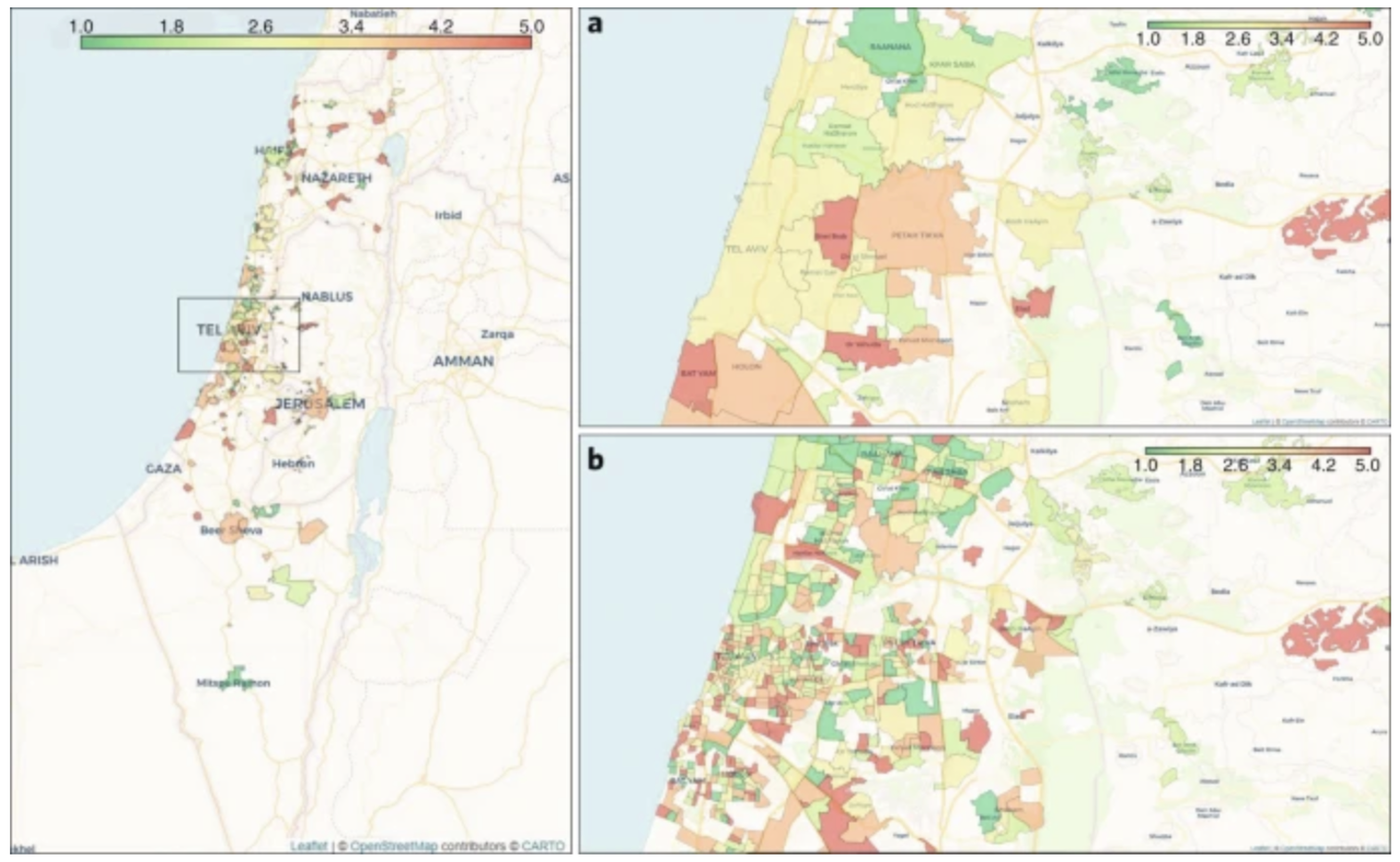
Figure 1: City municipal regions with at least 30 completed surveys and neighborhoods with at least 10 completed surveys are shown. The color of each region indicates a category defined by the average symptom ratio, calculated by averaging the reported symptom rate by responses in that city or neighborhood. The values were divided into five categories, and the color of each region indicates its associated category, from green (low symptom rate) to red (high symptom rate) (key). a, Area of Tel-Aviv and Gush-Dan with city regions. b, Area of Tel-Aviv and Gush-Dan with neighborhood regions. Map data are copyrighted by OpenStreetMap contributors and are available from https://www.openstreetmap.org. Publ. note: Springer Nature is neutral about jurisdictional claims in maps.
Key collaborations: Eran Segal
Publications
- Shoer S., Karady T., Keshet A., Shilo S., Rossman H., Gavrieli A., Meir T., Lavon A., Kilobkov D., Kalka I., Godneva A., Cohen O., Kariv A., Hoch O., Zer-Aviv M., Castel N., Sudre C., Ekka-Zohar A., Irony A., Spector T., Geiger B., Hizi D., Shalev V., Balicer R., Segal E. A prediction model to prioritize individuals for SARS-CoV-2 test built from national symptom surveys. Med (N Y), 2(2); 196-208. https://doi.org/10.1016/j.medj.2020.10.002 (2020)
- Shoer S., Karady T., Keshet A., Shilo S., Rossman H., Gavrieli A., Meir T., Lavon A., Kilobkov D., Kalka I., Godneva A., Cohen O., Kariv A., Hoch O., Zer-Aviv M., Castel N., Sudre C., Ekka-Zohar A., Irony A., Spector T., Geiger B., Hizi D., Shalev V., Balicer R., Segal E. Who should we test for COVID-19? A triage model built from national symptom surveys. MedRxiv. Doi: 10.1101/2020.05.18.20105569 (2020)
- Aharonov A., Shakked A., Baruch Umansky K., Savidor A., Kain D., Lendengolts D., Revach O. Y., Morikawa Y., Dong J., Levin Y., Geiger B., F. Martin J. and Tzahor E. ERBB2 drives YAP activation and EMT-like processes during cardiac regeneration. Nat.Cell.Biol., doi: 10.1038/s41556-020-00588-4 (2020).
* Pre-publication in bioRxiv. - Keshet A., Gavrieli A., Rossman H., Shilo S., Meir T., Karady T., Lavon A., Kolobkov D., Kalka I., Shoer S., Godneva A., Cohen O., Ekka Zohar A., Irony A., Geiger B., Dor Y., Balicer R., Shalev V., Segal E. The effect of a national lockdown in response to COVID-19 pandemic on the prevalence of clinical symptoms in the population. Eur.Psychiatry 28;63(1):e87 (2020) * Pre-publication in medRxiv.
- Keshet A., Gavrieli A., Rossman H., Shilo S., Meir T., Karady T., Lavon A., Kolobkov D., Kalka I., Shoer S., Godneva A., Cohen O., Ekka Zohar A., Irony A., Geiger B., Dor Y., Balicer R., Shalev V., Segal E., The effect of a national lockdown in response to COVID-19 pandemic on the prevalence of clinical symptoms in the population. medRxiv. doi: https://doi.org/10.1101/2020.04.27.20076000 (2020)
- Segal E., Zhang F., Lin X., King G., Shalem O., Shilo S., Allen W.E., Grad Y.H., Greene C.S., Alquaddoomi F., Anders S., Balicer R., Bauman T., Bonilla X., Booman G., Chan A.T., Cohen O., Coletti S., Davidson N., Dor Y., Drew D.A., Elemento O., Evans G., Ewels P., Gale J., Gavrieli A., Geiger B., Hajirasouliha I., Jerala I., Kahles A., Kallioniemi O., Keshet A., Landua G., Meir T., Muller A., Nguyen L.H., Oresic M., Ovchinnikova S., Peterson H., Rajagopal J., Ratsch G., Rossman H., Rung J., Sboner A, Sigaras A., Spector T, Steinherz R., Stevens I., Vilo J., Wilmes P. Building an International Consortium for Tracking Coronavirus Health Status. Nat. Med 26(8):1309 (2020) * Pre-publication in medRxiv.
- Segal E., Zhang F., Lin X., King G., Shalem O., Shilo S., Allen W.E., Grad Y.H., Greene C.S., Alquaddoomi F., Anders S., Balicer R., Bauman T., Bonilla X., Booman G., Chan A.T., Cohen O., Coletti S., Davidson N., Dor Y., Drew D.A., Elemento O., Evans G., Ewels P., Gale J., Gavrieli A., Geiger B., Hajirasouliha I., Jerala I., Kahles A., Kallioniemi O., Keshet A., Landua G., Meir T., Muller A., Nguyen L.H., Oresic M., Ovchinnikova S., Peterson H., Rajagopal J., Ratsch G., Rossman H., Rung J., Sboner A, Sigaras A., Spector T, Steinherz R., Stevens I., Vilo J., Wilmes P. Building an International Consortium for Tracking Coronavirus Health Status. medRxiv. doi: https://doi.org/10.1101/2020.04.02.20051284
- Rossman H., Keshet A., Shilo S., Gavrieli A., Bauman T., Cohen O., Blicer R., Geiger B., Dor Y., Segal E. A framework for identifying regional outbreak and spread of COVID-19from one-minute population-wide surveys. Nat.Med 26 (5):634-638 (2020)
* Pre-publication in medRxiv - Rossman H., Keshet A., Shilo S., Gavrieli A., Bauman T., Cohen O., Blicer R., Geiger B., Dor Y., Segal E. A framework for identifying regional outbreak and spread of COVID-19from one-minute population-wide surveys. medRxiv. doi: https://doi.org/10.1101/2020.03.19.20038844 (2020)