
Glaucoma
Glaucoma is a group of eye diseases that can lead to damage to the optic nerve. The optic nerve transmits visual information from the eye to the brain. Glaucoma may cause vision loss if left untreated. It has been called the "silent thief of sight" because the loss of vision usually occurs slowly over a long period. A major risk factor for glaucoma is increased pressure within the eye, known as intraocular pressure. This pressure is developing due to an accumulation of fluid at the front of the eye (a region called “the anterior chamber”) due to an imbalance between the “inflow” and “outflow” of fluid. (Key Recent Publications)
The Geiger group searched for novel approaches for increasing the outflow, thereby reducing excessive pressure.
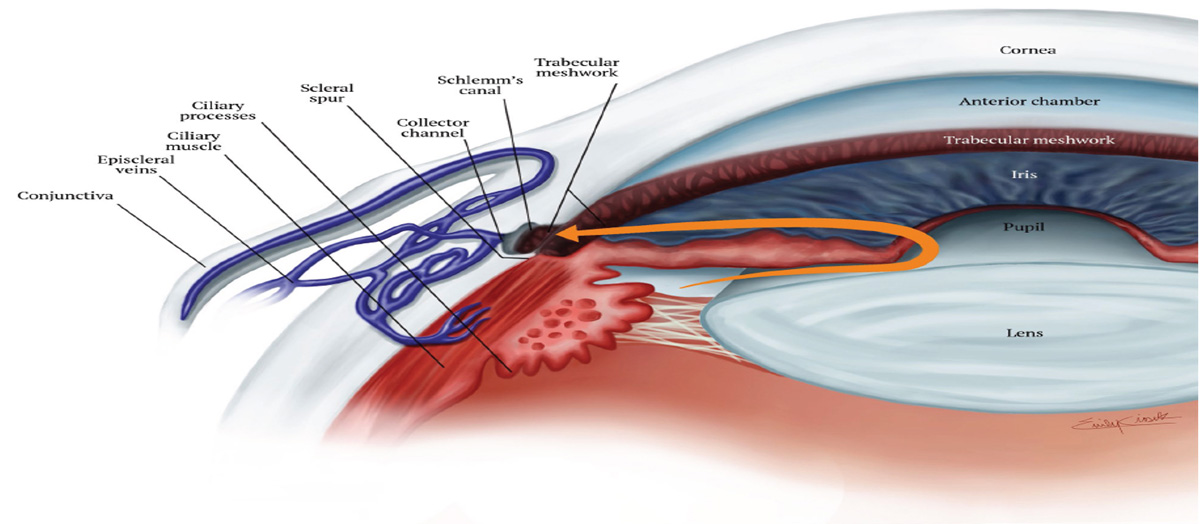
The figure on the left depicts the overall “journey” of the ciliary process across the iris, into the anterior chamber, and the exit of the fluid through the trabecular meshwork and the Schlemm’s canal. The study included a detailed analysis of the flow route, which demonstrated a major extension of Schlemm’s canal, induced by molecules that block actomyosin contractility (see the figure below).
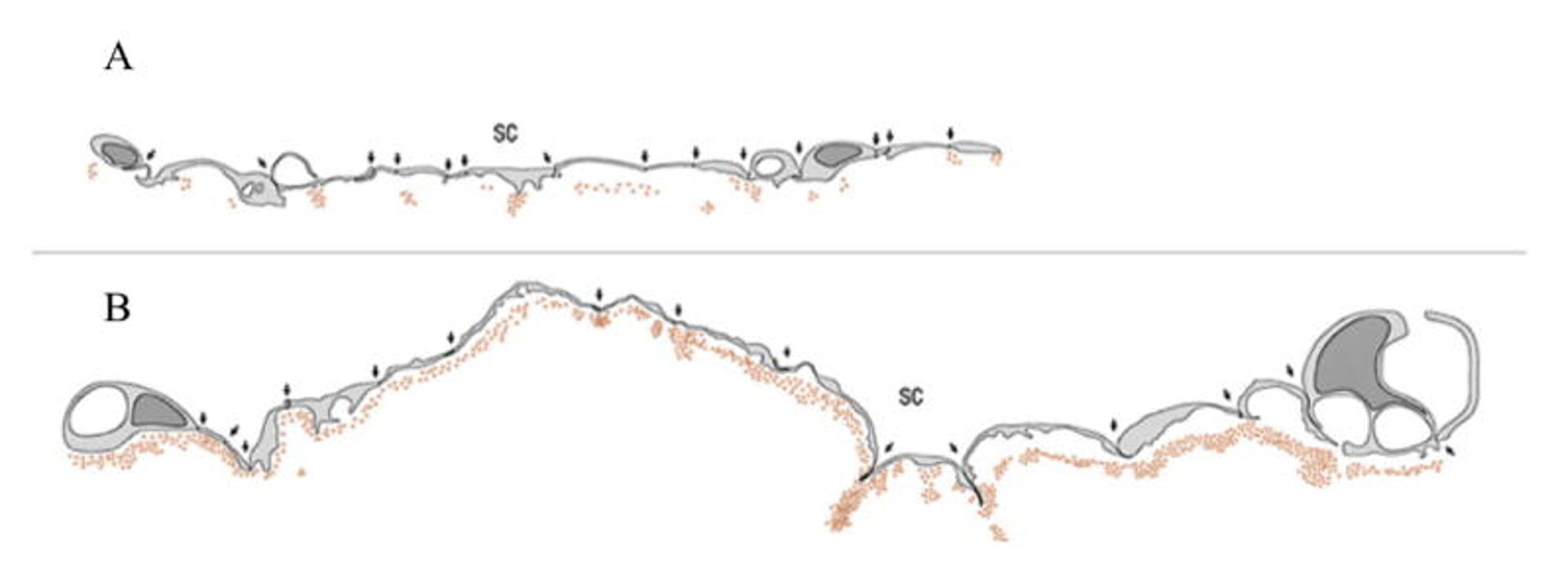
With this insight, the group, in collaboration with a leading ophthalmologist (Prof. Paul Kaufman, in Madison, WI), searched for drugs that might reduce actomyosin contractility, increase the outflow, and reduce the intraocular pressure. These studies led to a broad interest in Rho kinase inhibitors currently used for glaucoma therapy.
Main findings
- Screening for IOP-reducing inhibitors of myosin light chain kinase and Rho kinase
- In vivo recording of outflow rates
- Extensive drug screening for enhancement of outflow and reduction of IOP
Key collaborations: Paul Kaufman
Selected Publications
- Tian B, Gabelt BT, Geiger B and Kaufman PL. The cytoskeletal network of the trabecular meshwork. Encyclopedia of the Eye (Dartt DA, Ed). Oxford: Academic Press. Vol 1, 549-55 (2010)
- Grosheva I, Vittitow JL, Goichberg P, Gabelt BT, Kaufman PL, Borrás T, Geiger B, and Bershadsky AD. Caldesmon effects on the actin cytoskeleton and cell adhesion in cultured HTM cells. Exp. Eye Res. 82(6): 945-58 (2006)
- Gabelt BT, Hu Y, Vittitow JL, Rasmussen CA, Grosheva I, Bershadsky A, Geiger B, Borrás T and Kaufman P. Caldesmon transgene expression disrupts focal adhesions in HTM cells and increases outflow facility in organ-cultured human and monkey anterior segments. Exp Eye Res. 82(6): 935-44 (2006)
- Sabanay I, Tian B, Gabelt BT, Geiger B and Kaufman PL. Latrunculin B effects on trabecular meshwork and corneal endothelial morphology in monkeys. Exp Eye Res. 82(2): 236-46 (2006)
- Sabanay I, Tian B, Gabelt BT, Geiger B and Kaufman PL. Functional and structural reversibility of H-7 effects on the conventional aqueous outflow pathway in monkeys. Exp Eye Res. 78(1): 137-50 (2004)
- Liu X, Cai S, Glasser A, Volberg T, Polansky JR, Fauss DJ, Geiger B and Kaufman PL. Effect of H-7 on cultured human trabecular meshwork cells. Mol Vis. 7: 145-53 (2001)
- Sabanay I, Gabelt BT, Tian B, Kaufman PL and Geiger B. H-7 effects on the structure and fluid conductance of monkey trabecular meshwork. Arch Ophthalmol. 118(7): 955-62 (2000)
- Tian B, Geiger B, Epstein DL and Kaufman PL. Cytoskeletal involvement in the regulation of aqueous humor outflow. Invest Ophthalmol Vis Sci 41(3): 619-23 (2000)
- Peterson JA, Tian B, Geiger B and Kaufman, P.L. Effect of latrunculin-B on outflow facility in monkey. Exp Eye Res. 70(3): 307-13 (2000).