

Building and Remodeling Specialized Vascular Networks
Lymphatic to Blood Vessel Transdifferentiation
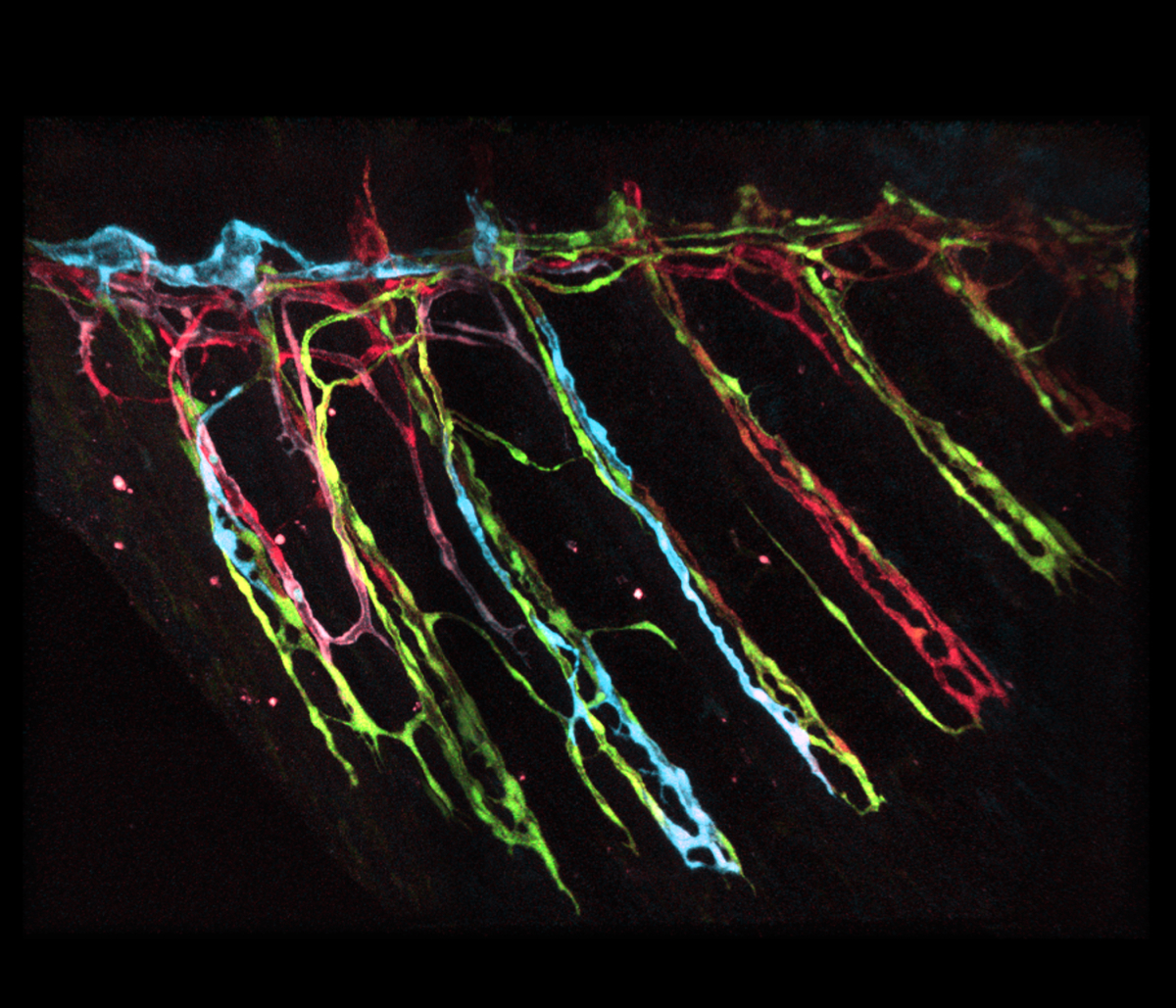
During zebrafish metamorphosis, the anal fin becomes rapidly vascularized by a specialized network of blood vessels. In our work, we discovered that these vessels do not arise from pre-existing blood vessels but instead form via transdifferentiation of lymphatic vessels. Using live imaging, lineage tracing, and single-cell analysis, we showed that lymphatic endothelial cells shift from a lymphatic to a blood vessel-like program. This process also occurs during adult fin regeneration, demonstrating that lymphatic vessels retain long-term plasticity throughout lifespan.
The transition from embryonic to adult venous circulation
In humans, the inferior vena cava forms through an intricate sequence of vessel fusion, regression, and replacement, and disruptions in this process can lead to congenital venous anomalies. In our recent work, we show that the key building blocks of this remodeling program are remarkably well conserved in evolution. Using zebrafish metamorphosis as an accessible in vivo window into post-embryonic vascular change, we reveal how an early life venous network is progressively rebuilt into a new, specialized main vein, offering a clear framework for understanding how large-scale venous remodeling is executed and how it can go wrong. Read more here.