|
Professor Gideon Berke |
Research Interests:
The Cytolytic T Lymphocyte : Cognitive and Effector Functions in Cancer
One theme of our research addresses the functions of the Cytolytic T Lymphocyte (CTL) in tumor immunity, with emphasis on the regulation of expression, function of the apoptotic death receptor Fas (CD95) of tumor cells and of FasL in CTL. Related to this is our interest in exploring CTL interactions with human tumor-specific antigens as a cancer detection means. Finally, we are interested in developing a test for predicting the sensitivity of human tumors to the action of specific chemotherapeutic drugs.
Tumor Immunity and Fas Expression
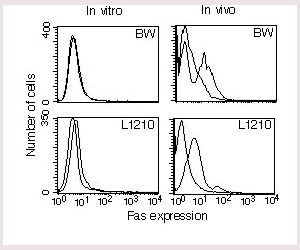
We have investigated how the death receptor Fas contributes to tumor immunity by studying the immune response of perforin-deficient (PO) mice against the progressor C57BL/6 Lewis lung carcinoma 3LL, which expresses no Fas when cultured in vitro. The results indicated that the perforin-independent, FasL/ Fas pathway of CTL/NK cells plays a role in acting against D122- and Kb39.5 (39.5) - high and low metastatic sub-lines, respectively, derived from the 3LL tumor. Although no membrane-bound Fas was detected on cultured D122 and 39.5 cells, cell surface Fas expression on both tumors was considerably up regulated when the tumors were grown in vivo. A similar enhanced expression of Fas was observed with a series of additional tumors injected into either syngeneic or allogeneic mice (Fig 1). In the absence of perforin, the induction of tumor specific immunity concomitantly with up-regulated Fas expression on tumor cells placed in vivo suggests that a Fas -based mechanism plays a role in tumor immunity.
Fas expression in tumor cells grown in vivo and in vitro Cultured L12 10 and BW tumor cells were injected into perforin knockout mice. After 3-4 days tumor cells grown in vivo and in vitro were stained with the Fas antibody Jo2, and analysed for Fas expression by flowcytometry.Immune Privilege and FasL: Two Ways to Inactivate Effector CTLs by FasL-Expressing Cells
The theory that FasL-expressing tumors are immune-privileged and can directly counterattack Fas-expressing effector T lymphocytes has recently been questioned and several alternative mechanisms have been proposed. To address this controversial issue, we analyzed the impact of FasL-expressing tumors on in vivo-primed CTLs and the mechanisms involved. CTLs were obtained from the peritoneal cavity (PEL) after in vivo priming with syngeneic or allogeneic murine tumor cells.
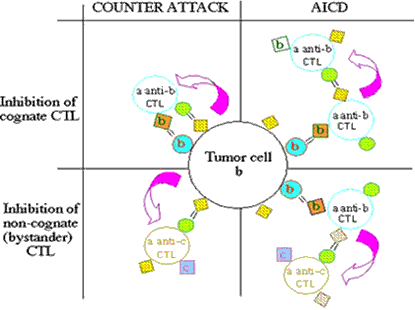
We have found that PEL populations undergo Fas-based apoptotic cell death when co-cultured with FasL-expressing tumor cells and that PEL destruction of cognate targets in a 51Cr release assay was markedly inhibited by the pre-exposure to either cognate or non-cognate tumor cells expressing FasL. Furthermore, cytocidal function of PEL was markedly inhibited by pre-incubation with FasL-negative tumor cells, if and only if they were the cognate targets of the CTL; this CTL inhibition involved FasL-Fas interactions. The killing function of "bystander" PELs, reactive to a third party target cell, was inhibited by co-cultivation with PELs mixed with their cognate target. This activation-induced CTL fratricide was not influenced by the expression of FasL on the cognate target cells. These studies demonstrate the existence of two distinct pathways whereby FasL-expressing cells inhibit in vivo-primed FasL-and Fas-expressing CTLs: (1) by FasL-based direct tumor counterattack, and (2) by FasL-mediated activation-induced cell death (AICD) of the CTLs (Fig. 2), which is consistent with the concept that FasL expression in vivo could play a role in inducing immune privilege.
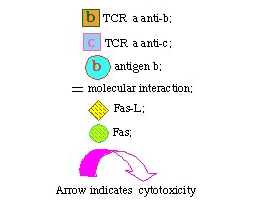
Inhibition of Tumor-Specific CTL Activity due to Counterattack and AICD. Specifically conjugated CTLs express more Fas and FasL (as well as auxiliary molecules) and become susceptible to AICD by cis or trans. They kill bystander effector CTLs (not conjugated to the cognate targets) since their Fas- FasL-based cytocidal potential is facilitated upon cognate TCR engagement. (Lietal., (2002). Immunology, in press.)Activation of Tumor -Specific T Cells by MHC-Peptide Complexes
The purpose of this study was to prove direct T cell activation induced by cognate MHC-peptide complexes. To this end we have developed a new approach for studying both binding to and activation of T cells by MHC-peptide complexes at the single cell level. We employed the CellScan, a non-flow cytometer designed for repetitive measurements of fluorescence intensity and polarization of individual cells. A melanoma-specific MART1 CTL line and a gp100-specific CTL clone were pre-incubated with specific and with control single-chain MHC-peptide tetramers and the fluorescence intensity and polarization were measured. Peptide-specific binding recorded by the CellScan was comparable to that monitored by flow cytometry. CellScan monitoring of the degree of fluorescence polarization of CTLs reacted with MHC complexes revealed activation of the CTLs, which was confirmed by cytokine production.
These results offer a new means for monitoring early T lymphocyte activation induced by bound cognate MHC-peptide complexes at the single cell level (in collaboration with Drs. Yoram Reiter and Yael Schiffenbauer, respectively of the Technion and Medis EL).
Tumor Sensitivity to Anti-Cancer Drugs at the Single Cell Level
This project is aimed at developing a test for determining tumor sensitivity to anti-cancer drugs, which is not based on tumor growth in vitro. To this end we have monitored changes in the fluorescence intensity and polarization of labeled cancer cells induced by anti-neoplastic drugs. T47D and T80 human breast cancer cell lines were exposed to anti-neoplastic drugs and the fluorescence properties of fluorescein diacetate (an indicator of cell viability), rhodamine 123 (an indicator of mitochondrial activity), and acridine orange- (for cellular DNA content) stained cells were measured. A strong correlation was found between growth inhibition induced by the commonly used anti-neoplastic drugs navelbine and 5-fluorouracil, and the changes in fluorescence intensity and polarization of cells stained with the different fluorochromes. Hyper-polarization of fluorescein diacetate as well as of rhodamine 123-stained cells occurred in conjunction with Annexin V binding and propidium iodide exclusion. This indicates that hyper-polarization, resulting from drug action, reflects early stages of apoptosis.
The new system for monitoring anti-cancer drug action is independent of tumor proliferation. Hence, it may serve as a method for determining sensitivity to drugs of cancer cells from fresh tumor biopsies (in collaboration with Drs. Y. Schiffenbauer and M. Chaitchik ).
Orit Gal-Gerber, Lab Aassistant