Through Bina, an innovative Weizmann technology has been licensed to US biotech company Vyriad
What began in 2019 as an expansion of Prof. Emeritus Menachem Rubinstein’s career-spanning efforts to develop gene therapy and other immunotherapies has now, with the assistance of Bina, been transformed into a licensed technology poised to make immunotherapy safer and more effective.
Prof. Rubinstein approached his Weizmann colleague and fellow protein-interaction enthusiast Prof. Gideon Schreiber to test his ideas. Dr. Diana Gataulin, a recent Weizmann alumna and research associate in the Shreiber lab, ran the experiments.
The trio of scientists realized early on that this newly developed “engager technology” might find use in multiple applications, including gene therapy, CAR-T cell therapy, and oncolytic virotherapy—an approach that recruits viruses to selectively kill tumor cells without harming healthy tissues. The scientists applied for patents through Yeda Research and Development, the Weizmann Institute’s technology transfer company.
The team then turned to the Bina unit, which identifies and nurtures the applicative potential of early-stage ideas. Bina staff provided a structured program and budgeting scheme, enabling the scientists to extend the application of their technology to create a platform for targeting multiple cancer types, thereby strengthening the patent application and positioning the product as a platform technology.
Says Dr. Gataulin, “Bina gave us a more translational perspective, as well as a clear framework and set of deliverables. They also arranged for us to meet with industry experts, who asked us the tough questions we would need to answer to make a successful sales pitch.”
In November 2024, Prof. Rubinstein and Dr. Gataulin presented their technology to Dr. Stephen Russell, the founder and CEO of Vyriad, Inc., a clinical-stage biotechnology company based in Rochester, Minnesota. Dr. Russell immediately realized it was a game changer in the field of CAR-T. Vyriad moved quickly, working with Yeda to secure a license while beginning to integrate the technology into its clinical development programs.
That process culminated in July 2025, when Vyriad signed an exclusive license agreement for the gene-delivery platform.
Next-gen treatment
This technology represents a next-generation advance in CAR-T cell therapy, a powerful treatment originally developed for blood cancers by the late Weizmann Prof. Zelig Eshhar, a pioneer in cancer research. Current CAR-T therapy is highly complex: immune T cells must first be removed from a patient’s blood, purified, and genetically modified in the laboratory using a specially engineered virus (a vector). These modified cells are then multiplied and infused back into the patient. The process can take several weeks, requiring chemotherapy and extended hospitalization, and is highly costly.
The newly licensed technology aims to simplify this process dramatically, making it affordable to many more patients. Instead of modifying T cells outside the body, it uses an “off-the-shelf” vector that is administered directly to the patient. Once in the bloodstream, the vector selectively targets only T cells. This precision is achieved through a specially engineered protein called an “engager,” which tightly coats the vector. The engager serves two critical functions: it blocks the vector from entering unwanted cells—including cancer cells—and directs it exclusively to T cells. As a result, the patient’s own T cells are equipped to fight tumor cells inside the body, without the need for chemotherapy.
Vyriad licensed this technology for use in immunotherapy applications, including in vivo CAR-T treatments, as well as for broader gene therapy applications. Clinical studies in multiple myeloma patients are expected to begin in 2027.
Founded in 2015 by Mayo Clinic physicians, Vyriad specializes in the engineering and delivery of anti-cancer viruses and is currently engaged in clinical trials and collaborations with Regeneron Pharmaceuticals and Novartis.

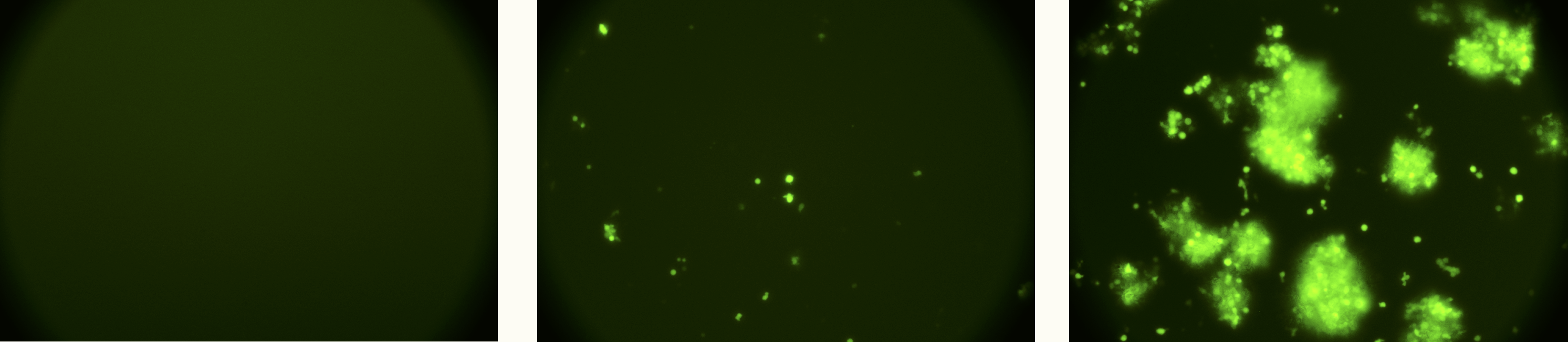
(At top) Activation of cancer-fighting CAR-T cells in multiple myeloma (l-r): Untreated (no activation); treated with a regular viral vector (minimal activation); treated with engager-coated vector (significant activation, leading to zero multiple myeloma cells in 21 days).
Bina is supported by Roberto and Renata Ruhman.
Prof. Gideon Schreiber is supported by the Abisch-Frenkel RNA Therapeutics Center, and the Jack, Joseph and Morton Mandel Foundation.