
We investigate the molecular mechanisms underlying neurodegeneration. We are particularly interested in understanding the neurogenetics and pathology of amyotrophic lateral sclerosis (ALS).
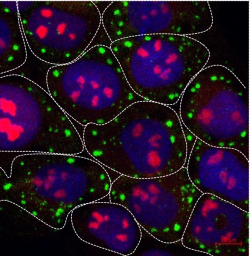
We use a multidisciplinary ‘systems’ approaches, including computational data science, machine learning, proteomics and transcriptomics. We use iPS cell-derived human disease-relevant brain cells, human biopsies and mouse genetics. We study RNA-related neuro-protective functions, explore the roles of biomolecular condensates in proteostasis and maps organelles in normal and disease biology.
We also translate the molecular mechanisms that underlie neurodegeneration into potential therapies. Finally, we develop cell-free biomarkers and test a small molecule therapies, based on our findings.