The biophysical basis of
the biological activity of Interferon

interferon receptor

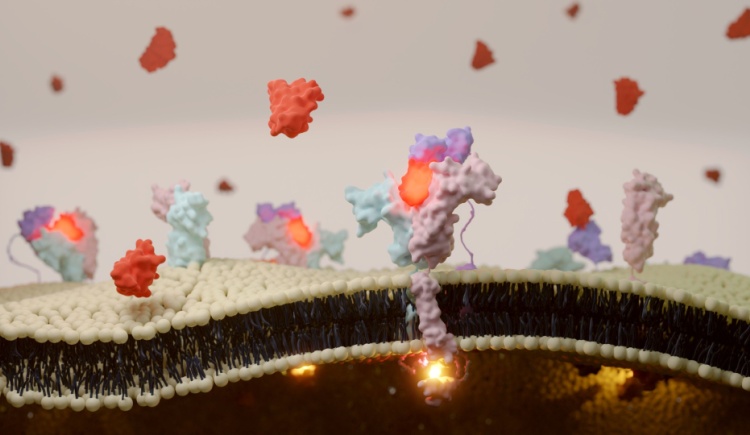
A second field of scientific activity utilizes biophysical tools to understand the relationship between a complex biological process and the protein-protein interactions which control it. The interferon induced cellular response to viral infection is a good paradigm for such study. In the sequence of host responses to viral infection, interferon (IFN) rapidly confers local protection, before stimulating second line defenses e.g. T cell response, macrophage barrier. The IFN system is unique in the sense that a single receptor complex binds many different ligands (15 in human), thus making a cytokine network by itself. The importance of this network is outlined by the fact that all living species having an IFN system diversified their ligands.

Activation of the IFN response is mediated through binding of the ligand to two cell surface receptors, ifnar1 and ifnar2. Despite this seemingly simple activation pattern it was found that different IFN subtypes cause a phenotypically different response. The mechanism underlying this differential response is not well understood, but presumably is related to differences in recognition and recruitment of receptors by different IFNs. We were intrigued to investigate the structural and biophysical diversity in ligand-receptor interactions that promotes this differential biological response. Most of the work described here relates to the interaction of ifnar2 with IFN2 or IFN. In the future we intend to investigate the ternary complex: ifnar1-IFN-ifnar2 as well as the interaction with other IFN subtypes.

  Investigating the IFN2-ifnar2 interaction

Initially we developed methodologies for expression in E.coli, refolding and purification of the 25 kDa, non-glycosylated extracellular domain of the ifnar2 receptor (ifnar2-EC) and the IFN2 ligand. The stoichiometry of ligand-receptor interaction was measured to be 1:1 at all concentrations (determined by gel filtration, chemical cross-linking and solid phase detection (Piehler & Schreiber 1999a)). The affinity of this interaction is 4 nM, which is similar to the affinity measured for the cell-surface bound ifnar2 receptor, and that of the soluble glycosylated receptor. This affinity was confirmed using a variety of kinetic and thermodynamic assays, including optical detection as BIAcore and RIfS, equilibrium titration and stopped-flow flourescence (Piehler & Schreiber 1999a). RIfS (Reflectometric interference spectroscopy) is a time-resolved detection method for biomolecules that was adjusted in our laboratory for monitoring label-free protein-protein interactions in heterogeneous phase (Piehler & Schreiber 2001).

While absolute kinetic and thermodynamic parameters of heterogeneous phase detection methods (like BIAcore) often do not agree with data from homogeneous phase methods, heterogeneous phase detection has proven to be very reliable for mapping relative changes upon mutation (1993; Albeck & Schreiber 1999; Piehler & Schreiber 2001).

Mapping the complete binding region of ifnar2 on IFN2 by means of introducing 36 individual mutations to Alanine and isosteric residues, indicated that the center of the binding site is the E-helix of IFN2 (which, until this study was not assumed to participate in binding), flanked by residues on the AB-loop and the A-helix (Piehler et al. 2000). Out of the six identified "hot spot" residues, four are located on the E-helix (Fig. 5a). Interestingly, the ifnar2 binding site overlaps the largest continuous hydrophobic patch on IFN2 (and vice versa - the IFN2 binding site on ifnar2 overlaps the largest hydrophobic patch on ifnar2) (Piehler et al. 2000). Yet, stopped-flow measurements have demonstrated that association of IFN-ifnar2 is fast and electrostatically driven (Piehler & Schreiber 1999a). Thus, hydrophobic interactions seem to play a significant role in stabilizing this interaction, with the charged residues contributing towards the rapid association of the complex (Piehler & Schreiber 1999a; Piehler et al. 2000). Relating the anti-viral and anti-proliferative activity of the various interferon mutants with their affinity towards ifnar2 results in a linear function over the whole range of affinities investigated (Fig. 5b), suggesting that ifnar2 binding is the rate determining step in cellular activation (Piehler et al. 2000).
Fig. 5. (A). The functional epitope for binding ifnar2 on IFN2 > 2 kcal/mol are colored red, of 0.5-2.0 kcal/mol are colored yellow, < 0.5 are blue (Piehler & Schreiber 1999b). Residue numbers and secondary structure elements are designated. (B) Correlation between affinity and the relative anti-viral or antiproliferative activity of IFN2 mutants (Piehler et al. 2000). (C). Relative antiviral and antiproliferative activity, ifnar2 binding affinity and cell surface binding affinity of mutant IFN2 proteins at the B and C-helix and CD-loop (unpublished results).

  Investigating non-ifnar2 active sites on IFN2

While ifnar2 is the ligand-binding subunit, ifnar1 may act as a species-specific transducer for the actions of type I IFN. The C-helix has been previously implicated in ifnar1 binding, and may be related to differential interferon activation. Therefore we mutated surface exposed residues on the B and C-helices and CD-loop in the search for differential biological activity which is not related to ifnar2 binding. Indeed, none of the over 20 mutations had any effect on ifnar2 binding as measured in RIfS. Interestingly, point mutations introduced along the B and C helices of IFN2 cause only moderate changes in antiviral activity or binding affinity, with the changes correlating with the affinity towards the cell surface receptors (Fig. 5 and GS unpublished). These moderate changes upon mutations are in stark contrast to the large changes observed for mutations of the ifnar2 binding site on interferon.

ifnar2 Fig. 6. Alanine scanning of IFN2 and IFN binding sites on ifnar2. Mutations which cause a decrease in binding affinity are colored yellow and red, mutations which cause an increase in affinity are green.

  IFN2 and IFN bind competitive to the same functional epitope on ifnar2, but with distinct centers for binding

An attractive explanation of differential activation caused by different interferons would be their mode of binding is they different, which would be translated into differential intracellular activation. We mapped the binding sites of IFN2 and IFN on ifnar2-EC by Ala scaning mutagenesis. These studies have revealed that IFN2 binds ifnar2 on loops 45-50, 78-82 and 102-106, with no interactions being mapped to the C-ter fibronectin like domain of the receptor (Fig. 6) (Lewerenz et al. 1998; Chuntharapai et al. 1999; Piehler & Schreiber 1999b).

Binding to domain I was confirmed by producing, and measuring binding of a truncated ifnar2-EC molecule which contains only domain I and the connecting loop (unpublished data). Although IFN2 and IFN bind competitively to the same functional epitope, mutational analysis revealed distinct centers of binding for these IFNs on ifnar2 (Fig. 6). Residues on ifnar2 which cause the largest decrease in IFN2 binding include Met 48, Glu 79 and Val 82, while mutations of these residues had only a moderate effect on IFN binding. Conversely, a mutation of Trp 102 proved to be the most destructive one for IFN binding (Piehler & Schreiber 1999b). This shift of the "hot spot" of the binding site may result in different angular orientation of the complexed receptor molecules, however, it could also reflect differences in the IFN2 versus IFN binding sites, with no implications on the structure of the complex (Roisman et al. 2001). Further studies are in progress to evaluate this point.

  Double-mutant cycle analysis of the IFN-ifnar2 complex
Fig. 7. Double-mutant-cycle analysis of the interaction between IFN2 and ifnar2. All measurements were done using RIfS. Blank spaces are of interactions which where not analyzed.

Following our identification of the binding sites on each protein, we probed the inter-protein interactions using double-mutant cycles. In the absence of a complex structure, we performed a systematic double mutant cycle analysis between 13 residues on IFN2 and 11 residues on ifnar2 (Roisman et al. 2001). Altogether, 90 double-mutant cycles were analyzed (Fig. 7). Five of them showed significant interaction energies above 2.5 kj/mol, including two salt bridges (R149-E79 and D35-K50), a H-bond between S152 and H78, one aromatic interaction (F27-Y45) and an interaction between R144 and M48 (the first residue is from IFN2 and the second from ifnar2). int between all other pairs of residues were significantly smaller than 2.5 Kj/mol. We deduce that these pairs of interacting residues are in close contact with each other.

  Modeling the structure of the IFN-ifnar2 complex

In the absence of an experimentally determined structure, there are numerous methodologies for docking two proteins. However, these algorithms rely on the high degree of similarity of the unbound and bound structures. This assumption cannot be made when an experimental structure, as in the case of ifnar2, is not available. For this case we developed a new docking algorithm (in collaboration with Prof. H. Scheraga (Cornell), which uses interprotein distance constraints as determined from double-mutant cycles as the driving force for docking (Roisman et al. 2001).

Those distance constraints have been implemented in a similar fashion as NMR constraints into the flexible docking program PRODOCK, with pairs of residues interacting with int>2.5 Kj/mol being assigned a maximal distance of 5 Å (the distance/energy relationship was determined from the analysis of 71 pairs of residues located on several protein systems, with 39 out of 42 interactions following this relation (Roisman et al. 2001). The docking algorithm was trained on the interaction between barnase and barstar, using a variable number of distance constraints for docking. Starting with the unbound structures, the RMSD of the modeled complex was in the range of 2 Å relative to the complex structure (Buckle et al. 1994).
Fig. 8. Structure of the IFN2 - ifnar2 complex as modeled using distance-constraint docking. The structure was calculated ten times, starting the simulation at different orientations (A). B. Ribbon of the structure of the complex, showing the five distance-constraints. C. Backview of the complex, with the letters marking the helixes and AB loop of interferon.

Distance constraint docking, was implemented to model the interaction of IFN2 - ifnar2, using the five distance-constraints identified by double-mutant cycles (Fig. 7). The unbound structure of IFN2 and a model of ifnar2 (which was generated by us based on the homology to TFR and IFNR) were used as input. Multistart-docking simulations of IFN2 converge to a well defined average structure with a mean RMSD of 1.6 Å for ten simulations (Fig. 8A) (Roisman et al. 2001). In all structures the five corresponding pairs of residues form close contacts, with the docked structure satisfying the binding energy without forming clashes between the proteins (Fig. 8B). The 45-52 loop of the receptor, which accommodates three "hot spots&uot; for binding, is found to be deeply inserted into the central groove of the IFN2 binding site making a major contribution to this interaction. Comparing the location of the active site as determined from mutagenesis studies with the binding site suggested from this model, shows an almost complete overlay of these two datasets (Roisman et al. 2001).

In addition to modeling, we collaborate with Prof. J. Anglister (Dept. Struct. Biol WIS) to determine the structure of ifnar2 using NMR. This work has recently yielded the NMR structure of ifnar2, and further knowledge in the binding mechanism of ifnar2 with interferon (Chill et al. 2002, and 2003 submitted).