
The shapes of giant planets are governed primarily by rapid rotation, but are also modified by interior density structure (encoded in the gravity field) and by atmospheric zonal winds. For Jupiter and Saturn, the gravity fields are now measured with high precision by NASA’s Juno and Cassini missions, enabling physically consistent shape calculations when combined with observed wind profiles.
In our recent study, we use Juno’s extensive radio-occultation (RO) dataset to redefine Jupiter’s size and shape while explicitly accounting for wind-induced departures from a purely hydrostatic (no-wind) figure. By fitting an equipotential shape to 24 Juno RO measurements (primarily near the 100-mbar level) and propagating constraints to the 1-bar reference level, we improve the precision of Jupiter’s reference radii by roughly an order of magnitude. At 1 bar we find an equatorial radius of 71,488 ± 0.4 km, a polar radius of 66,842 ± 0.4 km, and a mean radius of 69,886 ± 0.4 km—all smaller than widely used legacy values derived from Voyager/Pioneer occultations.
Beyond redefining the reference radii, the analysis indicates that winds above the visible cloud tops are largely barotropic up to the ~100-mbar level (only modest vertical variation is required to match the RO-derived shape). The updated radius profile has practical consequences for interior modelling and for spatial referencing of pressure-dependent measurements, providing a more accurate geometric framework for interpreting Jupiter’s atmospheric structure and dynamics.
Reference: Galanti, E. et al., The size and shape of Jupiter, Nature Astronomy (2026), https://doi.org/10.1038/s41550-026-02777-x.
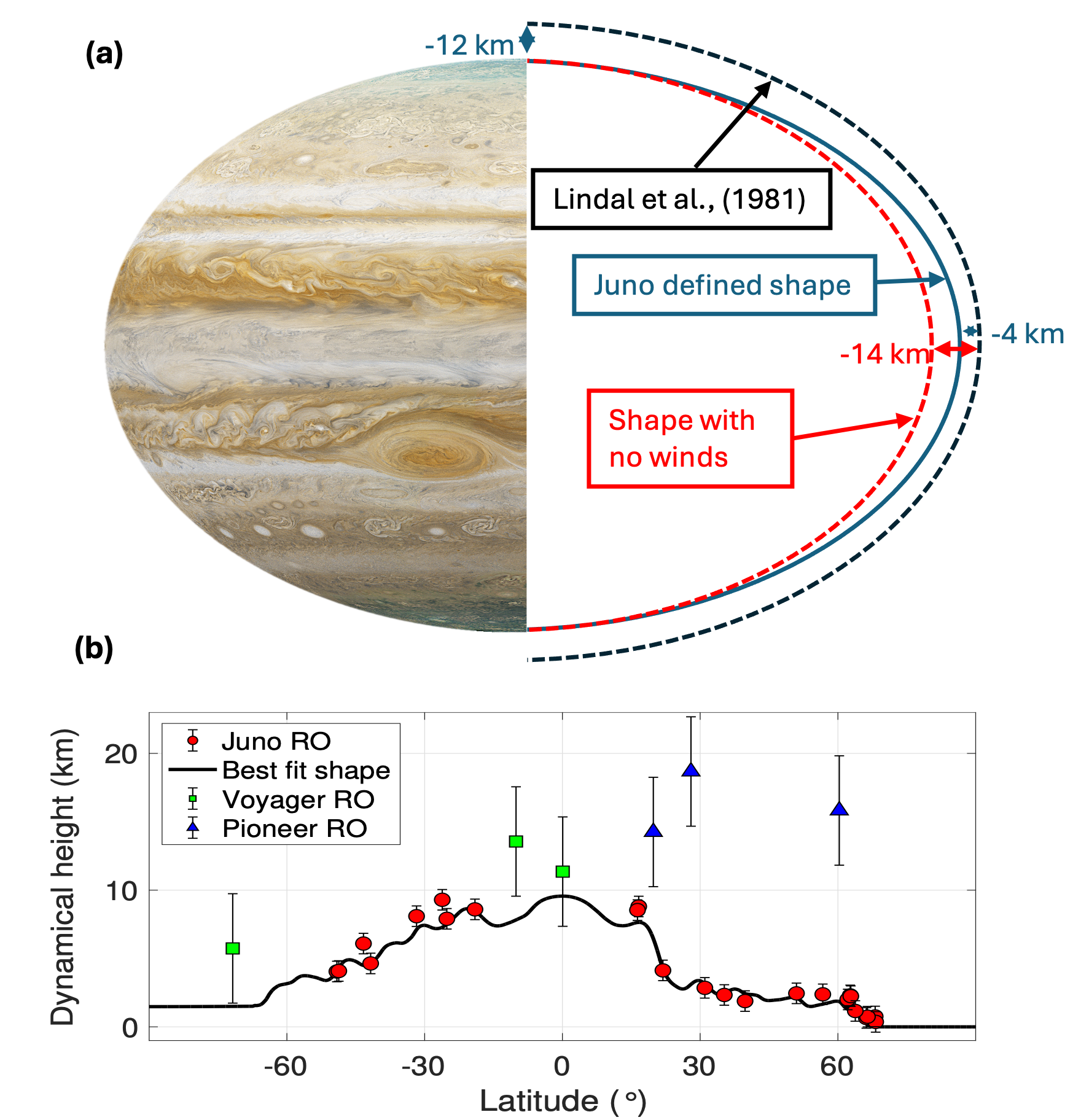
Radio occultations from the Juno spacecraft are redefining the shape of Jupiter. a, We have derived radii of Jupiter’s ‘surface’ (defined as the level at which the atmospheric pressure is 1 bar) from Juno radio-occultation (RO) data. The Juno-derived shape (blue) is compared — and contrasts — with the wind-free reference (red) and an earlier model from Lindal et al.1, which has a larger, less oblate Jupiter (grey). b, Dynamical height is calculated by subtracting the no-wind shape from the Juno radio-occultation shape; these data points have much lower uncertainties than similar points from the earlier Voyager and Pioneer missions. The latitude-dependent variations in dynamical height — kilometres in scale — are caused by zonal winds