

A mind for teaching math
Dr. Gil Schwarts is developing digital tools to improve communication between math teachers and students
New scientists
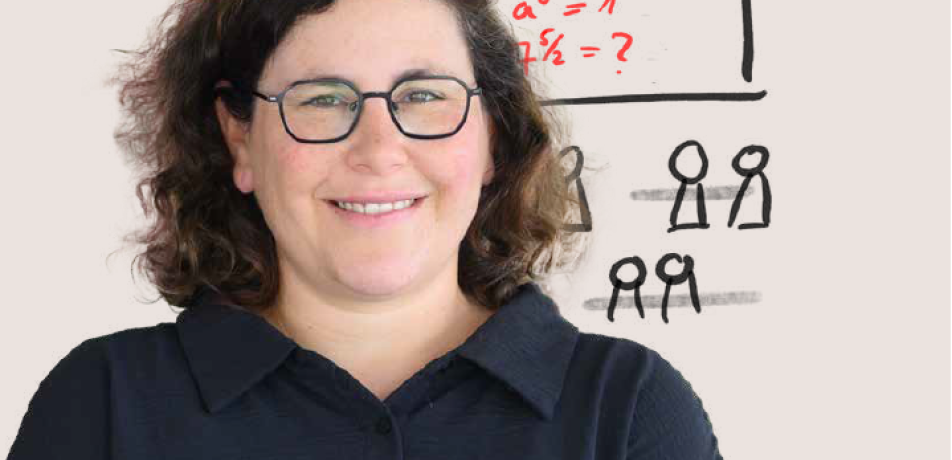
“Kids are brilliant—they know a lot! We want to understand their mathematical insights and shape instruction around them,” says Dr. Gil Schwarts, the newest member of the mathematics group in the Department of Science Teaching.
Dr. Schwarts studies mathematically responsive teaching—how teachers can deepen communication with students by recognizing what they already understand and building on their own ways of thinking, rather than viewing them as “empty vessels to be filled.”
To shift the paradigm of how instructors respond to students’ ideas and needs, she is developing digital models based on avatars that allow teachers to simulate responsiveness.
Unlike actor-based simulations, a model that has been used for a few decades in fields such as education and medicine, Dr. Schwarts’ digital environments are built to be scalable and flexible, allowing teachers to practice repeatedly without the cost or complexity of live role
play. Using artificial intelligence and avatars, these simulations create accessible, customizable spaces for teacher learning and professional development.
She would like to work with the Weizmann Institute’s new AI Hub for Scientific Discovery, part of the Knell Family Institute for Artificial Intelligence. The Hub pairs experts in AI development with scientists and students to apply the rapidly evolving field to their research.
“Teachers can practice giving a lesson to avatars and practice being mathematically responsive. While responsiveness is an interpersonal skill, my research shows that it can be practiced in a digital environment, and teachers take what they learn into real classrooms,” she explains.
Combining passions
From a young age, Dr. Schwarts was enchanted by math. “I always loved math because of the logic, the deduction. I remember myself as a high school student, thinking, ‘This is so beautiful.’”
But she was equally drawn to teaching. “At age six, I would teach my friends how to read,” she recalls. She was a high school teacher and tutored students for university entrance exams for many years. Toward the end of her BSc in mathematics at Ben-Gurion University
of the Negev, she found herself at a crossroads—liking the idea of teaching math but also wanting to conduct research. Then she discovered she could pursue a master’s degree in mathematics education at the Weizmann Institute, combining her two passions, “math, with people.”
She began her graduate studies at Weizmann in 2013, completing her MSc and PhD in math education under the supervision of Prof. Abraham Arcavi and Dr. Ronnie Karsenty in the Department of Science Teaching. Her dissertation focused on the work of facilitators who lead video-based professional development for mathematics teachers.
In 2022, she was awarded the Hebrew University of Jerusalem’s prestigious Mordechai Nisan Prize for Early Career Researchers in Education.
Dr. Schwarts then spent two years as a postdoctoral fellow in Prof. Patricio Herbst’s GRIP (Grasping the Rationality of Instructional Practice) lab at the University of Michigan. Working at Michigan’s Marsal Family School of Education, her research pivoted to the development of digital simulations, with an emphasis on how teachers manage their students’ contributions to classroom discussions of mathematical work.
‘Weizmann is something special’
In 2024, she returned to the Weizmann Institute to complete her postdoctoral studies, supported by the Bridge Position Program, an initiative of the Office for the Advancement of Women in Science and Gender Equality which supports women who need to return to Israel before completing their postdoctoral training abroad. She accepted a position as a principal investigator in September 2025.
Dr. Schwarts lives in Haifa with her husband and two children, ages four and six. She commutes to campus three times a week.
“There’s no place like the Institute. There’s no other place that operates like this one. Even when I was at the University of Michigan, I understood that Weizmann is something special,” she says.
EDUCATION AND SELECT AWARDS
• BSc, Ben-Gurion University of the Negev (2013)
• MSc (2016) and PhD (2022), Weizmann Institute of Science
• Postdoctoral Fellow, University of Michigan, Ann Arbor (2022-2023), and Weizmann Institute (2024-2025)
• Minerva Short-Term Research Grant, funded jointly by the German Federal Ministry for Education and Research and the Israeli Ministry of Science and Technology (2024), Hebrew University’s Mordechai Nisan Prize for Early Career Researchers in Education (2022), Elchanan Ezra Bondi Memorial Prize for Outstanding PhD Graduates from the Weizmann Institute (2021), Ariane de Rothschild Women’s Doctoral Program (2018‑2021)