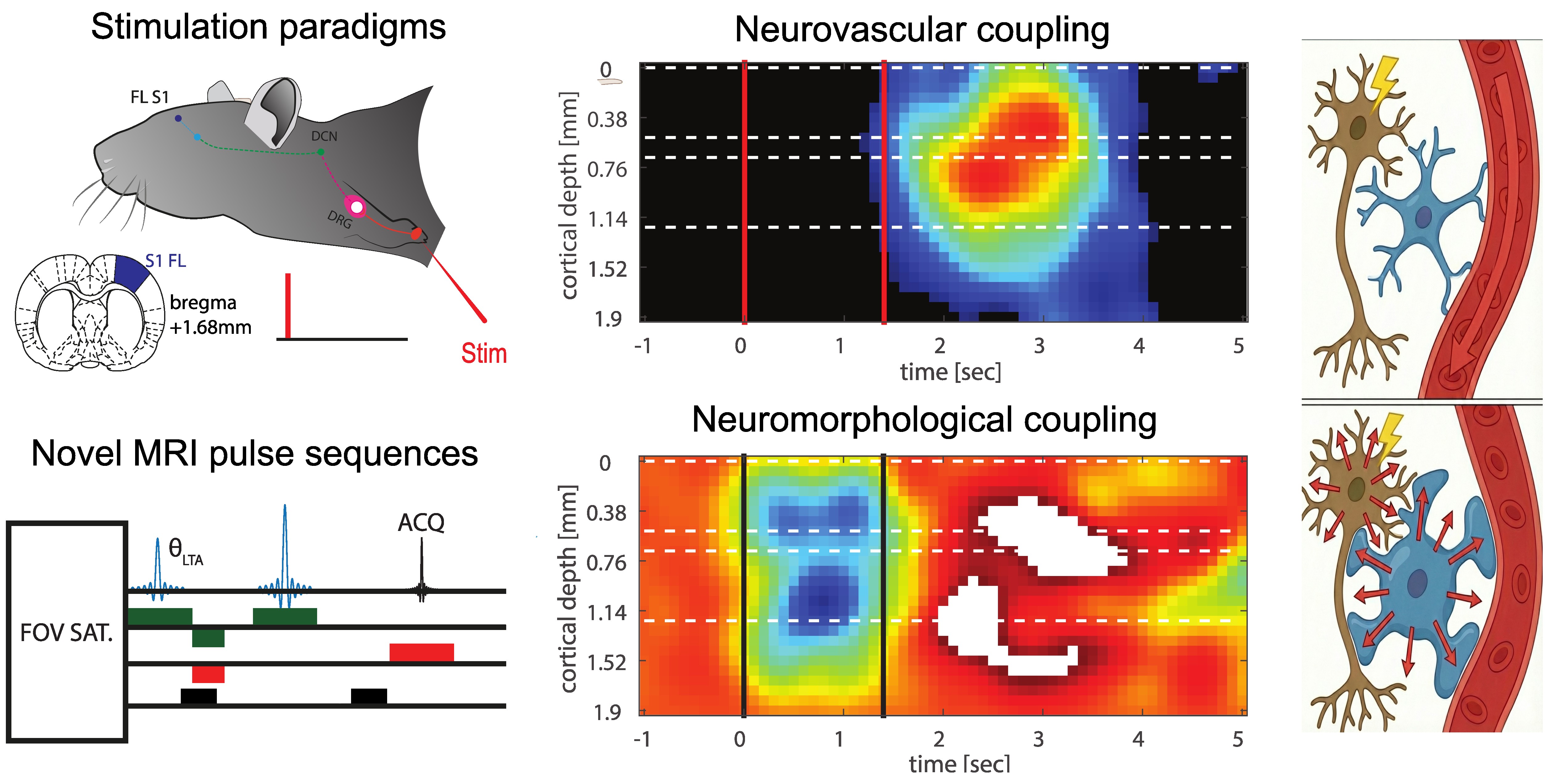
Mapping brain function with MRI beyond BOLD
BOLD-fMRI has transformed neuroscience, but it does not directly map neural activity, rather relying on vascular and metabolic coupling to deliver its signals. Thus, BOLD-fMRI can suffer from limiting specificity and interpretability, especially in disease where neurovascular coupling may be perturbed. We develop new functional MRI approaches and pulse sequences that probe neural activity and input/output properties more directly and via novel coupling mechanisms, including diffusion-based functional contrasts (dfMRI) and ionic/chemical contrasts such as sodium fMRI. Our methods are applied for mapping function in rodents (including in disease models) and validated in living brain slices, where vascular/BOLD effects are absent, enabling clean mechanistic grounding and direct validation against simultaneous optical/electrical activity measurements.