


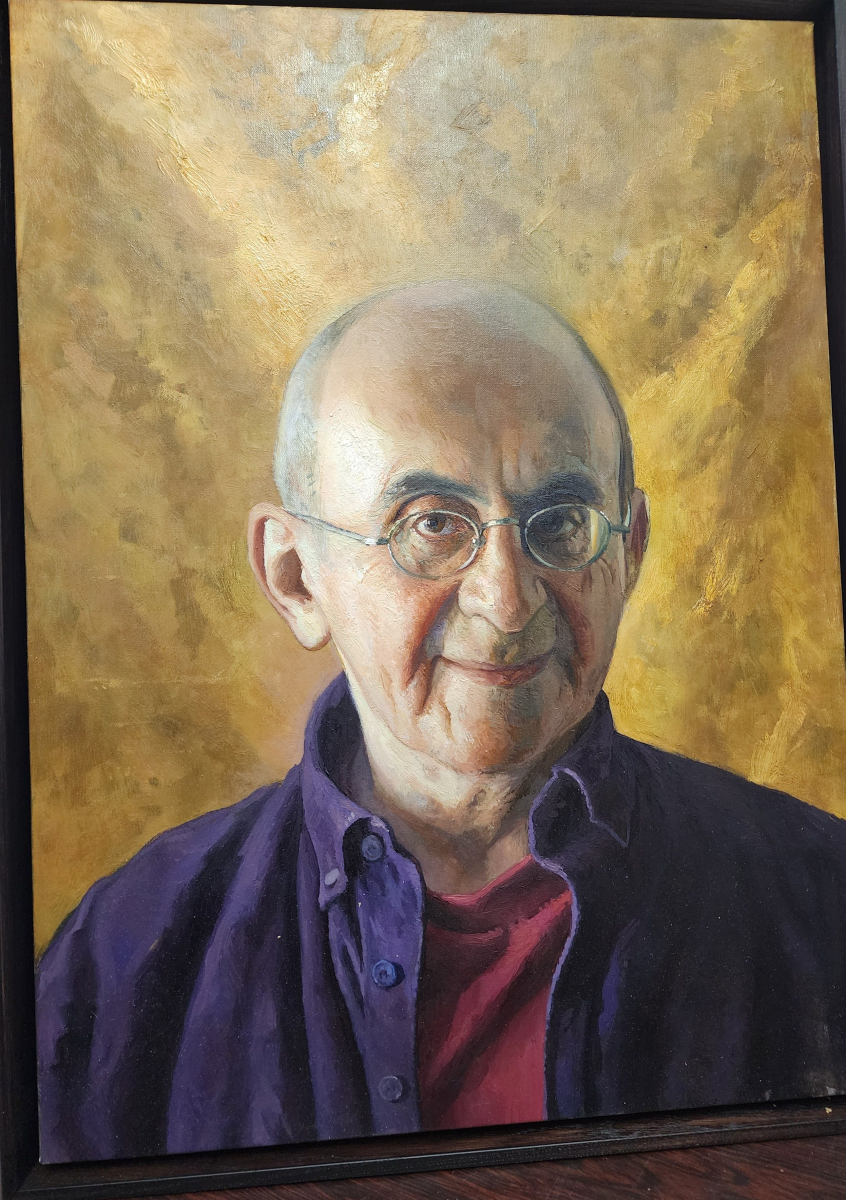
Gregory Falkovich

It from bit

Research

Apart from Physics, I have a keen interest in multidisciplinary applications of Information Theory, from neuroscience to linguistics.

I started in soliton theory and WEAK TURBULENCE.  For wave turbulence, we discovered the BOTTLENECK EFFECT, which I generalized for incompressible turbulence later. We then worked on a direct vorticity cascade in 2d turbulence and the related problem of a passive scalar in a spatially smooth flow. Work on a passive scalar in a non-smooth flow resulted in the discovery of zero modes (statistical integrals of motion) as a mechanism for an ANOMALOUS SCALING in turbulence, see review.  Apart from broken, we also discovered an emerging conformal symmetry in turbulence of inverse cascades.

I continue to work on fundamental problems of turbulence theory, including coexistence of turbulence and coherent condensate in both fluid and optical turbulence. In collaboration with experimentalists, we discovered how large vortex and small-scale turbulence conspire to provide for an inverse energy cascade in thick fluid layers.
 
In statistical physics, we suggested a fluid-mechanical view of fluctuation relations far from equilibrium. We have found empirically how the degree of non-equilibrium (breakdown of detailed balance) is encoded in the motion of a single fluid particle and suggested a simple (flight-crash) model to explain the scaling with the Reynolds number.
 
We applied the Lagrangian methods developed previously for a passive scalar to inertial particles with a view to cloud formation and rain phenomena, and predicted the SLING EFFECT in collisions of droplets. We discovered experimentally and described theoretically another set of inertial particles, small floaters; the effect of capillarity on these violates Archimedes' law. We measured the multifractality of the floater concentration and found the caustics due to the sling effect. 
We adapted to turbulence the saddle-point INSTANTON method of treating a path integral. we found the probability of strong vorticity fluctuations in 2d direct cascade. We are actively working now to describe the most singular fluctuations in Kolmogorov turbulence
 
The possibility of strongly interacting electron systems allowed us to introduce the new field of viscous electronics. We predicted negative nonlocal resistance, current vortices, conductivity exceeding the ballistic limit, and other phenomena. We described and observed fluidity onset in an electron system. 
Presently, we apply large-N field-theory methods to describe strong wave turbulence
 

Archive http://arxiv.org/a/falkovich_g_1      Google Scholar Profile       youtube.com/@GregoryFalkovich58        Books at Amazon 


Popular writings in Hebrew, more, some art.    ResearcherID : K-1561-2012     ORCID ORCID logo https://orcid.org/0000-0002-0570-7895

Research page