Unlike most other ants, weaver ants construct their nests in tree canopies. A nest is made from several leaves which the ants bend and then glue together to make a stable hollow structure.
The ants are small compared to the leaves so to manipulate them into place, they assemble their bodies into collective tools large enough to link the leaves and strong enough to move them into place. The tools work in unison, much like an ant-made machine.
The ants then bring their larvae to the construction site. They use the silk produced by the larvae to glue the bent leaves together so that they don’t spring open. The resulting structure is hollow, sphere-like and structurally stable.
To study this behavior in the lab, we allowed the ants to construct nests from a simple configuration of four artificial leaves. To track the entire process we surrounded the construction-area with 52 cameras that filmed it from all angles. The ants assembled their bodies into weight and zipper tools and used these to bend the leaves into the structure of the nest. They work quickly and a nest is typically completed in less than 25 minutes.
If the angle at which the leaves were connected to their holder was small enough the ants made their nest by bending the leaves downward.
We used geometry to precisely calculate the transition angle between these two kinds of nests. It has to do with the relation between the reach of the ant-made zipper and the location of the ridge lines that form on the flexible leaves as they bend under gravity.
Finally, we showed how, in our setup, the ants can act locally but still produce the correct structure at the large scale. Here, differential geometry come to the rescue: Gauss’s famous theorema egregium ensures a sphere-like stable nest.
Carpenter ant long term construction
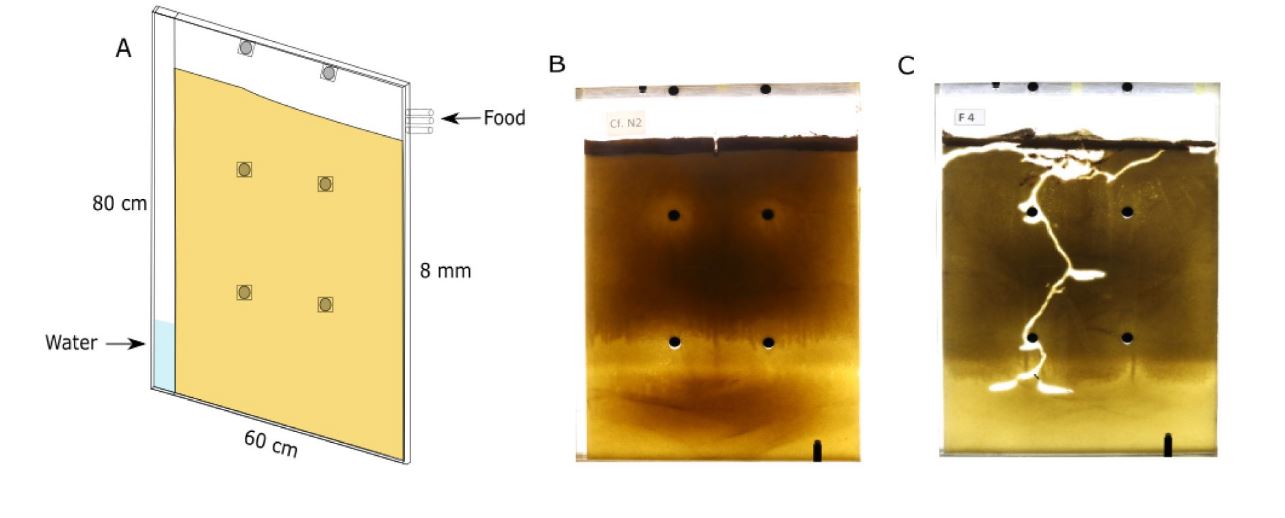
How do ants regulate the size of their nests? We started nest digging experiments from a single fertilized queen and measured how colony population and nest size co-develop.
We found that, to first approximation every new ant that ecloses adds extra volume to the nest making it larger. Wouldn't it be nice if human babies would do the same?
Nest selection
We study conflict resolution in emigrating ant colonies during binary nest selection. We find that individuals concede their potential benefit to promote social consensus. In particular, colonies resolve the conflict imposed by a persistent minority through “majority concession,” wherein a majority of ants that hold first-hand knowledge regarding the superior quality nest choose to reside in the inferior one.
Further reading
Trocki, G., Roitman, M., Fonio, E., & Feinerman, O. (2025). Local rules and geometric constraints enable robust leaf-nest construction in weaver ants. Current Biology.
Rajendran, H., Weinberger, R., Fonio, E., & Feinerman, O. (2025). Colony demographics shape nest construction in Camponotus fellah ants. eLife, 13.
Rajendran, H., Haluts, A., Gov, N. S., & Feinerman, O. (2022). Ants resort to majority concession to reach democratic consensus in the presence of a persistent minority. Current biology, 32(3), 645-653