
Requests
Below is a selection of recently synthesized materials that are available for collaborative research.
Additional materials are in progress and will be posted as they become available.
For further information please contact: markus.huecker@weizmann.ac.il
CrPS4
Our CrPS4 crystals were grown by physical vapor transport (PVT), i.e., without the addition of a transport agent. Chemicals: Cr powder (4N) from Strem, P powder from Alfa Aesar, and S lumps (5N) from Thermo Scientific.
Fe3GeTe2
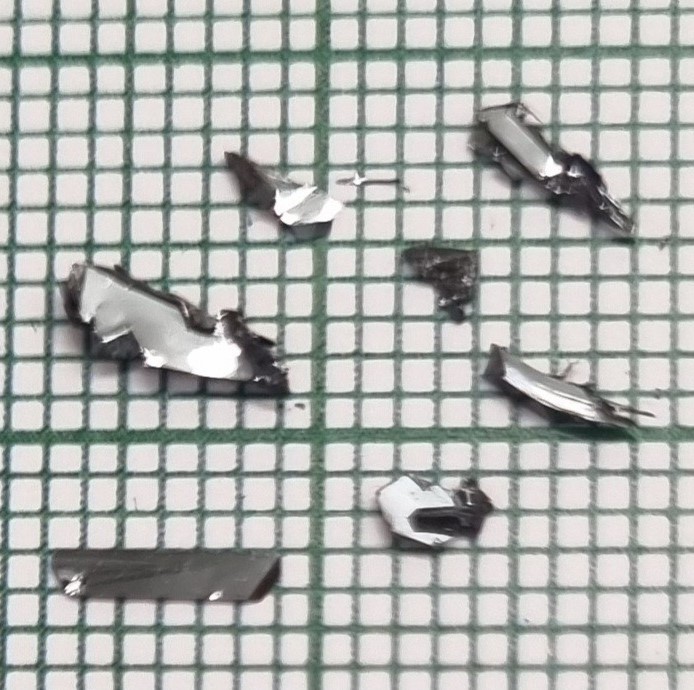
This crystal was grown by self-flux from a Te-rich melt using a ratio Fe:Ge:Te of 2:1:4. Chemicals: Fe powder (3N) from Strem, Ge powder (5N) from Alfa Aesar, and Te granules (5N) from Thermo Scientific.
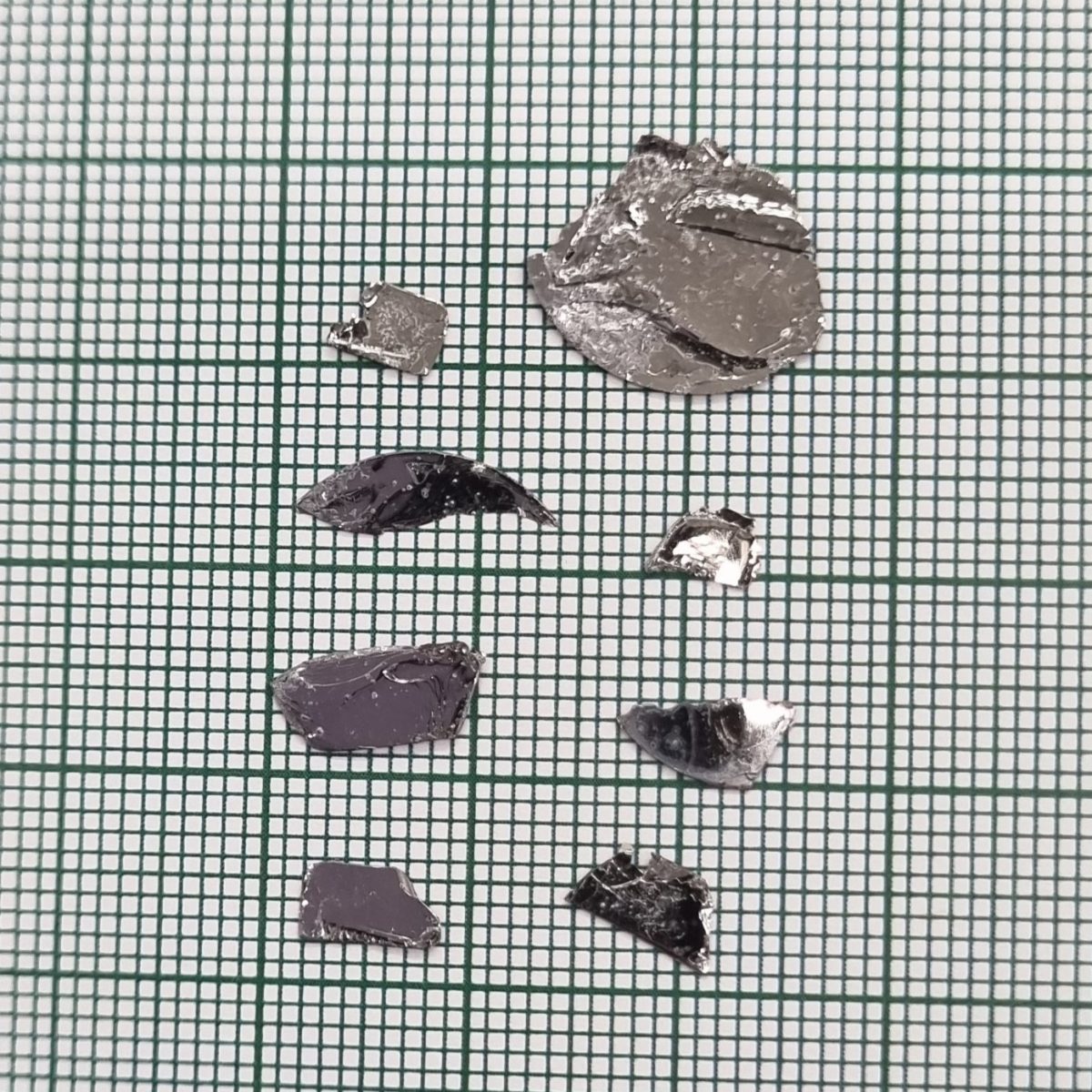
Fe3GaTe2
This crystal was grown by self-flux from a Te-rich melt using a ratio Fe:Ga:Te of 1:1:2. Chemicals: Fe powder (3N) from Strem, Ga lump (4N) from Strem, and Te granules (5N) from Thermo Scientific.
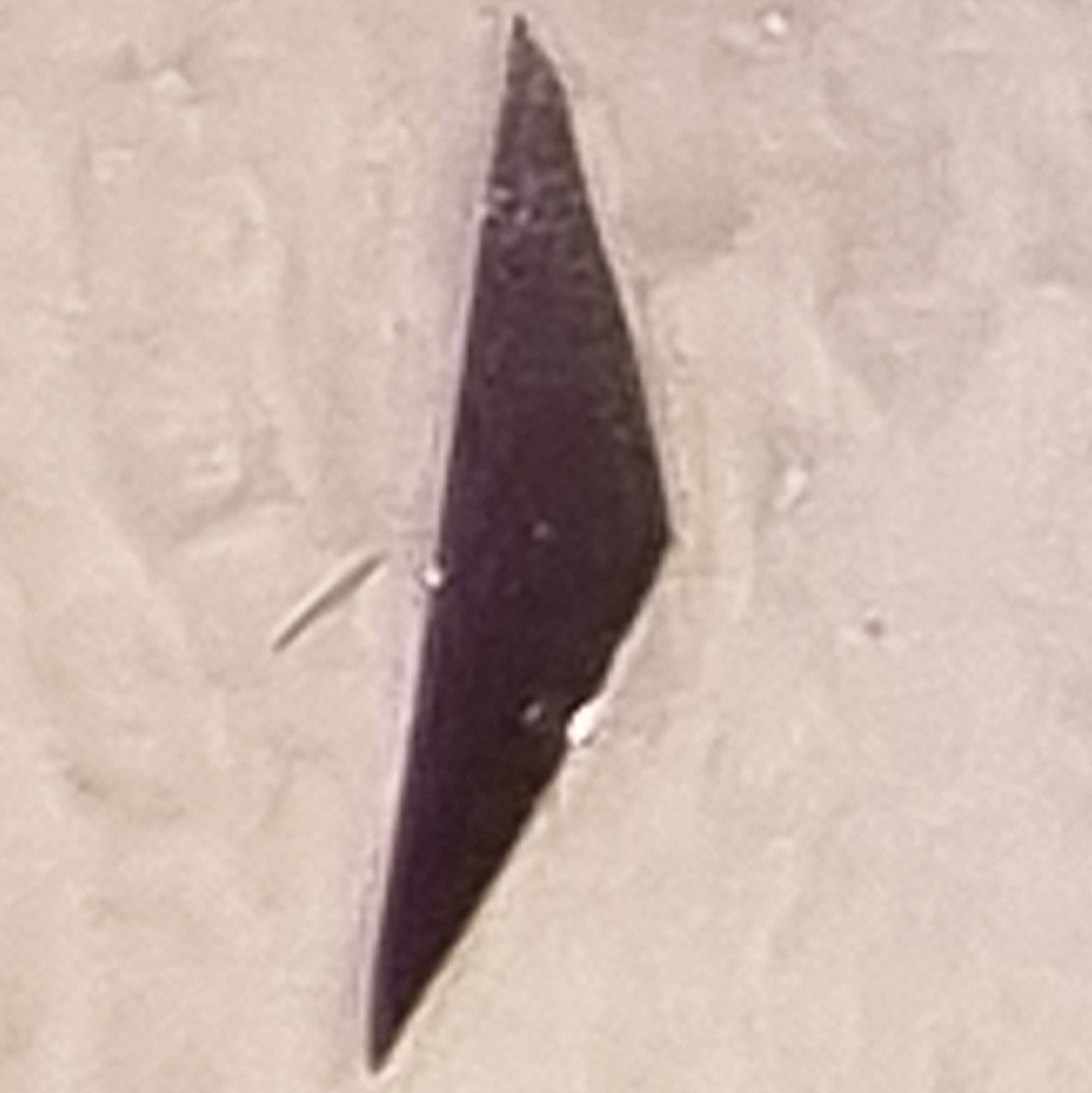
Bi2Se3
This crystal was grown by modified Bridgman method using a stoichiometric ratio of the starting materials. Chemicals: Bi granules (5N) from Strem, and Se granules (5N) from Alfa Aesar.
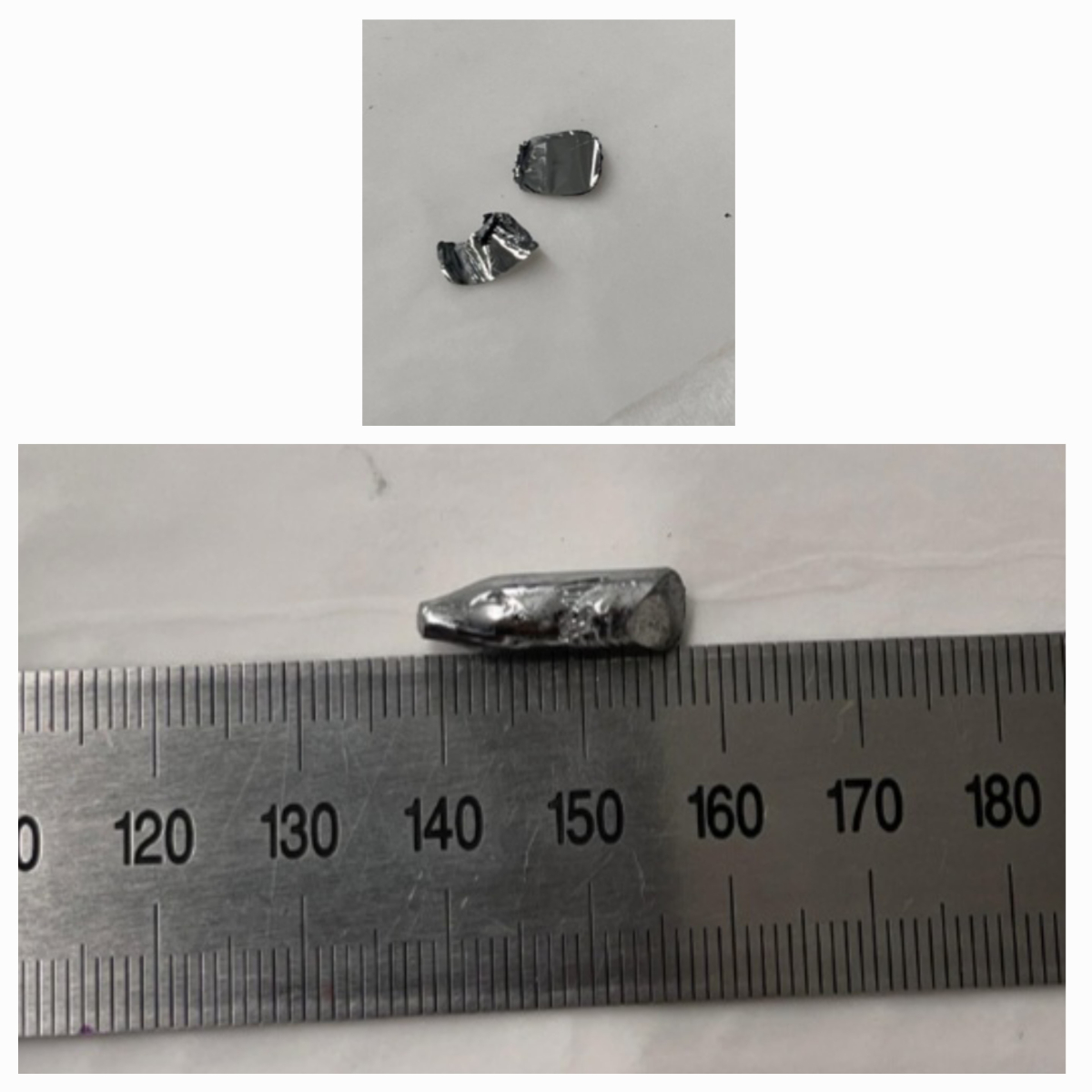
BiSbTe3
This crystal was grown by modified Bridgman method using a stoichiometric ratio of the starting materials. Chemicals: Bi granules (5N) from Strem, Sb chunks (5N) from Stem, and Te granules (5N) from Thermo Scientific.
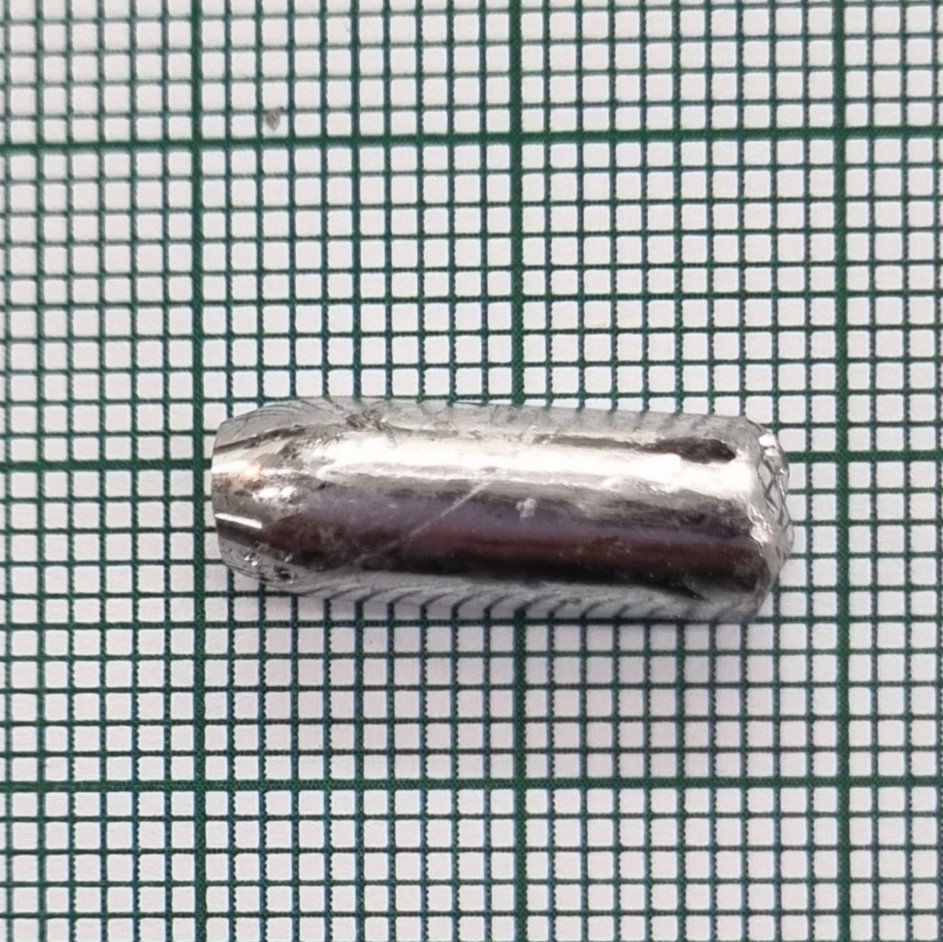
Ni3In2S2
This crystal was grown by modified Bridgman method using a stoichiometric ratio of the starting materials. Chemicals: Ni pieces (5N) from Alfa Aesar, In pieces (5N) from Alfa Aesar, and S lumps (5N) from Thermo Scientific.
CrSb
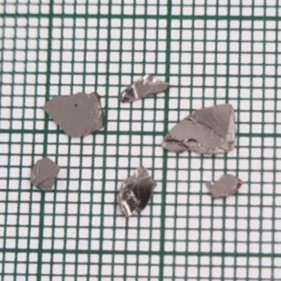
This crystal was grown by flux method using Bi as flux. Chemicals: Cr powder (4N) from Strem, Sb chunks (5N) from Stem, and Bi granules (5N) from Strem.
NbSe2
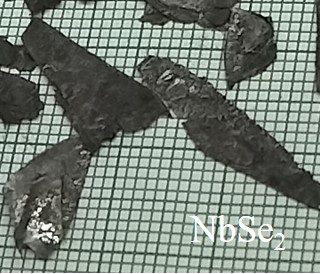
This crystal was grown by the liquid transport growth method. Chemicals: Nb powder (4N) from Strem, Se granules (5N) from Alfa Aesar.
MoSe2
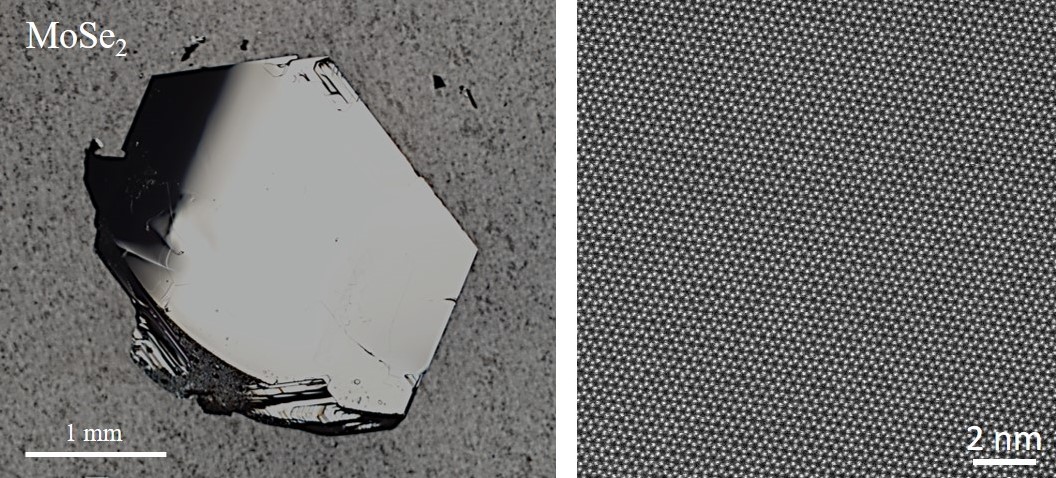
This crystal was grown by the liquid transport growth method.
WSe2
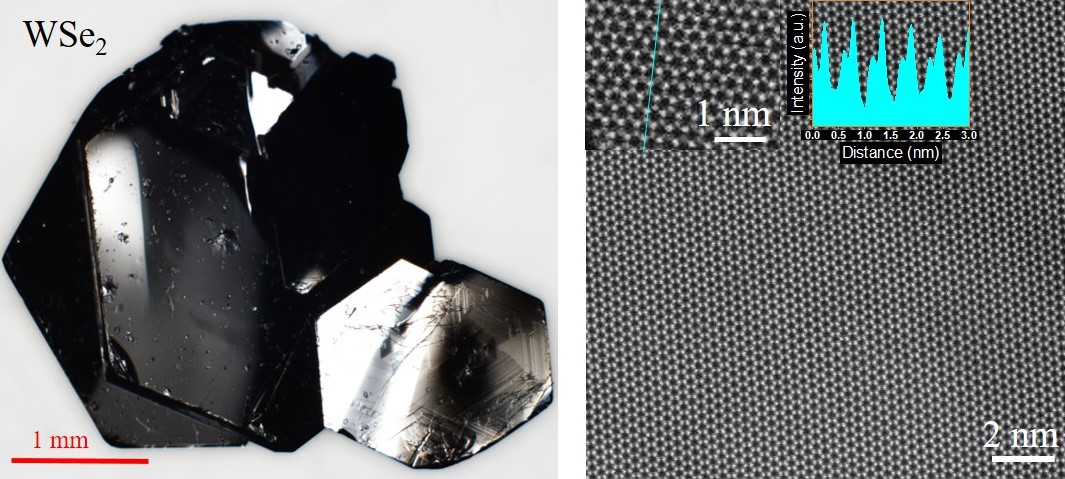
This crystal was grown by the liquid transport growth method.
MoTe2
This crystal was grown by self-flux from a Te-rich binary melt.
WTe2
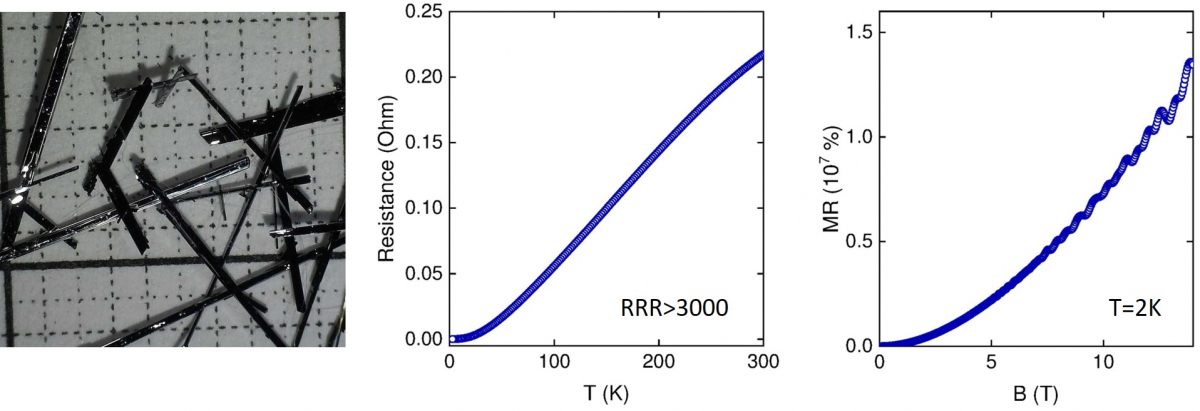
WTe2 is a semimetallic transition metal dichalogenide that has attracted attention in several ways. As bulk material WTe2 shows a large non-saturating positive magnetoresistance which has been attributed to perfectly balanced electron and hole pockets. At high pressure this positive magnetoresistance disappears while supercoductivity emerges. It was predicted and then experimentally confirmed that WTe2 is a type-II Weyl semimetal in the bulk. WTe2 can be exfoliated down to monolayer thickness where it becomes a quantum spin Hall insulator.
Our WTe2 crystals were grown by self-flux from a Te-rich binary melt using a ratio W:Te of 1:99. Typically our crystals reach RRR values higher than 103, and magnetoresistance ratios at 9T higher than 104. Chemicals: W powder (5N) and Te chunks (6N) from Furuuchi Chemical Corporation, Japan.
MnBi2Te4
MnBi2Te4 is a recently discovered antiferromagnetic topological insulator. Structurally, it is derived from topological insulator Bi2Te3 through intercalation of an additional MnTe layer. The Mn moments order ferromagnetically within the planes while the planes couple antiferromagnetically. MnBi2Te4 devices are attracting tremendous attention following the observation of several quantum phenomena such as QAH, axion insulator, and high Chern number QH, depending on the thickness of the device and whether the number of layers is odd or even.
Our crystals were grown by Te-self flux. The two graphs for H II c-axis indicate sharp bulk transitions at the antiferromagnetic ordering temperature, and the critical fields of the spin flop transition as well as the onset of the first magnetization plateau. Chemicals: Mn flakes (4N) , Bi shots (5N), and Te chunks (6N) from Furuuchi Chemical Corporation, Japan. 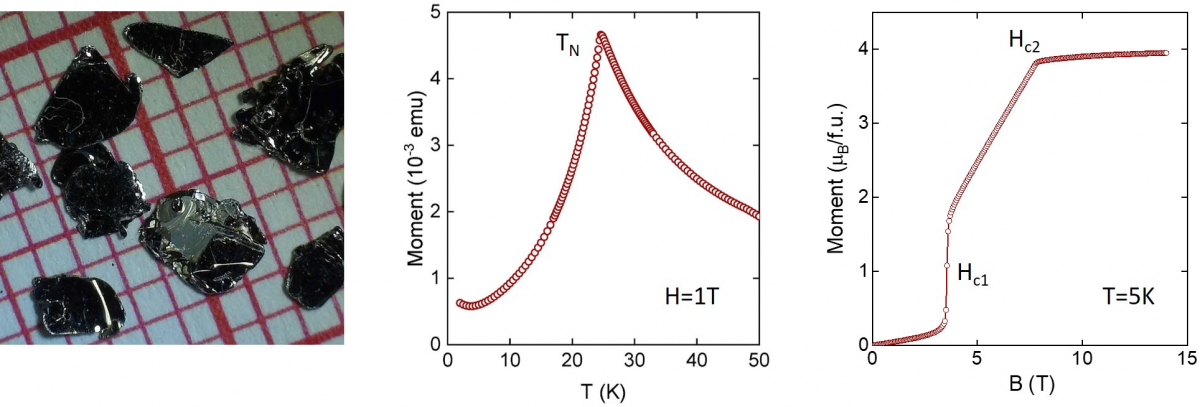
La2CuO4
La2CuO4 is a well known Mott insulator and the parent compound of the La-based 214 cuprate superconductors. It is an important model system for quasi 2D spin S=1/2 Heisenberg antiferromagnetism. Antiferromagnetic correlations in the cuprates are very strong even in the region of the superconducting dome, giving rise to the idea that magnetism may play a role for the formation of superconductivity.
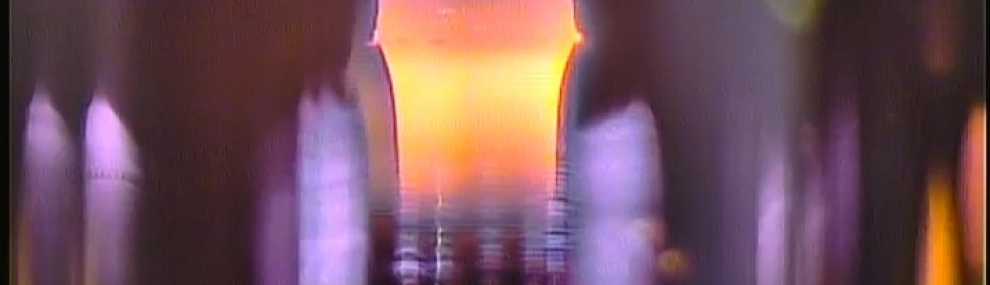
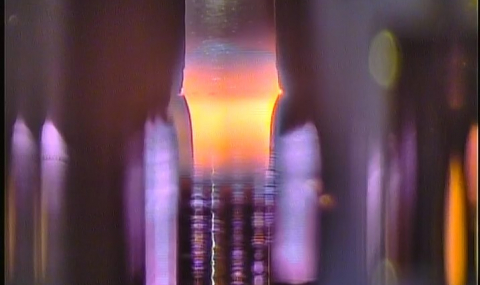
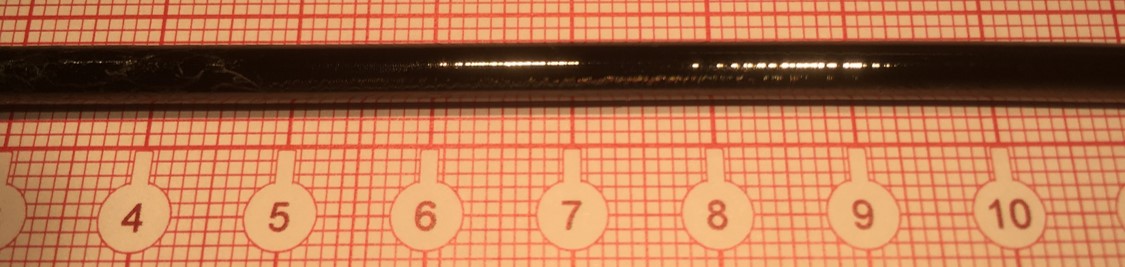
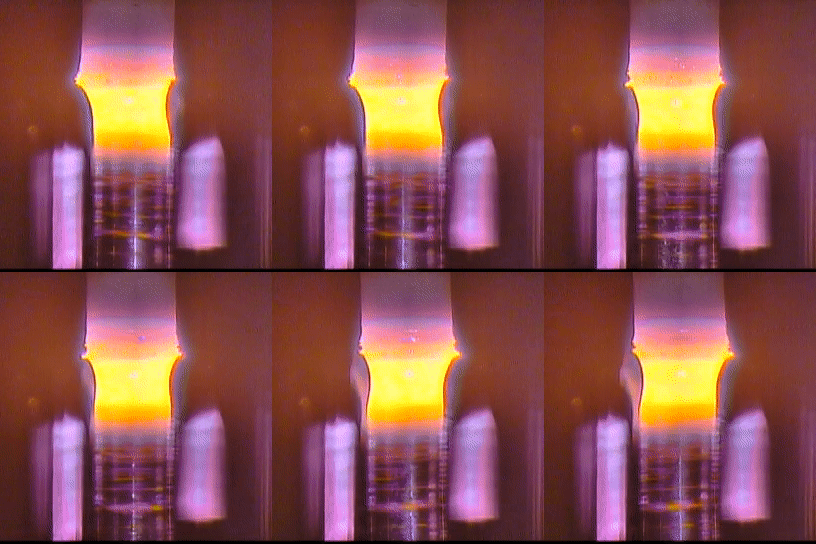
Single crystals were grown with the Laser Floating Zone technique in pure O2 (5N) at a pressure of 3 atm. Chemicals: La2O3 (99.999%), CuO (99.9995%) from Alfa Aesar.
La2-xBaxCuO4
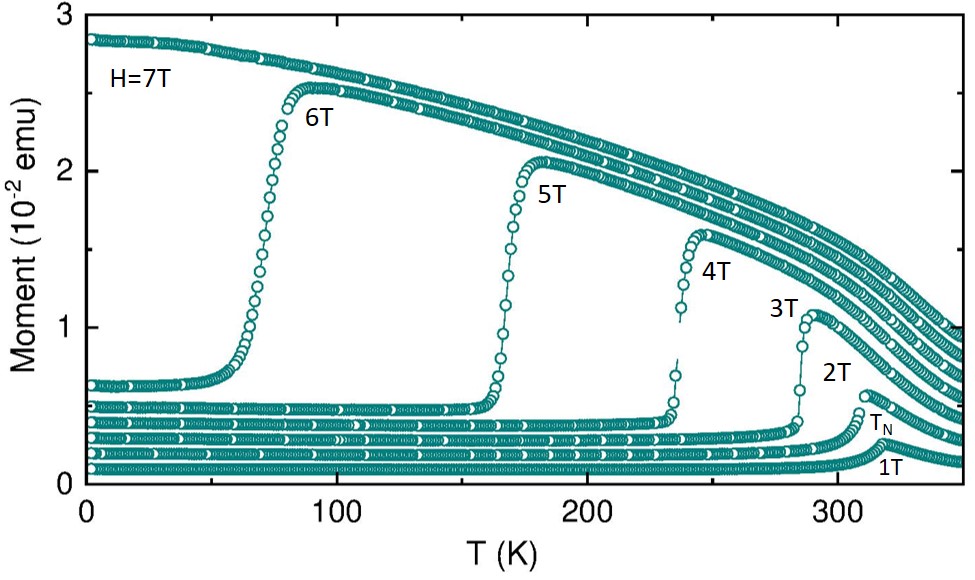
La2-xBaxCuO4 is famous for being the first high-Tc superconductor, but since has become something like the Rosetta Stone of cuprate science, helping to decipher the role of the various coexisting electronic states. Of particular interest is the region around a charge carrier concentration x=1/8 where superconductivity competes with static charge and spin orders.
Single crystals were grown with the Laser Floating Zone technique in 96% O2 and 4% Ar at a pressure of 3 - 5 atm. The small amount of argon helps suppress the formation of bubbles in the liquid zone which can disrupt stable growth. Crystals with different Ba concentrations are available. Chemicals: La2O3 (99.999%), Ba2CO3 (99.99%), CuO (99.995%) from Alfa Aesar.
