Kahn N., Garti D., Goldblatt U., Joshi L. M., Lafont F. & Rosenblum S.
(2026)
arXiv.org.
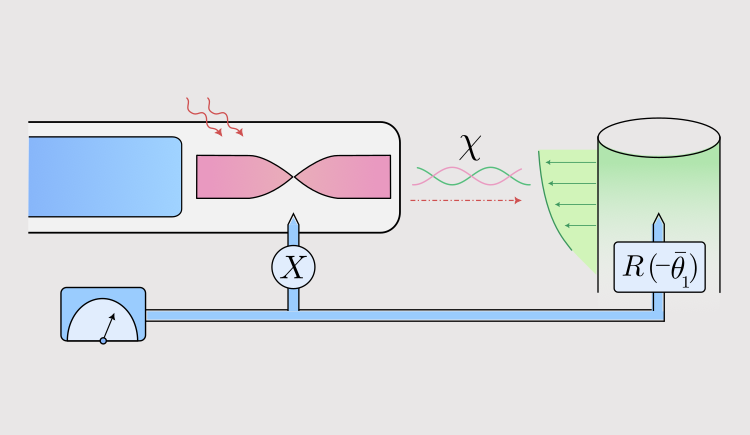
Characterizing noise in superconducting qubits is essential for improving coherence and gate performance. Conventional noise-sensing methods typically use the qubit itself as the sensor, which limits both accessible bandwidth and applicability during driven operation. Here, we demonstrate a method for measuring qubit frequency noise by converting it into photon loss in a coupled high-Q superconducting cavity. We use repeated mid-circuit qubit measurements with post-selection to separate this induced loss from intrinsic cavity decay. We validate the protocol using injected noise and show that the extracted loss scales as expected with the applied noise strength. Without added noise, we place an upper bound of 5×10³ Hz2/Hz on the qubit frequency-noise power spectral density at 508 MHz. The protocol opens access to a higher-frequency spectral window than standard qubit-based spectroscopy and may enable noise characterization during strong driving.
Guttel B., Gov D., Netzer N., Goldblatt U., Hazanov S., Joshi L. M., Romito A., Gefen Y., Kumar P., Snizhko K., Lafont F. & Rosenblum S.
(2026)
arXiv.org.
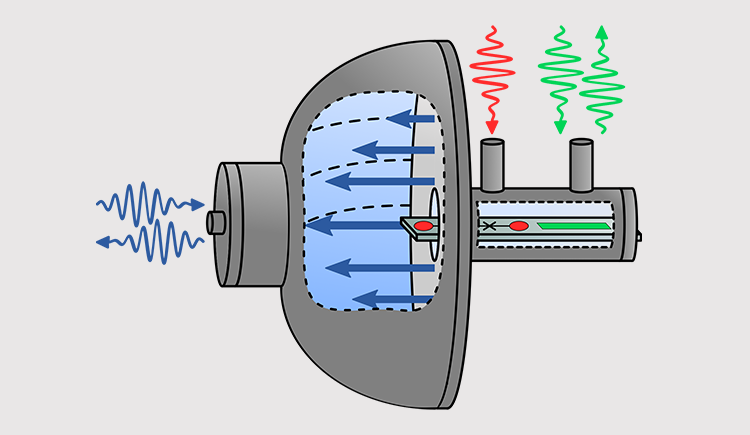
Quantum mechanics predicts that unobserved systems may exist in a superposition of states, yet measurement produces definite outcomes, a tension at the heart of the quantum-to-classical boundary. How the transformation between these opposing regimes unfolds as observation strength increases has remained experimentally unexplored. Here, by continuously tuning the measurement strength on a superconducting qubit, we reveal that measurement-dominated dynamics emerge not gradually but through three distinct transitions: coherent oscillations abruptly halt; the system then freezes near a stable quantum state; and finally enters the quantum Zeno regime, where stronger observation paradoxically slows relaxation. Decoherence, rather than washing out this structure, reorganizes it, inverting the order in which transitions appear and decoupling signatures that coincide in idealized models. These results establish that the route from quantum dynamics to measurement-dominated behavior unfolds in sharp transitions governed by the interplay between observation and environment.