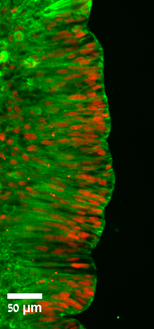
NDE1 is a gene that encodes a member of the nuclear distribution E (NudE) family of proteins. NDE1 is part of a multiprotein complex that controls the function of the molecular motor cytoplasmic dynein. The protein localizes to centrosomes and is involved in neuronal migration, mitosis, and intracellular transport. A recent missense point mutation, S214F, was discovered among schizophrenia patients and is believed to affect the developing brain at a molecular level by forming abnormal interactions with other proteins and altering myelination, which may have implications in the context of psychiatric diseases but is yet an understudied topic. This research examines the possible contribution of NDE1-S214F mutation to schizophrenia- predisposition in the molecular, cellular, tissue, and organism levels. We will combine human organoids with mouse models to accomplish this, providing a powerful tool for studying the pathophysiology of neurodevelopmental diseases.