


Some of our recent highlight results include:
-
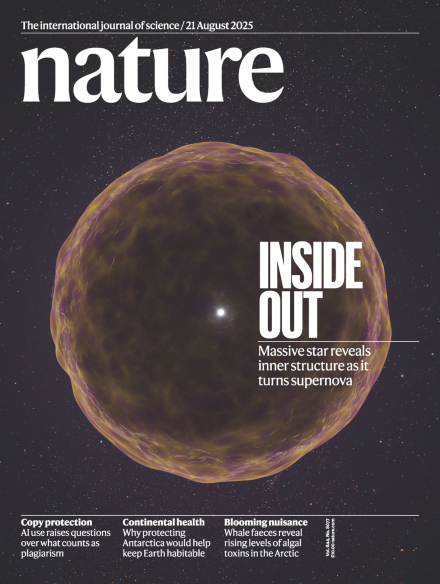 A paper by former postdoc and current collaborator Dr. Steve Schulze (Schulze, Gal-Yam, et al. 2025, Nature) reporting the discovery of a new and puzzling type of supernova (type Ien) that requires a progenitor star so stripped that the wind around it is dominated by heaby elements silicon, sulfur and argon. See the Nature cover art here. Some press coverage including CNN, El Pais, Xinhua and the Jerusalem Post is here.
- A paper (Zimmerman et al. 2024, Nature) elucidating in detail what happens when a star explodes within a distribution of surrounding gas, presenting the earliest UV spectra from the Hubble Space Telescope of the very nearby and well-studied SN 2023ixf. See some press here, as well as a viral video on Erez Zimmerman and his dedication.
-
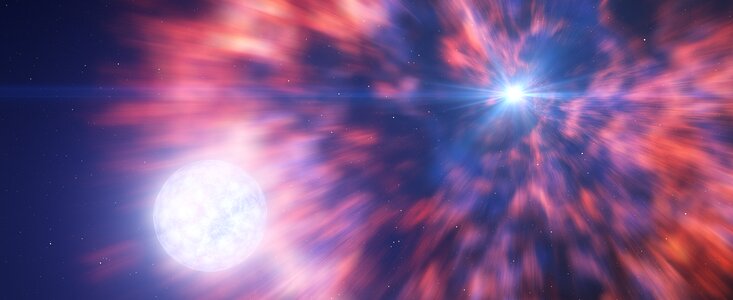 A paper by our postdoc Dr. Ping Chen (Chen, Gal-Yam et al. 2024, Nature) reporting the discovery of the first ever direct evidence for a supernova arising from a binary system of stars. The system survived the explosion, and gamma-ray emission from the compact remnant is detected. A nice ESO press release is here.
- Staff Scientsit Dr. Ofer Yaron led a Nature Physics paper (see also news and views) using the earliest spectroscopic observations of a Type II supernova ("flash spectroscopy") to chart the confined distribution of CSM around the supernova progenitor, indicating pre-explosion instabilities months prior to the supernova event may be common. Some press reports from Science, The Guardian, USA today, and Space.com.
- Nature paper presenting our discovery of a new type of supernova explosion (Type Icn) arising from the death of a massive Wolf-Rayet star. Some PR materials from Weizmann are here and in hebrew here. You can see press coverage here and here (in hebrew) and also here and here (in English) and also, if you like, here (in Swedish).
- Postdoc Dr. Giorgos Leloudas led a paper proposing an explanation to the most luminous transient observed so far as a disruption of a star by a spinning black hole (Nature Astronomy paper).
- Nature paper presenting the first application of "flash spectroscopy" to reveal a progenitor star blowing a Wolf-Rayet-like wind for the Type IIb Supernova SN 2013cu.
If you are interested in supernovae and their classification: a chapter I wrote in the new "SN Handbook" about classification of SNe is now online (also available on arXiv).