Therapy of Aspergillosis by conjugates of Mab-Alliinase that produce Allicin
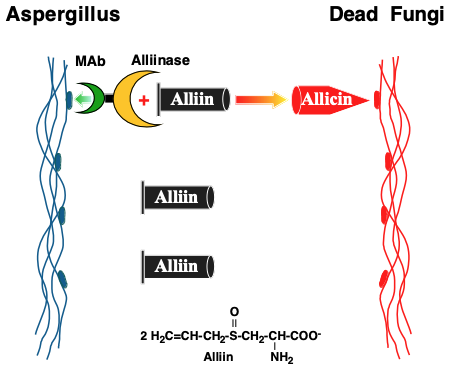
In the late 1980s, Mirelman participated in a Conference in Shanghai on Dysenteric Diseases and became intrigued by the long established Chinese Medical practice to use alcoholic extracts of freshly crushed Garlic cloves, to treat patients with intestinal pathogens. Upon his return, he initiated together with his colleague, Prof. Meir Wichek, studies on the identification of the antimicrobial molecules in the Garlic extracts and their mode of action. They identified Allicin as the bio active molecule responsible for its wide ranging and superb anti-microbial effects as well as its mode of action – its excellent penetration of pathogen cell membranes due to its hydrophobic properties and the subsequent thiolation of essential -SH groups of enzymes and proteins of the pathogens. Microorganisms, in contrast to mammalian cells are mostly devoid of glutathione and therefore can not reduce the disulfide bonds.produced by Allicin. They also characterized the Garlic clove components, the enzyme Alliinase which resides in isolated clove vacuoles and the inert substrate Alliin and developed lab methods to quantify and study the properties of Allicin . Due to its relative chemical instability, Allicin per-se could not be used as an off-the-shelf anti-microbial so they invented a new method, especially to kill pathogenic fungi such as Aspergillus . It consisted of a monoclonal antibody against a surface antigen of the fungus that was chemically ligated to the Garlic Alliinase enzyme using a bi-functional reagent. Upon the supply of the inert and hydrophilic substrate Alliin, the conjugated Ab-Enzyme present on the fungal surface target, produced toxic Allicin molecules that penetrated the cell membrane and rapidly killed the fungi. ( see figure, Refs 1,2 ). In vivo studies in immune-suppressed mice infected with Aspergillus in their lungs in which the conjugate was introduced through the trachea, over 90% of the animals survived whereas all untreated control animals died from the infection within 8-10 days. Mirelman and colleagues are still fascinated with the potential uses of the targeted Allicin method to kill other pathogenic drug resistant fungi such as Candida species.