


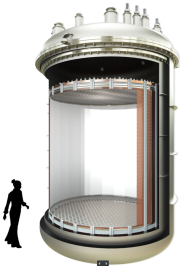
XLZD is the next-generation liquid-xenon observatory currently in design by the combined XENON, LZ, and DARWIN collaborations. Building on the strengths of these pioneering experiments, XLZD aims to construct a multi-tonne-scale detector with unprecedented sensitivity to dark matter and other rare processes, including double-beta decay. The project unites leading expertise in noble-liquid detector technology, background mitigation, and precision measurement.
How we got here.
From XENONnT and LZ, which now define the state of the art in dark-matter searches, the community is moving toward a unified effort: a detector large and quiet enough to reach the ultimate sensitivity before encountering the irreducible neutrino background. XLZD will extend the search for dark matter by an order of magnitude and explore new frontiers in neutrino and nuclear physics.
The Weizmann Group
Our work within XLZD focuses on developing the technologies, tools, and methods that will make the next-generation detector possible.
Main activities:
- Detector development: R&D on optical and charge readout technologies for multi-tonne noble-liquid detectors
- Detector design for rare events: concepts combining dark-matter and double-beta-decay sensitivity
- Slow Control and monitoring: design and implementation of robust, scalable systems for detector operation and safety
- Calibration and reconstruction: innovative deployment strategies and algorithms for precise energy and position determination
- Data analysis and statistical methods: signal extraction, background modeling, and global sensitivity studies
- Simulation and modeling: detailed Monte Carlo tools for detector response and performance optimization
- Hardware and integration: design, prototyping, and testing of sub-systems in collaboration with international partners
View the poster of our recent DARWIN meeting 2015 at the Weizmann Institute.