
Using the Retina to Study Neurodegenerative Disease
Because the retina is part of the central nervous system and contains well-defined neuronal subtypes, it offers a unique opportunity to study brain function and dysfunction in a relatively accessible tissue. Several neurodegenerative diseases – including Parkinson’s and Alzheimer’s – affect retinal circuits, often in ways that mirror changes in the brain.
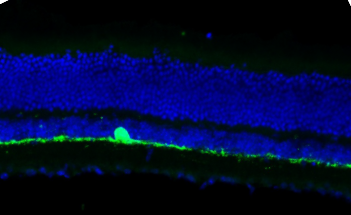
We explore how alterations in retinal dopaminergic and cholinergic signaling – systems known to be disrupted in these diseases – may be reflected in visual processing. The retina contains specialized amacrine cells that release dopamine, broadly modulating retinal circuits. Starburst amacrine cells, the retina’s only cholinergic neurons, are key components of the direction-selective circuit. These pathways may offer a foundation for developing visual-based, non-invasive diagnostics for neurodegenerative disease.
Read more: