
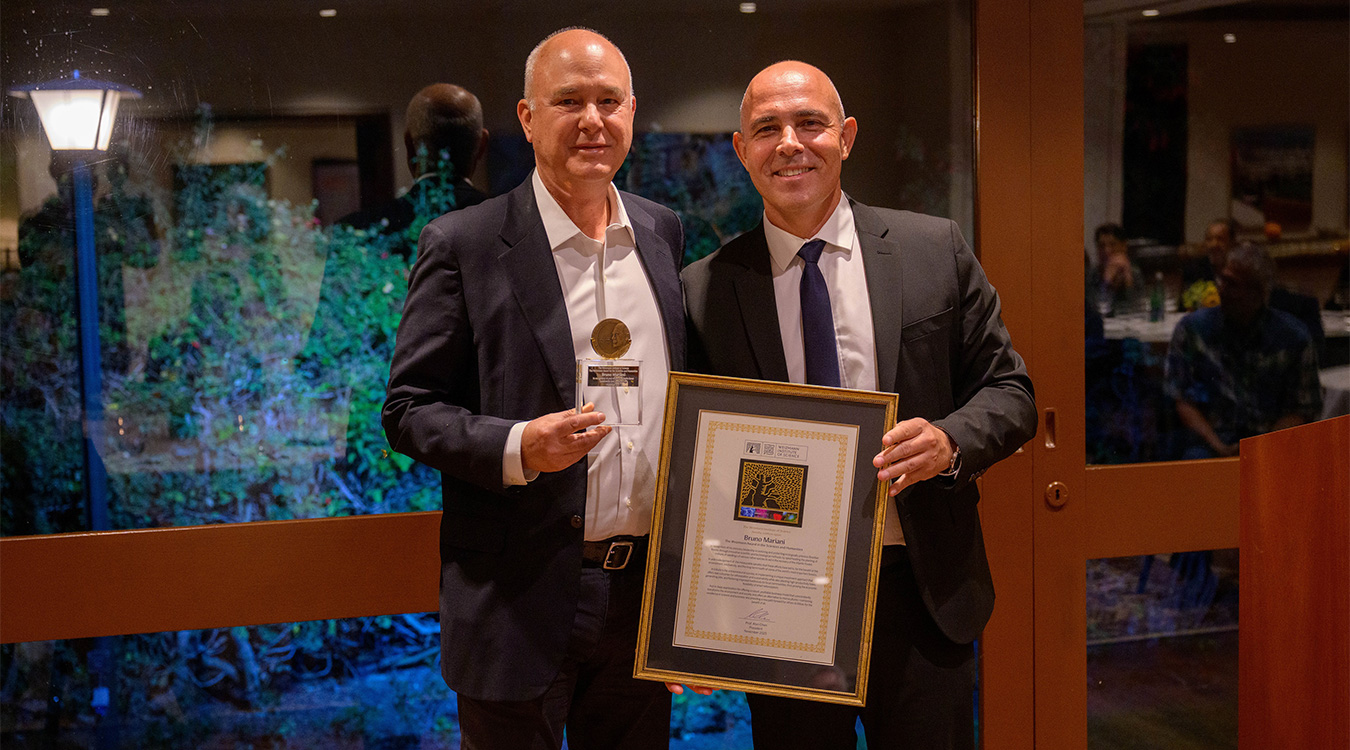
In a ceremony on campus on November 13, Prof. Alon Chen bestowed the Weizmann Award upon Bruno Mariani, a Brazilian entrepreneur who is helping reverse the deforestation of Brazil's Atlantic Forest.
When the Portuguese explorers arrived in 1500, this thick and lush carpet of green—about 1.5 million square-miles in all, filled with life—was the second-largest rainforest on the planet, behind the Amazon Rainforest. Today, more than 85% of its original area has been cleared, and native tree species are facing extinction.
Mariani understood that new solutions were urgently needed. Not only is this precious resource critical to Earth’s ecosystem, but the forest’s destruction has other implications. The Atlantic Forest is a major carbon sink, absorbing CO₂ and helping to regulate global climate. It prevents soil erosion and floods and is home to indigenous peoples. Even in its diminished state, the forest is still one of the richest biodiversity hotspots on the planet.
Leaving behind his successful banking career, Mariani turned his attention full-time to the matter. He started Symbiosis, a company whose goal is to restore and preserve this rainforest. Its business model is grounded in the belief that large-scale restoration can only happen if it is tied to financial incentives and a total reshaping of the standards of the timber industry. And it has done just that.
Most traditional plantation forests grow species like pine and eucalyptus in a monoculture approach for the many demanding industries that require wood. The monoculture approach is problematic because it increases the risk of pests and disease, ultimately undermining productivity.
No attention had been given to improving the productivity of native species. Bruno changed that. The forests planted by Bruno’s company are diverse, native species. His method is based on robust scientific research; the identification of seeds of native trees; and the use of cloning and other technologies. This conserves endangered trees while supporting biodiversity and improving the quality of soil and water.
The approach ensures timber gets into consumers’ hands, and also regenerates lost ecosystems. Thousands of acres of the Atlantic Forest have been rehabilitated in this way. And that’s not all. Symbiosis sells carbon credits to major multinational companies aiming to achieve net-zero emissions. Its agreement with Apple will enable the expansion of the forest by five-fold. It could be just the beginning of a model that could be replicated elsewhere, for the benefit of the entire planet.
For his successes, Mariani has become known as “the tree whisperer” in Brazil for a reason: He has pioneered a unique and successful solution that could be replicated across the country—and beyond.