
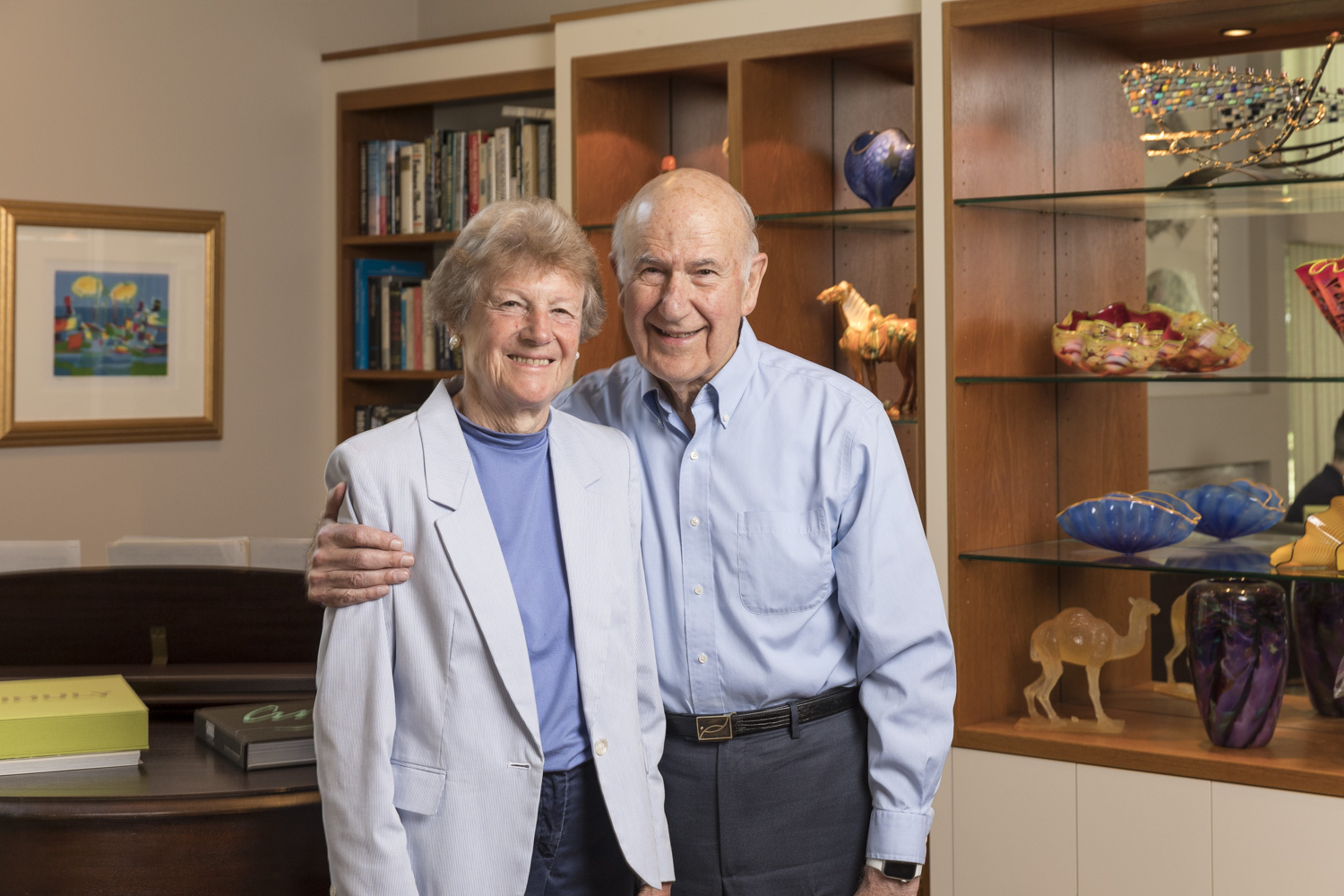
For Dr. Gil Omenn, the roots of a lifelong relationship with the Weizmann Institute of Science were planted in 1962, when he came to Israel after his first year at Harvard Medical School.
It was a natural choice. “My mother had imbued in me an appreciation of the essential role of Israel for the future of the Jewish people. She had witnessed with awe the creation of the country,” he says. At Harvard, he had started working on synthetic polypeptides—chains of amino acids that comprise proteins—and learned that the Weizmann Institute had a world-renowned expert in the field: Prof. Ephraim Katzir (Katchalsky). After passing muster with the Israeli biophysicist’s brother, Prof. Aaron Katzir who was at Yale University on sabbatical at the time, Gil received an invitation to spend a summer in Ephraim Katzir’s lab.
“I spent a wonderful two months in Rehovot and exploring the country—a truly transformative period in my life,” recalls Dr. Omenn. He worked on studies involving a synthetic polypeptide called poly-L-lysine, which promotes cell adhesion. He met outstanding Weizmann scientists who would become colleagues and friends over the subsequent decades: Profs. Michael Sela z”l, Ruth Arnon, Sara Fuchs, David Givol z”l, Israel Silman, Meir Wilcheck, and Joel Sussman. His closest relationship remained Prof. Ephraim Katzir (who served as President of Israel, 1973-1978). Aaron Katzir tragically died in a terror attack at Lod Airport in 1972.
Fast forward to November 2024, when Dr. Omenn and Ms. Darling received honorary PhDs from the Weizmann Institute in recognition of their lifelong commitment to science, medicine, and society, and their dedication and support for the Weizmann Institute. The six decades between Gil’s summer lab experience and that moment tell a story of two remarkable careers which reflect their shared holistic view of advancing society, and an important relationship with the Weizmann Institute.
Their work, public service, and volunteer engagements have spanned a mindboggling array of fields, from basic science to clinical care to public health and public policy, and from economic and educational policy to the business, banking, and airplanes sectors. They are also politically active in Michigan and nationally. Their philanthropy and volunteer leadership encompasses science, medicine, the environment, education and science literacy, and beyond. It’s a breathtaking array of areas. Add to that their commitment to family: they have three kids—Rachel, Jason, and David—and eight grandchildren they greatly enjoy.
At Weizmann, Gil is a Life Member of Weizmann’s International Board and a member of the National Board of the American Committee for the Weizmann Institute of Science. They are members of the prestigious President’s Circle.
“Gil and Martha have an incredible diversity of important missions and the ability to dedicate themselves deeply to each one of them. It was an honor for us to be able to bestow on both of them honorary PhDs from the Weizmann Institute,” says Prof. Alon Chen, President of the Weizmann Institute. “We value their interest in and generosity to advancing outstanding scientists, particularly women, and investing in the next generation of curious minds. They also enabled us to launch a highly successful collaboration in pediatric medicine with Schneider Children’s Hospital, which serves as a model for research partnerships with hospitals, and which is having a tangible impact already for a range of childhood diseases and conditions.”
Trailblazer: Martha Darling
Martha Darling was born into a pioneering family; she traces her roots in America back 400 years, when her forebears arrived at Plymouth Rock in Massachusetts Bay. They explored westward, ultimately reaching Oregon on the Oregon Trail. Her mother was a career woman who earned a doctorate from UCLA at age 46 and became an organizational and leadership consultant for the Children’s Hospital of Los Angeles. “My mother was always the example of a working woman,” says Martha. “I had no expectation of anything different for myself.”
Martha graduated from Reed College and was one of the first women to receive an advanced degree from the Woodrow Wilson School of Public and International Affairs at Princeton University. As a policy consultant for the Organization for Economic Cooperation and Development in Paris in the early 1970s, she researched and reported on the role of women in the OECD economies. The experience opened her eyes to the degree to which, at that time, the US was lagging behind many European countries when it came to health care, maternity leave, childcare, women’s career advancement opportunities, and pay equity. She brought those learnings home and they shaped her outlook on advancing women and their careers, which she has carried with her until today.
Back in the US, she became a White House Fellow under President Jimmy Carter and Treasury Secretary Michael Blumenthal, and afterward became a senior legislative aide to Senator Bill Bradley of New Jersey. She held leadership roles at Seattle-First National Bank and The Boeing Company, and oversaw a thorough examination of the state of education in Washington State as the head of its Business Roundtable Education Study, resulting in key policy changes.
She sits on numerous nonprofit and educational boards, but admits she never had an aspiration to run for an elective government office. “I prefer to work behind the scenes to make things happen, to get the right people together to solve particular challenges, and to help society work,” she says.
Martha is also a leading conservationist who is deeply committed to the preservation of America’s natural spaces and wildlife. She is a member of the President’s Leadership Council of the National Wildlife Federation and its Action Fund, the political advocacy arm that focuses on climate. She is also on the Board of Directors of the Salzburg Global Seminar, which brings together emerging leaders to tackle some of the world’s greatest challenges across fields.
Gil: Curiosity and Discovery

Gil’s mother, Leah Omenn, earned an undergraduate degree in chemistry from Temple University. She was deeply involved in Hadassah and was inspired by Golda Meir. For Gil’s eighth grade, the family spent the year in Texas where his father, Dr. Leonard Omenn, had been drafted into the US Air Force as a specialty dentist during the Korean War.
As a freshman at Princeton University who had come from a public high school, Gil felt underprepared academically. However, he earned the Freshman First Honor Prize, joined the junior class, and was quoted in the New York Times (the “Quote of the Week”) for a comment in his Latin Salutatorian address at graduation. He also appeared on the cover of Sports Illustrated in the first row of the Princeton Marching Band.
Upon his graduation from Harvard Medical School, he was chosen to be class speaker. His topic: “The Value of Curiosity”. It’s a value, he says, that has marked his entire life trajectory. “As adults, we should encourage curiosity and discovery, and teach the scientific method,” he says. “No matter what you do in life, you can develop the ability to acquire knowledge and skills through careful observation and skepticism, while stripping away assumptions and prejudices, eventually improving the lives of other people.”
As a fourth-year medical student, Gil was on rotation at Boston Children’s Hospital when a mother brought in her baby with symptoms like those of two previous kids who had died without a diagnosis. By evening he learned that this was the twelfth case in an inbred family. In an article in the New England Journal of Medicine, he described this fatal genetic disease—Familial Reticuloendotheliosis with Eosinophilia—which came to be known as Omenn Syndrome. It is a prominent cause of severe immune deficiency. Fifteen years later, a French team produced a cure with bone marrow transplantation. Another 20 years passed before the responsible gene mutations were discovered by an Italian scientist.
After his residency in internal medicine at the Massachusetts General Hospital, Gil was assigned to the NIH for his Vietnam-era obligatory military service. He worked with the legendary Christian B. Anfinsen, a close friend of Michael Sela and of the Weizmann Institute. There Gil re-connected with Sara Fuchs and Meir Wilchek, who were visiting scientists in the lab.
In 1969, he moved to the University of Washington in Seattle to pursue specialty training in Medical Genetics with Prof Arno Motulsky. He earned a PhD in Genetics, began applying genetic methods to studies of the human brain, and became a Howard Hughes Medical Investigator.
In the year 1973-74, he served as a White House Fellow at the US Atomic Energy Commission, under the Nixon and Ford Administrations. He had a key role in Project Independence and “Our Nation’s Future”, a major report on reducing America’s dependence on foreign oil. During a visit in Israel and a personal meeting with President Katzir in Jerusalem, after hearing about his work and about U.S. interest in promoting cooperation in R&D between Israel and Egypt, President Katzir switched to an official posture and authorized Gil to cable Washington to express Israel’s interest. 50 years later the Israel/Egypt Treaty has stood up.
Gil returned to Seattle and resumed his academic and clinical duties. But 3 years later there was another interruption. He was recruited to serve in the new Carter White House as an Associate Director of the Office of Science and Technology Policy and later as Associate Director of the Office of Management and Budget.
The “thrill of exploring the roots of disease in the lab” combined with “the human impact” involved in caring for his own patients and families and seeing firsthand how the disease plays out or is cured has marked his career as a physician-scientist. After returning from the Carter Administration in 1982, he served as Dean of the School of Public Health & Community Medicine at the University of Washington and launched a major program in cancer chemoprevention as a Member of the Fred Hutchinson Cancer Research Center.
In 1997 he was recruited to the University of Michigan as Executive Vice-President for Medical Affairs and CEO of the UM Health System. At Michigan, he is the Harold T. Shapiro Distinguished University Professor of Computational Medicine & Bioinformatics, Internal Medicine, Human Genetics, and Environmental Health.
Nourishing the Future of Weizmann Science
Before the passing of Ephraim Katzir in 2009, Gil and Martha endowed the annual Katzir Lecture at the Davidson Institute of Science Education in his memory, an invitation-only event for outstanding high school students featuring Weizmann scientists as speakers. “Recalling his youthful experiences attending the Faraday Lecture in London, Katzir made clear this was how he would like us to recognize him”, said Omenn.
“We are so pleased that the vision of Professor Ephraim Katzir, emphasizing curiosity and inquiry as the foundation for groundbreaking solutions, continues to be realized through our activities, and are deeply grateful to Gil Omenn for his generous support in making this lecture possible, helping to inspire and empower future generations,” says Ruth Shoham, CEO of the Davidson Institute.
Keen on helping launch the careers of women scientists, and as a way to honor Gil’s mother following her passing in 2012, they endowed the Leah Omenn Career Development Chair for a woman scientist, initially held by Prof. Ayelet Erez of the Department of Molecular Cell Biology and also a physician-scientist. Prof. Erez runs a pediatric rare disease clinic at Sheba Tel Hashomer Hospital as well as her lab at Weizmann, and is co-head of the new Miriam and Aaron Gutwirth Medical School. The chair’s current incumbent is Dr. Sivan Refaely-Abramson of the Department of Molecular Chemistry and Materials Science.
“By supporting my career development, Gil and Martha showed me that they believe in the path of physician-scientist when I needed this encouragement most, after having been recruited to Weizmann while practicing as a physician,” says Prof. Erez.
The couple also established the Dr. Gil Omenn and Martha Darling Professorial Chair in Molecular Genetics, which is held by Prof. Maya Schuldiner of the Department of Molecular Genetics. “What I most value about the support of Martha and Gil is their true involvement,” says Prof. Schuldiner. “I am very lucky to have the ability to share my science with Gil, who is one of the founders of my field of functional genomics.”
Most recently, they established the Dr. Gilbert S. Omenn and Martha A. Darling Weizmann Institute - Schneider Hospital Fund for Clinical Breakthroughs through Scientific Collaborations, which funds scientific collaborations between Weizmann scientists and physicians at Schneider Children’s Medical Center in Israel.
Among the studies it is supporting is a collaboration between Prof. Erez and Schneider’s Prof. Shair Izraeli on a common pediatric cancer, a leading cause of mortality in children, called adult acute lymphoblastic leukemia (ALL). They are investigating whether the amino acid arginine might be helpful in treating a subtype of this cancer and also breast cancers. Another study focuses on how the immune system interacts with the gut microbiome in Type 1 diabetes, and a third study aims to create a better clinical treatment for children who develop graft-versus-host disease, a complication that can happen after bone marrow transplantation. This initiative will inspire the new MD/PhD program of the Medical School.
“We are proud to be closely associated with the Weizmann Institute and confident about its ambitious future based on science for the benefit of humanity”, say Dr. Omenn and Ms. Darling.
Photo credit: Brad Ziegler