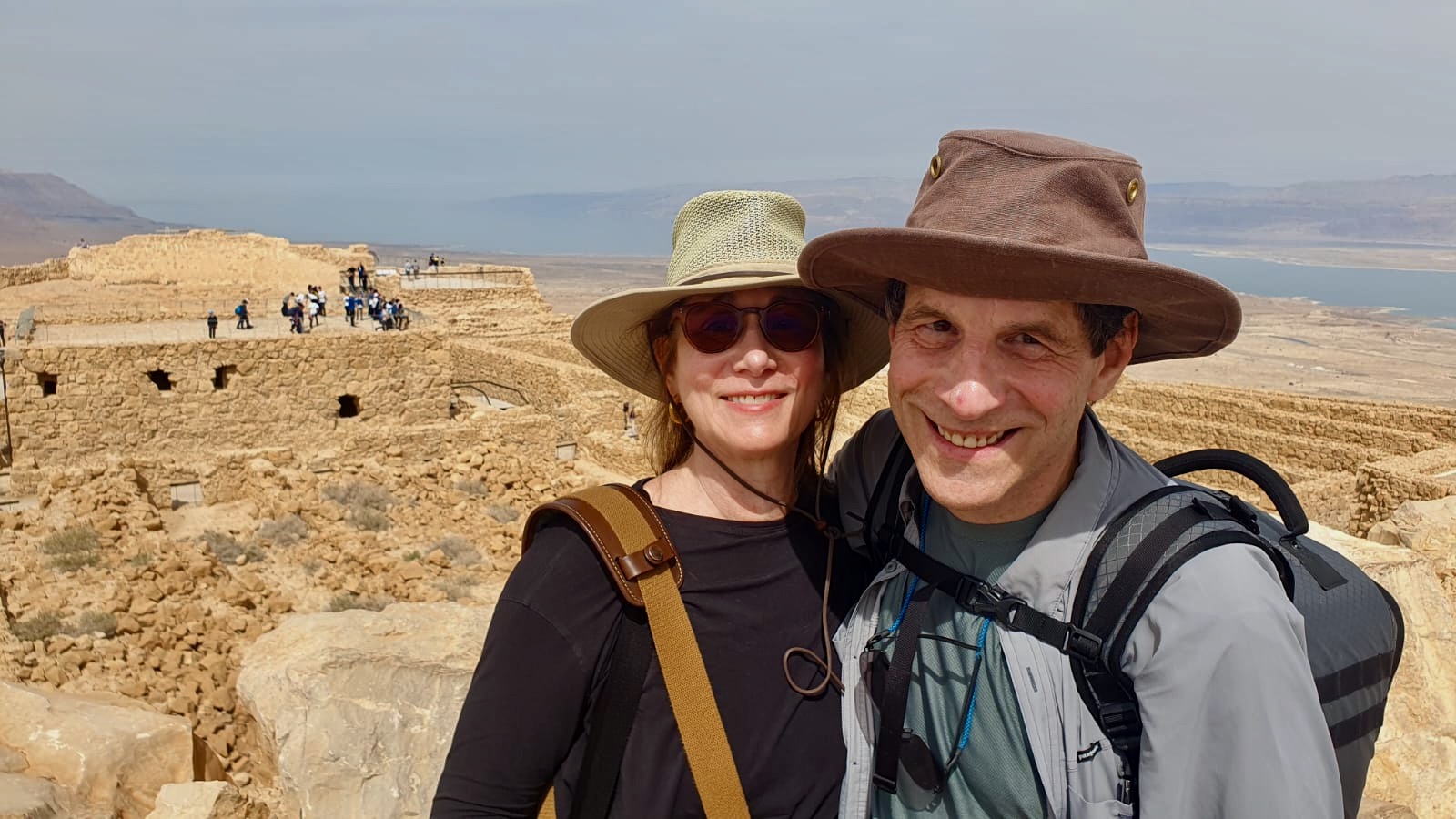
An oncologist and medical school professor, Dr. Ruth Oratz spends most of her time treating breast cancer patients and training medical students, and she conducts clinical research on cancer treatments. But it was her ordinary research skills that brought her to the gates of the Weizmann Institute of Science.
Ruth is a clinician at New York University Langone Health, and Clinical Professor of Medicine at NYU’s Grossman School of Medicine (GSOM). She has also chaired the school ethics committee and has served in numerous academic and administrative roles. She and her husband, Dr. Albert Knapp, also Clinical Professor of Medicine at NYU GSOM, is a gastroenterologist and internist, have multiple degrees from some of the most prestigious U.S. institutions, including Harvard and Columbia. But several years before the Hamas attacks of October 7, 2023, they were already feeling uncertain about their ongoing giving to their alma maters. They began to sense burgeoning antisemitism on those campuses, the growth of the BDS movement, and increasing anti-Israel sentiment.
“I just felt that the administrations were putting up with a lot of really negative messaging about Jews and Israel. So we took pause about where to devote our attention, and future philanthropy,” says Ruth. “Albert and I don’t have children, and we really needed to think about our testamentary giving. I wanted to find an institution that truly embodied what we believe in, that we trust, and which could carry forward the legacy we wish to leave to the world.”

By 2022, Ruth and Albert had found their destination: the Weizmann Institute would be a beneficiary in their will, through the American Committee. Today, they are increasingly active in the Institute: Ruth is new member of Weizmann’s International Board, serves on the Board of the American Committee, and the couple were recently inducted into the prestigious President’s Circle of the Institute’s most generous donors.
“It is a great honor to have friends like Ruth and Albert who are such accomplished physicians and know medicine and biomedical research inside and out—and who took the initiative and chose to befriend and give generously to the Weizmann Institute,” says Weizmann President Prof. Alon Chen.
Science and education in the family
“Like a kibbutz on Long Island” is the way Ruth describes her unusual American upbringing. Her parents and maternal aunt and uncle had bought houses next to each other, so Ruth grew up with her own sister, and her cousins, aunts and uncles, and also her grandfather. The tight-knit extended tribe gave her a sense of the value of family and community before she took her first steps. Israel was a theme of their lives, and her grandfather often told stories about his time spent in British Mandate Palestine as a solider in the British Army during WWI. Her father served in the US Navy during WWII.
As the years passed, science and education were the through-lines of her youth. Her mother was a lifelong educator—a schoolteacher and principal, and ultimately an assistant chancellor of the New York City Board of Education. Rosalyn Oratz ran a citywide reading program that raised the literacy levels across the city. “My mother would say, ‘If you teach a child to read, you will unlock the Universe for them.’”
Murray Oratz, now almost 99, a biochemist who worked on protein synthesis, in particular the role of messenger RNA (mRNA) and transfer RNA (tRNA) in the synthesis of albumin. The height of his career coincided with the early days of the study of RNA. The discovery of DNA in 1953 had opened up the question of how information encoded in DNA gets translated into proteins, spurring research into RNA molecules that might act as intermediaries.
“As a professor, my father also taught, so between him and my mother there was an atmosphere in the house of education, free thinking, asking questions, and trying to understand how things work and why things are the way they are. It was also a real balance between the sciences and the humanities,” recalls Ruth. “We used to have formal dinner parties with scientists and colleagues from my father’s network, and my mother’s friends who were in teaching and the arts. And we were always reading.”
Ruth and her sister traveled extensively with their parents, accompanying them on many work trips, not only vacations. Motivated by the Six-Day War, the family went to Israel in 1968, when Ruth was 12. “It was a wondrous trip,” she recalls. Her father decided a visit to the Weizman Institute was an important stop. On campus, they visited the Weizmann House and were moved by the story of Dr. Chaim Weizmann, whose work as a chemist assisted the British Army in WWI and led to the Balfour Declaration.
“My father, as a scientist, was very excited by the fact that the Zionist movement and the creation of Israel was paved through science,” she recalls.
Careers in science and medicine

Already at age six, Ruth knew with certainty that she wanted to be a doctor. Having spent ample time in the lab with her father, she developed deep respect for scientific research, but one thing attracted her more. “I thought the doctor’s office was the coolest thing in the world,” she says. “I loved that big leather examination table and the paper pulled over it. I loved that the pediatricians examined me and vaccinated me. I loved how they talked to me and asked me questions and listened carefully to her answers. It was simply fascinating. To me, medicine was also the perfect combination of science and care for the human being.”
As an undergraduate at Radcliffe College, she read Dante in her literature class, and at the same time her math professor also referenced the famous Italian poet and philosopher in his class. Ruth figured the coincidence “was divine providence”—a sign that she should feed her curiosity for the context in which medicine emerged and exists. She majored in the history and philosophy of science.
“I wanted to try to understand how people thought about health and sickness,” she says. “What does it mean to be healthy or ill on an individual level, a community level, or societal level? When you learn that in the Middle Ages, plagues wiped out a third of the population of Europe, you question how does a society respond and prevent it from happening again?” Rather than focusing on public health or global health, these questions led to her to consider how physicians might intervene on an individual level, to help patients.
Next, she ventured off on a year-long fellowship in France before attending Albert Einstein Medical School in New York City. At Einstein, in addition to the essential coursework, she was drawn to scholarship in medical ethics. At that time—the 1980s—a key ethical quandary in medicine was how to handle end-of-life care and the definitions of brain death versus cardiac death. The advent of new technologies like ventilators and new life-sustaining drugs were driving these discussions.
“We explored questions like, ‘When do we intervene?’ and ‘When do we stop?’ Physicians, philosophers, and social scientists were weighing in on these kinds of questions and they really interested me,” she recalls.
On a clinical rotation in internal medicine, she and Albert met. He was doing his residency. They hit it off, becoming good friends. But their lives took different turns and they married different people. Ruth did her internship and residency at Bellevue Hospital and began her career in oncology at NYU. Albert—who had received his medical degree from Columbia University before his residency—set off for a fellowship at Harvard’s Brigham and Women’s Hospital in Boston. Eventually, both pursued careers in medicine in New York, but didn’t cross paths again for 15 years.
Throughout that time, Ruth passed Albert’s private office on her regular jogs to Central Park and noted the shingle indicating his medical practice—but never knocked on the door. When they were both divorced and single, a mutual friend reintroduced them. “It was as if not a day had passed since we’d last seen each other in medical school,” Ruth says. They were married soon after.
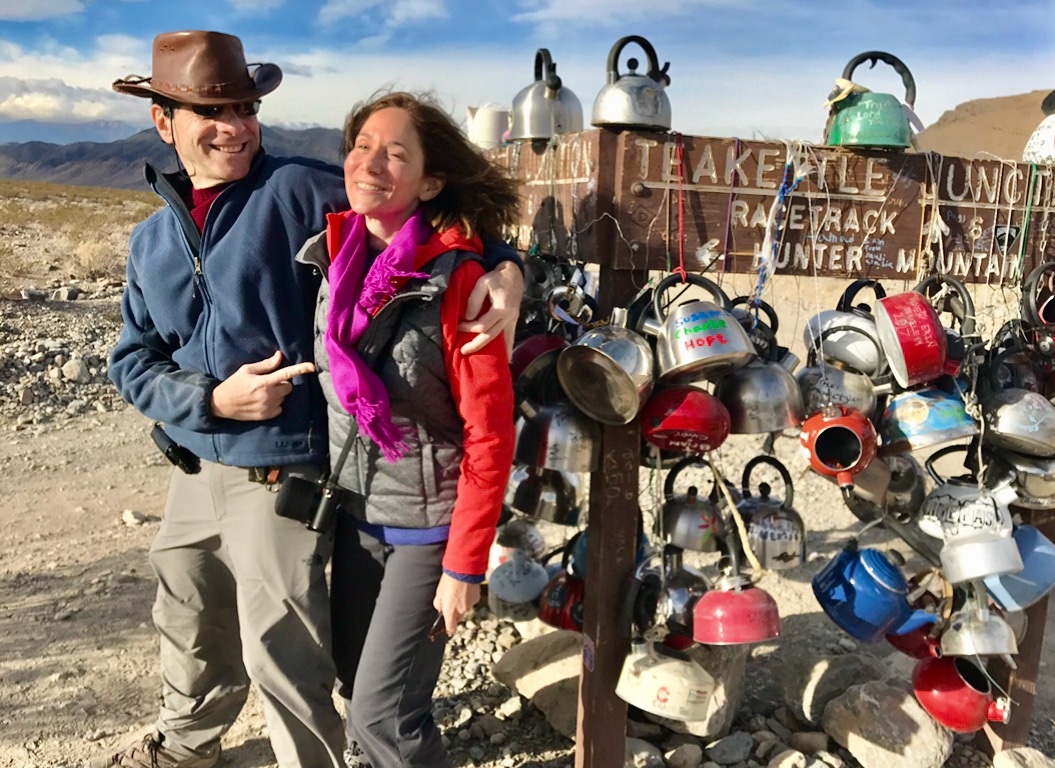
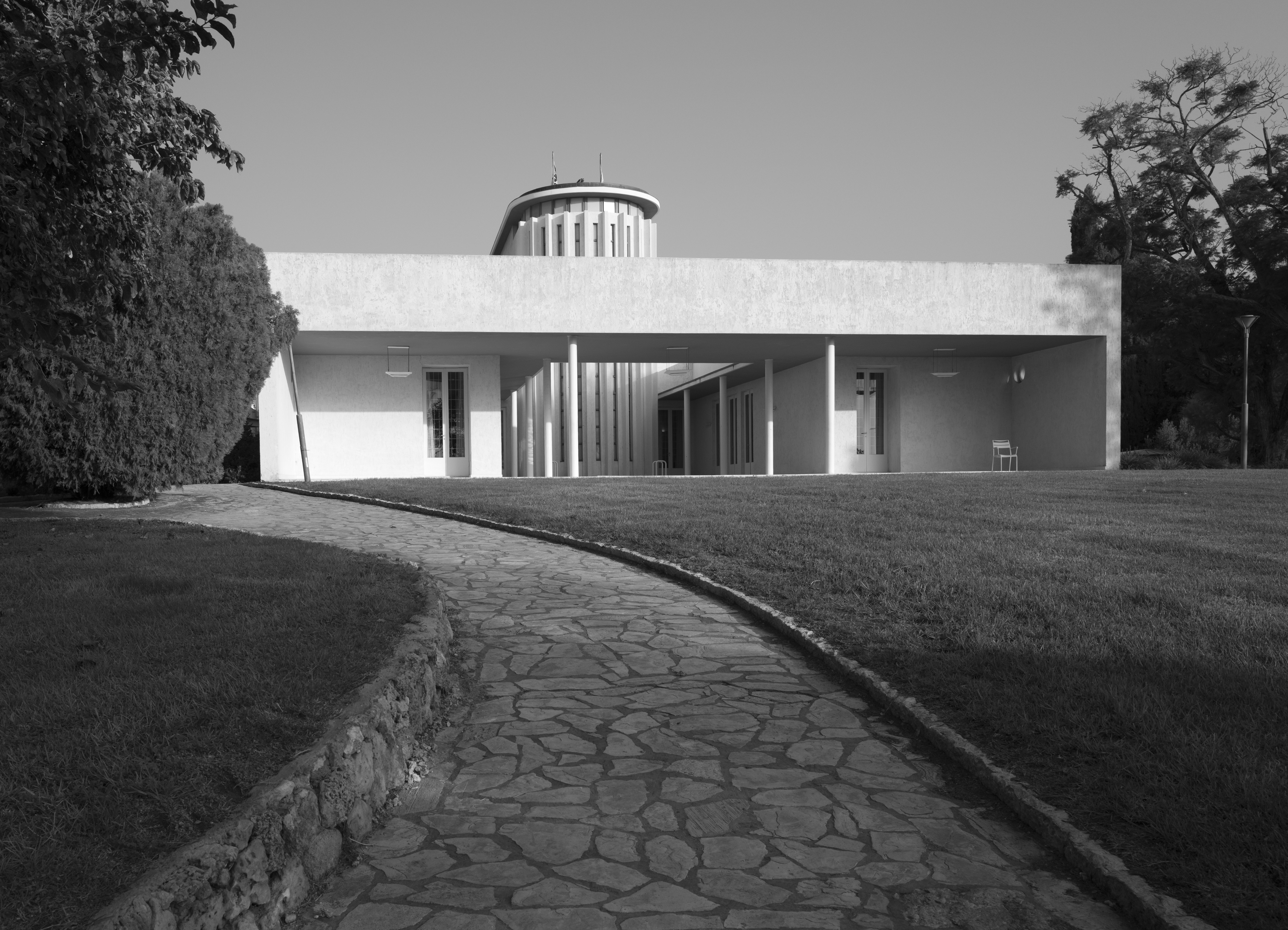
When they are not working long days, the duo travels extensively together and are amateur photographers with impressive photography collections. (The photographs that accompany this story represent a small selection from her wanderings and observations around campus in 2025.) Their interests are diverse: Ruth is also one of the founders of the Bellevue Literary Review, an independent literary journal at the intersection of the arts and science inspired by the traditions of Bellevue Hospital and NYU that brings together the perspectives of patients, caregivers, and others in the hospital’s community. Albert is a devotee and expert in history, particularly military history and political science, and is a member of the Council on Foreign Relations.
The Weizmann connection
Thirty years after her first trip to Israel in the late 60s, Ruth came on her second trip in 2000. Following the discoveries of the BRCA1 and BRCA2 tumor suppressor genes in breast cancer, Ruth helped lead clinical trials for patients carrying mutations in these genes, which can greatly increase risk of breast cancer. Aware of the high incidence in Israel, and among Ashkenazi women in particular, Ruth attended a conference on the Weizmann campus on the topic, and among other meetings, met with oncology colleagues at Hadassah Hospital.
In the last decade, as they began to think seriously about their philanthropic legacy and were at the same time becoming increasingly disillusioned by the intellectual atmosphere in the academic institutions they had attended, Ruth spent time reading and researching—a task that took her on a spree of reading, comparison, and contemplation. Her personal experiences at Weizmann and her growing body of knowledge of the institution continued to draw her in.
“I told Albert: Weizmann is perfect for us. Here’s an independent scientific institution that is doing the best science in the world. The research is amazing. And not just in the biomedical sciences—which is what we tend to care about most—but also in astrophysics, mathematics, chemistry, and environmental sciences. Across the board, the level of excellence was astonishing.”
There was another appeal. Weizmann’s hiring model—based on excellence, not filling quotas and positions being vacated—felt like an epiphany amidst the focus on diversity, equity and inclusion (DEI) popular at many of the institutions she was familiar with. “Weizmann has a clean, pure model. You can trust that Weizmann is hiring the best people in the field, with no other considerations other than the outstanding nature of their research.”
She also reminisced about her previous visits to campus, and how her father was moved by the Chaim Weizmann story. “But that was just the starting point,” she says. “The more I learned about Weizmann, the more I realized how special it is. The model of the scientists living on campus and fertilizing each other’s imaginations. The total academic freedom, the productivity going in a positive direction, free of politically motivated agendas, tangibly benefitting humanity and the planet. And—on top of all that—it is in Israel. I looked at other places in the US, and in Israel, and I kept coming back to Weizmann until I realized there was no reason to look any further.” She reached out to the American Committee.
Then, October 7 happened. In its wake, anti-Israel student protests erupted on the very campuses they had graduated from, validating all their concerns in the previous few years.
Advocacy in the medical world
In the immediate aftermath, she recalls, “my NYU colleagues and I were at a tremendous loss as to what to do. We started texting each other, discussing how we can help Israel.” They reached out to the medical school dean and board chair, encouraging them to express a strong commitment to Israel and a willingness to help.
“At that point, it was about helping Israel—we didn’t think about the need to support our Jewish community within the school. Within a week, we had 800 physicians eager to support Israel and donating funds for Israel, including for an ambulance and supplies.

But even before Israel’s incursion into Gaza began, the anti-Israel protests began and after the incursion, “the narrative quickly changed. All that we were hearing was that Israel was killing innocent Palestinians—and the idea that a sovereign country has a right to defend itself just evaporated into thin air. And then it morphed pretty quickly into the genocide message, and the outbursts on campuses and social media were horrific—like nothing we could have imagined.” The organized nature of the protests, their foothold in academia, the fact that the epicenter was at Columbia University in New York and Harvard University in Cambridge, and the anti-Israel statements published by several medical journals provided more and more fuel to the fire.
She and a small group of colleagues saw a burgeoning need for mutual support among Jews in the healthcare professions, including medical students, in the face of rising antisemitism and anti-Israel sentiment. Together, they established the American Jewish Medical Association. Within two years, it grew to include nearly 2,000 members across the US.

In its first year, the Association was primarily focused on pushing back against misinformation, discrimination, and hate speech. Eventually, it grew into an informal network of colleagues who serve as sounding boards and mentors, a platform for educational seminars and a launching pad for interactions with Israeli medical colleagues. Those have resulted in collaborations with physicians at Israeli hospitals, including one on prosthetics for amputees and trauma medicine. The Association is funding a major study by the renowned Brandeis University scholar of contemporary Jewish studies and social policy, Prof. Leonard Saxe, on antisemitism in American medicine.
Since October 7, Ruth’s and Albert’s commitment to Weizmann, “as an Israeli institution that strengthens Israel and the world at the same time”, she says, has only deepened.
In 2024, she traveled to the Atacama Desert in Chile with a small Weizmann group of astrophysicists and management to see the Giant Magellan Telescope, an international collaboration in which Weizmann is a leading partner. While her interest is mainly in the life sciences, the trip solidified her appreciation for Weizmann’s broad reach across the sciences.
In 2025, Ruth joined the Institute’s International Board. On campus for the 77th Annual General Meeting, she met with the first cohort of students in the Miriam and Aaron Gutwirth Medical School. She was deeply impressed because, she points out, while most MD-PhD programs separate MD and PhD studies chronologically, the Weizman program fully integrates the study of medicine and the pursuit of basic research throughout the entire seven-year training period.
Furthermore, the cohort is small—the first year had 18 students and will ramp up to 40—enabling interaction and collaboration. “I saw how the students, when studying any clinical subject, are expected to be simultaneously asking a research question,” she says. “This program will graduate doctors who are always thinking about what needs to be explored more deeply in research, and it will graduate scientists who are always keeping patient treatment in mind.”