
Near-Field ISAC & Semantic Communications
With the commercial deployment of 5G networks, researchers in both academia and industry have turned their attention to the development of sixth-generation (6G) wireless networks. These future systems aim to deliver higher data rates, improved energy efficiency, lower latency, enhanced security, and integration of radar functionality. To support these ambitious goals, our group focuses on the following key technologies for 6G: Integrated Sensing and Communication (ISAC), Near-Field Wireless Communications, and Dynamic Metasurface Antennas (DMAs).
Integrated Sensing and Communication (ISAC):
In next-generation communication systems, sensing capabilities are expected to support applications such as intelligent transportation, smart cities, and industrial automation. ISAC, also known as Dual-function Radar and Communications (DFRC), merges radar and communication functionalities within the same system. This integration enables spectrum sharing, reduces hardware complexity, and improves power efficiency. To this end, we pursue two complementary ISAC research directions: Bi-static MIMO ISAC for URLLC Prioritization: We propose a bi-static MIMO ISAC system to detect targets and trigger ultra-reliable low-latency communication (URLLC) within ongoing eMBB transmissions. In particular, we deploy a sensing receiver to sense targets and employ dirty-paper coding to mitigate interference, optimizing the rate–reliability–detection trade-off in the finite-blocklength regime. Agile Radar with Index Modulation and Precoder Design: We investigate embedding digital communication methods into radar operations to ensure reliable joint functionality with minimal interference. In particular, we explore the use of agile radar combined with index modulation and the design of dedicated precoders for simultaneous radar and communication support.
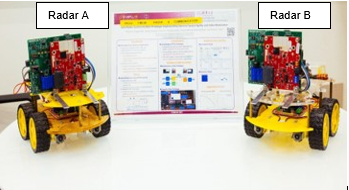

Extended Line of Sight based on Joint Radar and Communication.
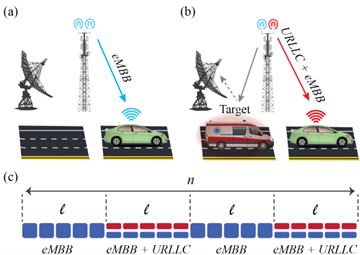
MIMO ISAC System for Ultra-Reliable and Low-Latency Communications.
References:
- H. Nikbakht, Y. C. Eldar and H. V. Poor, "An integrated sensing and communication system for time-sensitive targets with random arrivals", IEEE Journal on Selected Areas in Communications, vol. 44, 2026.
- F. Liu, Y. Cui, J. Xu, T. X. Han, Y. C. Eldar and S. Buzzi, "Integrated Sensing and Communications: Towards Dual-functional Wireless Networks for 6G and Beyond", IEEE Journal on Selected Areas in Communications, vol. 40, issue 6, pp. 1728-1767, June 2022.
- T. Huang, N. Shlezinger, X. Xu, Y. Liu and Y. C. Eldar, "MAJoRCom: A Dual-function Radar Communication System Using Index Modulation", IEEE Transactions on Signal Processing, vol. 68, pp. 3423–3438, 2020.
Demos: https://www.weizmann.ac.il/math/yonina/software-hardware/hardware/joint-radar-communications-systems
Near-Field Wireless Communications:
With the use of large-scale antennas and higher frequencies, future wireless systems will increasingly operate in the near-field (Fresnel) region. Unlike the far-field regime characterized by plane wave propagation, the near-field supports spherical wavefronts and distance-dependent radiation patterns. This makes beam focusing—targeting a specific location rather than a direction—feasible, enabling multiple coexisting links even at similar angles. Our research explores how beam focusing in near-field conditions enhances spatial multiplexing and supports new communication paradigms for 6G.
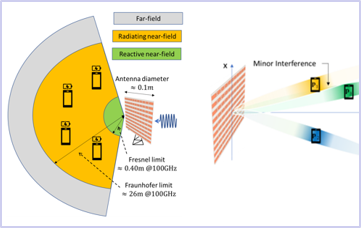
Near-Field Wireless Communications.
References:
- H. Zhang, N. Shlezinger, F. Guidi, D. Dardari and Y. C. Eldar, "6G Wireless Communications: From Far-Field Beam Steering to Near-Field Beam Focusing", IEEE Communications Magazine, vol. 61, issue 4, pp. 72–77, April 2023.
- H. Zhang, N. Shlezinger, F. Guidi, D. Dardari, M. F. Imani and Y. C. Eldar, "Beam Focusing for Near-Field Multiuser MIMO Communications," in IEEE Transactions on Wireless Communications, vol. 21, no. 9, pp. 7476-7490, Sep. 2022.
Dynamic Metasurface Antennas (DMAs):
DMAs offer a low-cost, energy-efficient alternative to traditional large-scale antenna arrays. As practical implementations of large intelligent surfaces, DMAs allow for programmable control of transmit/receive beam patterns while enabling advanced analog signal processing and RF chain reduction. Their compact and dense structure supports enhanced communication performance through spatial diversity and reduced interference. We investigate the application and optimization of DMA in wireless communication and power transfer to jointly design beamforming and energy-focusing patterns that maximize spectral efficiency and wireless power delivery under practical hardware constraints.
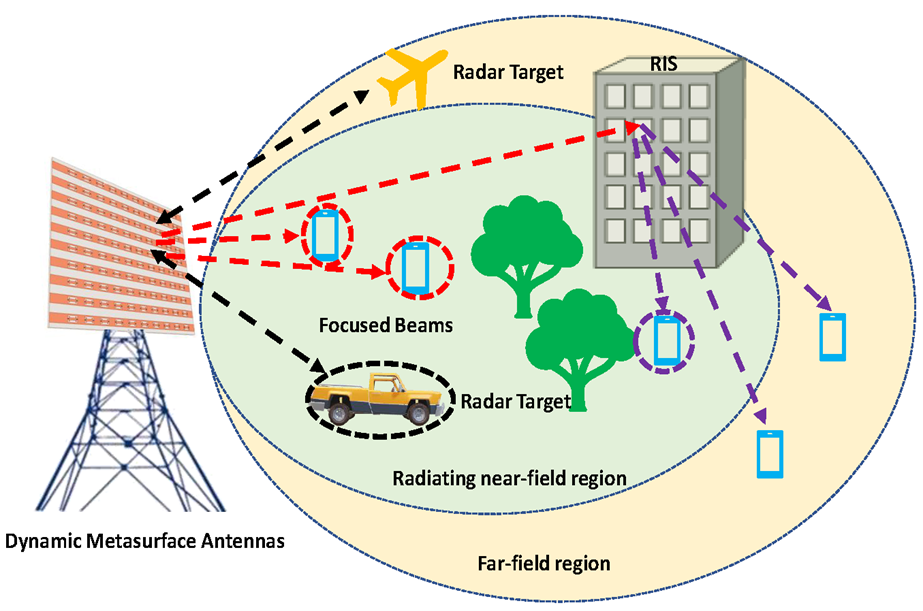
Dynamic Metasurface Antennas (DMA).
References:
- N. Shlezinger, G. C. Alexandropoulos, M. F. Imani, Y. C. Eldar and D. R. Smith, "Dynamic Metasurface Antennas for 6G Extreme Massive MIMO Communications", IEEE Wireless Communications Magazine, vol. 28, issue 2, pp. 106-113, April 2021.
- H. Zhang, N. Shlezinger, F. Guidi, A. Guerra, D. Dardari, M. F. Imani and Y. C. Eldar, "Near-Field Beam-Focusing for Wireless Power Transfer With Dynamic Metasurface Antennas", IEEE Internet of Things Journal, 2025.
- R. Zhang, H. Zhang, Y. Zhang, H. Ruan, H. Chen, and Y. C. Eldar, "Sum-Rate Maximization for DMA-Based Wideband Near-Field Systems with Lorentzian Responses," in Proc. IEEE Int. Conf. Acoust., Speech, Signal Process. (ICASSP), 2026.