


Daphne
Meidan (Alumni)
Daphne Meidan was previously a postdoctoral associate at Cornell University, working in the research group of Prof. Natalie Mahowald and Prof. Peter Hess. She holds a PhD in Chemistry from the Weizmann Institute of Science in Israel, where she specialized in studying the chemical reactions of nitrogen oxides, gas-to-aerosol phase interactions, and tropospheric ozone, under the supervision of Prof. Yinon Rudich.
In her research, Daphne focused on understanding the intricate iron aerosol-chlorine reactions and their impact on methane removal from the atmosphere. Utilizing the global climate model, Community Earth System Model (CESM), she aimed to investigate the complex relationship between these reactions and their effect on methane concentrations. Her work has made significant contributions to the critical examination of a climate intervention approach targeted at methane and its climate feedback.
Beyond her academic pursuits, Daphne actively engages in a range of community and educational activities. At Cornell, she played a pivotal role in supporting a student-led diversity and inclusion group, where she contributed to the development of a conflict-solving platform. At the Weizmann Institute, she hosted two teachers in the lab as part of their teaching certification studies, providing them with insights into her research and its practical applications.
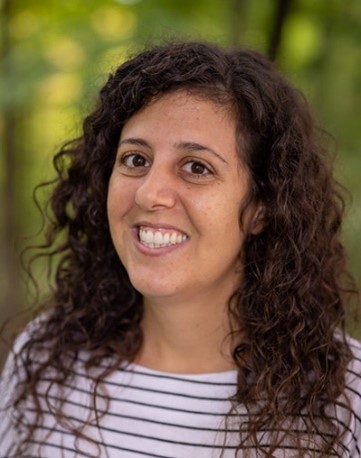
- Where are you originally from?
-
I was born and raised in Yavne, Israel. My mother was a biology professor at the nearby Faculty of Agriculture, Department of Animal Sciences. She inspired me and my sisters to pursue scientific career paths.
- Where does your interest in science, the environment, and sustainability come from? What was your path to Weizmann?
-
I was interested in environmental topics from an early age, and since my bachelor’s degree I aspired to study at the Weizmann Institute of Science. I completed my B.Sc. at the Department of Material Engineering at the Ben Gurion University of the Negev and later continued to an M.Sc. at the same department, in collaboration with Environmental Engineering. After that, I decided to pursue a PhD at the Weizmann Institute of Science, under the supervision of Prof. Yinon Rudich.
- What did your research focus on at WIS, and what does your current research focus on?
-
During my BSc, I implemented a theoretical concept studied by my advisor, Prof. David Katoshevski, to improve water treatment facilities. My work helped demonstrate the feasible potential of this project, which resulted in the issuance of a patent.
During my PhD, I developed an optical system for measuring the concentration of NO3, an atmospheric nighttime oxidant. Later, I started developing near-explicit chemical box models with multiple reactions to explain nocturnal oxidation processes of natural (biogenic) organic compounds due to pollutants. For my PhD work, I received the Shimon Reich Memorial Prize of Excellence in recognition of my achievements.
At my postdoc at Cornell University, together with Prof. Natalie Mahowald and Prof. Peter Hess, I focused on understanding the intricate iron aerosol-chlorine reactions and their impact on methane removal from the atmosphere. Using a global climate model - Community Earth System Model (CESM), I investigated the complex relationship between these reactions and their effect on methane concentrations. I was responsible for the critical examination of a climate intervention approach targeted at methane and its climate feedback. I recently moved to Madrid, to the Spanish National Research Council (CSIC) where I am working with Prof. Alfonso Saiz-Lopez to conduct an additional postdoc. Using the tools I acquired during my time at Cornell, I strive to understand the natural interactions between dust and halogens, and their impact on methane and ozone concentrations and other climate feedbacks.
- Why did you want to become an IES Fellow? How did being an IES Fellow impact your work?
-
I heard about the program in its first year from my PhD advisor Yinon Rudich. Ever since I joined the fellow program, I was curious and excited to meet people from different departments and disciplines across campus, and to learn from them. I am still friends with and in touch with many of them. From a social perspective, the other fellows gave me a sense of support, and an opportunity to exercise and develop skills that were not part of my daily activities. The experience was a chance to share scientific ideas and conduct scientific discussions on topics far from my own, in a common language that we all shared, even though we came from diverse backgrounds.
- What perspectives have you gained as a postdoc on your experience as a PhD and SAERI/IES Fellow at WIS?
-
At Cornell there is a wonderful environmental initiative that WIS can learn from, regarding more organizational aspects of a “green campus”. But as an intimate platform for students, the SAERI Fellows’ program is a very unique feature of WIS that can set an example for other institutions.
- What are your plans for the future?
-
I would like to stay in academia and therefore am currently beginning a second postdoc in Spain. Eventually, I would like to come back to Israel and to WIS in particular.
- To complete the picture: Formal Background
-
Daphne completed her B.Sc. in Material Engineering in 2013 at the Ben Gurion University of the Negev, where she continued in her M.Sc. in Environmental Engineering. She gained her Ph.D at the Department of Earth and Planetary Sciences at the Weizmann Institute, under the supervision of Prof. Yinon Rudich. In 2021, after completing her Ph.D., she was a postdoctoral fellow at Cornell University in the US (2021-2023) and she recently relocated to Spain to conduct an additional postdoc at CSIC. At the Weizmann Institute, Daphne was awarded the Shimon Reich Memorial Prize of Excellence (2019) and the SAERI Fellowship (2018-2021).