


Center for Climate Research

About
Climate change is arguably the greatest challenge we will face in the coming decades, and climate research plays a crucial role in understanding and responding to this urgent challenge. Climate research helps us understand the causes, mechanisms, and impacts of climate change. It enables an assessment of vulnerabilities and risks associated with the impacts of climate change, and provides valuable information for the development of effective strategies to mitigate and adapt to climate change.
Climate research improves climate models, refining predictions of future climate scenarios and aiding in decision-making. It supports international agreements and frameworks by providing the scientific foundation for negotiations, policy development, and monitoring of progress. It also promotes innovation and the development of technology by uncovering opportunities for renewable energy, sustainable agriculture, and other climate-friendly solutions. By providing the knowledge and evidence necessary to address climate change challenges, climate research lays the foundation for working towards a sustainable future.
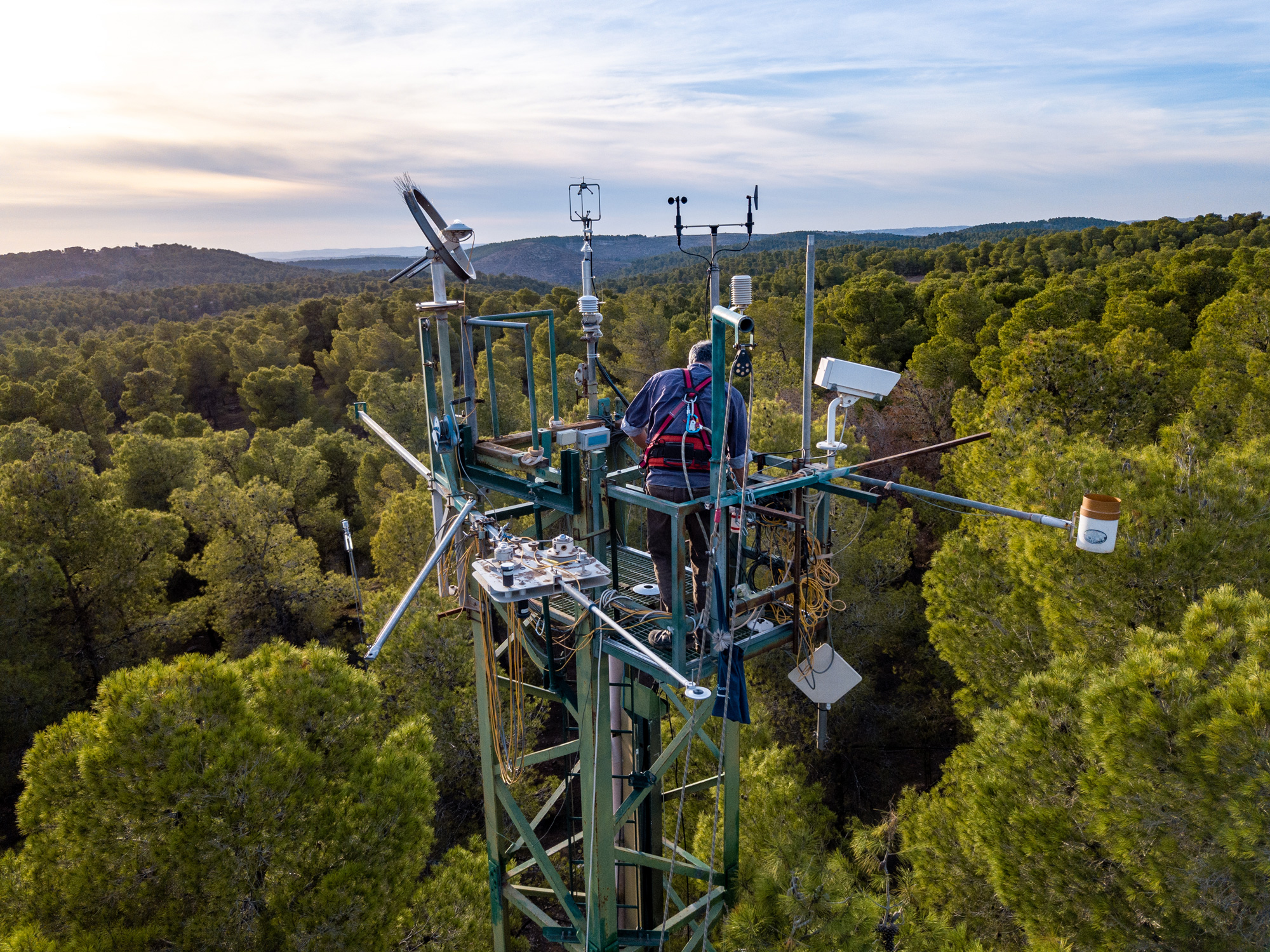
The Center for Climate Research engages scientists with a wide range of expertise to address the grand challenges of climate change. It supports climate and weather observations, theoretical and modeling studies, and investigations of climate feedbacks and the carbon cycle, among other topics. The Center further bridges these approaches to encourage collaborative, multidisciplinary, synergetic studies and provides a framework for interaction among the Center’s members. Through the activities of the Center for Climate Research, the Weizmann Institute aims to divert one of the greatest threats to humanity.
Topics studied at the Center for Climate Research include:
- Atmospheric dynamics
- Dynamic meteorology
- Cloud physics and the climate impact of clouds
- Terrestrial and marine carbon cycle
- Paleoclimate reconstructions
Prof. Itay Halevy

Itay Halevy is a professor in the Department of Earth and Planetary Sciences at the Weizmann institute who studies the long-timescale evolution of Earth systems. In his research, Prof. Halevy deciphers the chemical and isotopic fingerprints of the biogeochemical processes encoded in the rock record. With a mechanistic understanding of these processes and how they have varied through geologic time, he attempts to shed light on topics ranging from the most basic controls on Earth’s surface environment to the most extreme episodes in the chemical, biological and climatic evolution of the planet.
Prof. Halevy earned BSc degrees in Geology and Computer Science from Ben-Gurion University in the Negev, and his MSc and PhD in Geochemistry from Harvard University, where he was the recipient of a Fulbright Graduate Fellowship, a Harvard University Origins of Life Initiative Fellowship, and NASA Earth and Space Science Fellowship, among other awards. For his postdoctoral work at the California Institute of Technology, he was awarded the Texaco Prize Postdoctoral Fellowship and the Sussman Center for Environmental Sciences Fellowship from the Weizmann Institute.
Prof. Halevy joined the Department of Earth and Planetary Sciences at the Weizmann Institute of Science in 2011. He was awarded the Sir Charles Clore Prize for Outstanding Appointment in the Experimental Sciences (2011), a Yigal Alon Fellowship from the Israeli Council for Higher Education (2012), the Krill Prize for Excellence in Scientific Research from the Wolf Foundation (2016), and the Scientific Council Prize for Chemistry at the Weizmann Institute (2018).
In 2020, Prof. Halevy was elected to the Israel Young Academy, and in 2023 he was elected Chair of the Young Academy. He has been awarded two starting grants from the European Research Council and serves as Chair of the Climate Advisory Committee to the Ministry of Education. In addition, he is a member of the National Committee for Planning and Budgeting’s Climate and Energy Panel, and a member of the Steering Committee on Climate Risks on behalf of the Israeli Academy of Sciences and Humanities.
Research Highlights
- Understanding the relationship of changes in atmospheric circulation to human activity
-
The rapidly changing climate in recent and coming decades is one of the largest challenges of our time, and deserves immediate attention from science and policymakers. Motivated by this challenge, Dr. Rei Chemke's research focuses on understanding the physical mechanisms underlying human induced large-scale flow changes in the atmosphere and ocean, and their climatic impacts (e.g., changes in precipitation, temperature, ice, etc.). Large-scale climate phenomena play a central role in the distribution of the climate zones on Earth by transferring heat, moisture, and momentum across different regions.
These processes are investigated by applying a theoretical understanding of large-scale thermodynamic and dynamic phenomena to observations and the latest suite of climate models. For example, the two most important uses of climate models are for the attribution of climate change signals to human activity and for multi-decadal climate projections. However, the lack of an observed wind record has prevented scientists over the past two decades from revealing how one of the major components in the climate system, the Hadley cell -- which largely contributes to regional precipitation and temperature patterns in tropical-subtropical areas, has been changing in recent decades, and how much of this change may be attributed to human activity.
To address this knowledge gap, Dr. Chemke derived a mathematical relationship between Hadley cell strength and sea level pressure, and used observations of sea-level pressure to show that the Hadley cell has been weakening in recent decades and that this weakening can be attributed to anthropogenic emissions. The ability of climate models to adequately capture this weakening increases our confidence in their tropical climate projections.
- Developing AI-based tools to understand climate and weather phenomena driven by remote sensing, reanalysis, and in-situ data
-
The critical importance of early prediction of severe weather and climate phenomena cannot be overstated, particularly in mitigating the impacts of global climate change. This is especially true in the Eastern Mediterranean and Middle East (EMME) region, identified by the IPCC and WMO as an area highly susceptible to the adverse effects of climate change.
Traditional methods used in operational weather forecasting primarily rely on complex numerical simulations based on physical models. However, these models have their limitations -- they struggle to adapt to new patterns observed in real-time and to effectively utilize the enormous amount of diverse climate data and observations available. While artificial intelligence (AI) has transformed many aspects of human life, it has yet to fulfill its promise in extreme climate event prediction.
Prof. Yinon Rudich’s team is addressing this gap by designing innovative AI models that are both grounded in physics and driven by data. These models are specifically tailored to meet the challenges presented by extreme weather events, focusing on the most pressing climatic issues in the EMME region. Specifically, the group’s studies focus on developing a comprehensive understanding of and predictive capabilities for a variety of critical weather phenomena in the region. These include dust storms from various sources, incidents of high pollution events, heat waves, and floodings. By doing so, the group aims to improve our ability to forecast these events, enhancing our readiness and reducing the potential harm they can cause.
- Understanding the relevance of Mediterranean cyclones to the generation of high impact weather
-
Changes to weather and its extremes in the densely-populated Mediterranean region are key for understanding the environmental implications of climate change, and are of immediate concern to society. In this region, cyclones cause most high-impact weather events, ranging from heavy precipitation, storm surges, strong winds, extreme temperatures and dust storms.
In the lab of Dr. Shira Raveh-Rubin, the atmospheric dynamics and physics governing those weather systems and their impacts are systematically examined, considering thousands of cyclones from the past decades. Understanding these dynamical interactions is key for evaluating numerical model simulations that provide forecasts to reduce risks. This research enables a process-based evaluation of our current modeling capabilities, with the aim to ultimately reduce uncertainties and improve predictions on both weather and climate time scales.
Research Groups


IES Fellows




Barack Obama
We are the first generation to feel the impact of climate change and the last generation that can do something about it.
UN Secretary-General Antonio Guterres
The climate emergency is a race we are losing, but it is a race we can win.
Dalai Lama
It is our collective and individual responsibility to protect and nurture the global family, to support its weaker members and to preserve and tend to the environment in which we all live.
Albert Einstein
Look deep into nature, and then you will understand everything better.
Kofi Annan
Former Secretary-General of UN
The world is reaching the tipping point beyond which climate change may become irreversible. If this happens, we risk denying present and future generations the right to a healthy and sustainable planet – the whole of humanity stands to lose.
Native American Proverb
We do not inherit the earth from our ancestors, we borrow it from our children.