


Dr.
Vivek
Singh (Alumni)
Vivek Singh was previously a PhD student working on porous materials under the supervision of Prof. Milko van der Boom in the Department of Molecular Chemistry and Materials Science at Weizmann Institute. He has a BSc in Physics, Chemistry and Mathematics from Veer Bahadur Singh Purvanchal University in Jaunpur, India and an MSc in Chemistry from the Indian Institute of Science Education and Research Bhopal, India.
In his PhD work, Vivek sought to answer critical questions in chemistry, including whether multi-domain morphology and concave angles always correspond to polycrystallinity, how to modulate morphology without changing the crystal structure, and what are the differences between ‘solution-structure’ and ‘surface-structure’ formed from similar starting materials. In his work, he has synthesized and studied the crystal forms, such as multidomain and concave single crystals, that do not follow the conventional crystallographic rules.
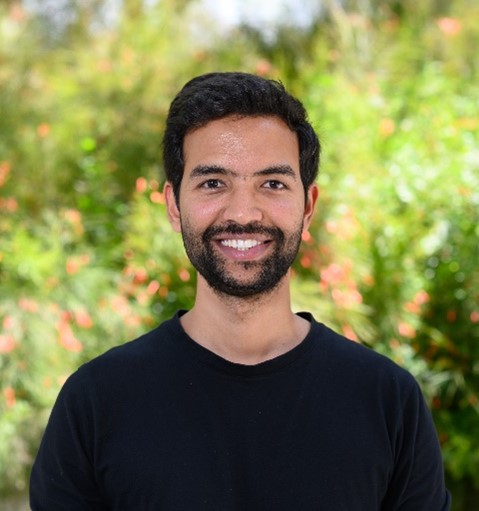
- Where are you from?
-
I was born in a village near Azamgarh, Uttar Pradesh, India. I am the youngest of three brothers, and the first in my extended family to pursue an academic career in science.
- Where does your interest in science, the environment, and sustainability come from?
-
Only in retrospect do I understand that my interest in these topics is rooted in my childhood. Growing up, I was always surrounded by my immediate and extended family – my grandmother, grandfather, uncles, aunts, and cousins. My grandfather especially had a great influence on me. He used to ride his bike everywhere, until he was 90 years old! He encouraged me to do the same, not only for my mental and physical health, but also for the environment—though he did not use the same terms that we use today, like “sustainability”. Looking back, I understand that my grandfather in his own way was trying to preserve simple, “older” customs that were closer to nature.
My interest in chemistry was sparked by my high school chemistry teacher, Mr. Pradeep Pandey. He taught chemistry in simple terms, using daily language which helped me to understand the material and drew my interest. I ended up majoring in chemistry in high school and later studying it at college and university.
- What was your path to Weizmann?
-
My MSc advisor was Prof. Joyanta Choudhury, who works on carbon capture and hydrogen storage at the Indian Institute of Science Education and Research in Bhopal, India. Joyanta was a postdoctoral fellow at Scripps Research in the United States, but when Prof. Milko van der Boom offered him a postdoc position he relocated to Israel. He did his postdoc at Weizmann in 2011, and Joyanta always told me exciting stories about Milko and the Institute. That sparked my interest in Weizmann, and indeed my advisor made the initial connection for me with Prof. van der Boom’s group.
- What does your research focus on?
-
My PhD research focuses on understanding the growth of metallo-organic frameworks, which is a topic that is currently studied in many research institutions. It has huge applicative potential, and I am interested in finding ways to create and design new properties for these materials – to be able to use them for energy storage, as catalysts, and for water harvesting. Whereas many groups are trying to focus on the applications, we first developed a fundamental understanding on the rules governing the formation of such materials. This approach allowed me to do my research with great scientific freedom and publish my work in high impact journals. I have also presented my results at conferences in Israel and abroad.
- Why did you want to become an IES Fellow?
-
I heard about SAERI/IES in my first year at Prof. van der Boom’s lab and I thought it would be an interesting way to help me “think bigger” about my research, and how it can be advanced on a broader and larger scale. I was also interested in thinking about the applicative aspects of my curiosity-driven research.
- How did being an IES Fellow impact your work?
-
On a basic level, being an IES Fellow has helped me get to know other Fellows and build contacts with them. It was very exciting for me to meet people from other groups and departments with different scientific backgrounds and to get the chance to learn about their work. This experience has made me realize that sustainability-related research is much broader than I originally thought and has many different aspects not only related to chemistry, but also to physics and even mathematics.
The diversity of the Fellows group is very beneficial. At the meetings, we hear wonderful science and have great conversations that give me new perspectives due to the different backgrounds of the Fellows who present and contribute to the conversation. Being part of the group has also given me a sense of confidence to participate and communicate openly even for topics that are not my expertise. The meetings have also helped me explain my own scientific research in clear, simple terms and I feel that I can now communicate better with people from other fields and with donors. I think the exposure to different communities allows me to go beyond the scope of a typical PhD student and has helped me gain self-esteem and recognition.
Being a Fellow has given me the sense that I can start any initiative and that other Fellows will join and make it happen. This what happened with the Palmachim beach clean-up, which we conducted after a major oil spill. Also, as a Fellow I have the opportunity to reach out to guest speakers for our seminar series. This has given me the chance to interact with several distinguished scientists from around the world, and in fact has resulted in helping me find a postdoc position with one of them in UC Berkeley. Next year I plan to visit Israel for the exciting PhD graduation ceremony and look forward to seeing many of the Fellows and share my experiences with them.
- What are your plans for the future?
-
I plan to complete my postdoctoral studies at the University of California, Berkeley under the supervision of Prof. Omar Yaghi, where I concentrate on materials for water harvesting. I then want to go back to India and find an academic position advancing sustainability-related research, both in academia as well as in educating the younger generation. Hopefully some of my future students will also study at Weizmann!
- To complete the picture: Formal Background
-
Vivek completed his BSc and MSc in India (2012-2018). He then came to the Weizmann Institute for his PhD studies under the supervision of Prof. Milko van der Boom and Dr. Michal Lahav (2018-2023), where his thesis was titled “Growth of Complex Morphologies in Metal-Organic Frameworks”. He recently continued his postdoctoral studies at University of California, Berkeley, US under the supervision of Prof. Omar M. Yaghi (Aug. 2023). Professor Yaghi was awarded the Wolf Prize in Chemistry and the ENI award for Energy.
Vivek’s PhD research focused on Metal-Organic-Frameworks (MOFs), which are promising crystals that have real-world applications at an unprecedented scale if they can be designed to store and release gases at low-to-moderate pressure under ambient conditions. He explored and investigated the formation of unique morphologies of MOFs which can host guest molecules inside its pores. Some of his findings were published in recent articles (Chem.–A Eur. J. 2023, e202301825; Angew. Chem. Int. Ed. 2021, 60, 18256;).
During his time at the Weizmann Institute, Vivek received numerous prizes at conferences, including:
- Best oral talk award: MSMLG’22, “Unusual Surface Texture: Single Crystallinity and Chirality”, July 2022, Dublin, Ireland
- Best poster award: EUROBIC 16, “Extraordinary Isostructural Crystals: Unexplored Morphologies of Chiral Crystals”, July 2022, Grenoble, France
- Best poster award: ICCC 2022, “Unusual Surface Texture: Multidomain Single Crystal and Chirality”, August 2022, Rimini, Italy
- Best poster award: InterPore Israel National Chapter-2022, “Directing Porous Crystal Growth into Complex Morphologies”, September 2022, Israel